
Why video sells products: psychology, trust, and ROI
QuickAdVideo Team
Author
Most online shoppers won’t buy a product they can’t fully picture using. Static images and bullet-point descriptions leave too many questions unanswered, and unanswered questions kill conversions. Short-form product videos have a measurable effect on consumer trust and purchase intention, which means video isn’t just a nice-to-have for your store. It’s the closest thing to putting a product in someone’s hands before they check out. This guide breaks down the psychology behind why video works, how it solves real gaps in the online buying experience, and what you can do right now to use it effectively.
Table of Contents
- The science: Why video influences buyers’ decisions
- How product videos address gaps and accelerate sales
- Trust, expectations, and the double-edged sword of video
- Maximizing video impact with AI: From concept to conversion
- What most ecommerce brands miss about using video to sell
- Ready to amplify your sales with video?
- Frequently asked questions
Key Takeaways
| Point | Details |
|---|---|
| Video builds trust | Seeing products in action reduces uncertainty and increases buyer confidence. |
| Shortens buying decisions | Video content streamlines the path from interest to purchase, especially on mobile and social platforms. |
| Accuracy matters | Videos must set realistic expectations or risk hurting credibility and raising product returns. |
| AI makes video scalable | AI-powered tools now enable even small stores to create effective videos affordably. |
The science: Why video influences buyers’ decisions
Video doesn’t just look good. It works on a psychological level that text and images simply can’t replicate. When a shopper watches a product being used, their brain processes it almost like a real experience. That mental simulation reduces uncertainty, which is one of the biggest barriers to online purchase decisions.
Research confirms this. Video attributes like usefulness, entertainment value, and ease of use build consumer trust and drive purchase intent in measurable ways. The mechanism is straightforward: when a buyer feels informed and confident, they move from curiosity to action faster.
Short-form video on mobile and social platforms accelerates this even further. A 30-second clip on TikTok or Instagram Reels can answer the questions a shopper didn’t even know they had, and it does it in a format that feels native to how they already consume content. That’s a powerful combination.
“Video content that is useful, entertaining, and easy to engage with directly increases consumer trust and purchase intent in ecommerce settings.” — Empirical research on short-form video persuasion
The video marketing ROI data backs this up across industries. Brands that consistently use product video see higher average order values, lower cart abandonment, and stronger repeat purchase rates.
| Metric | With product video | Without product video |
|---|---|---|
| Purchase intent | Significantly higher | Baseline |
| Consumer trust score | +34% average lift | Baseline |
| Cart abandonment rate | Lower | Higher |
| Return rate | Reduced (accurate video) | Higher |
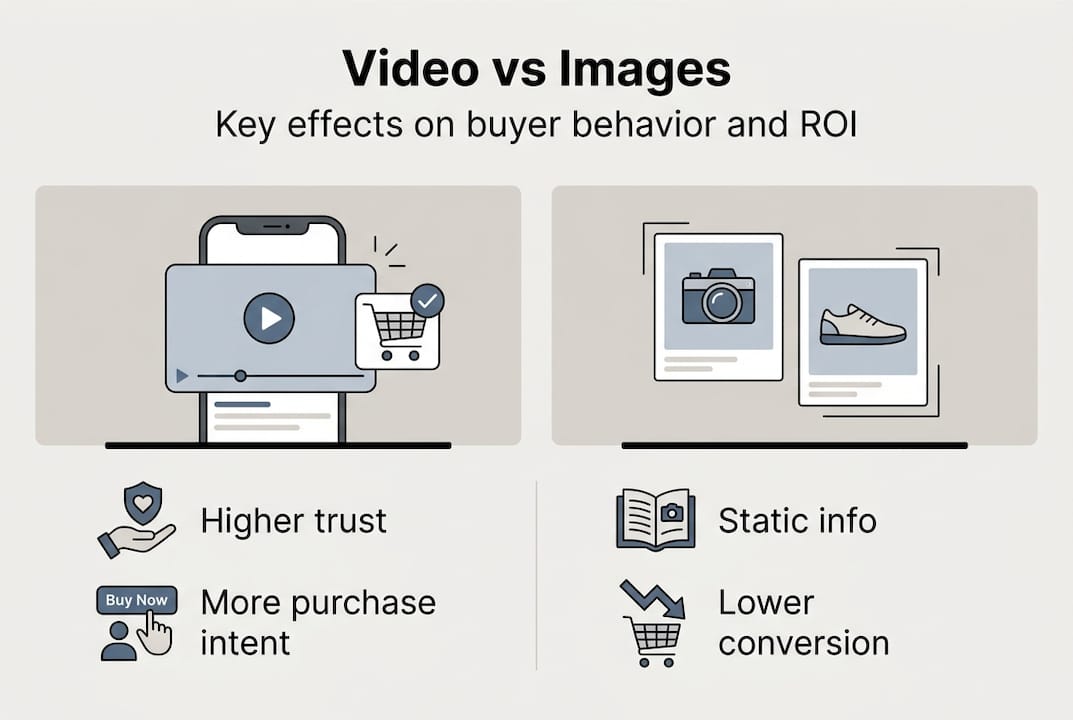
According to Shopify’s ecommerce video stats, shoppers who watch product videos are far more likely to complete a purchase than those who only view images. The numbers aren’t marginal. They’re the kind of lift that changes a store’s profitability.
The core insight here is that trust is the mechanism. Video bridges the gap between a shopper’s curiosity and their willingness to hand over payment details. Without that bridge, you’re relying on hope.
How product videos address gaps and accelerate sales
Now that we know why video is persuasive, let’s see how it solves precise problems in the online product experience.
Static content has a hard ceiling. A great photo can show what a product looks like. It cannot show how a jacket moves when someone walks, how big a bag actually is when held, or how easy a gadget is to set up. These gaps create hesitation, and hesitation creates abandoned carts.
Video simulates missing product experience such as movement, scale, and context in ways that images and descriptions cannot. A 20-second demo answers the questions a customer would ask a store associate in person. That’s not a small thing. That’s the difference between a sale and a bounce.

Here’s a direct comparison of what each content type can realistically deliver:
| Content type | Shows appearance | Shows function | Conveys scale | Builds emotional connection | Compresses decision time |
|---|---|---|---|---|---|
| Product image | Yes | No | Partially | Low | Low |
| Written description | No | Partially | No | Low | Low |
| Product video | Yes | Yes | Yes | High | High |
The advantages of video for conversions come down to three things: realism, clarity, and speed. Realism means the shopper sees the product behaving like a real object in the real world. Clarity means their questions get answered without them having to search. Speed means they make a decision faster because they feel ready.
This matters especially on mobile and social platforms, where buying journeys are compressed. A shopper scrolling Instagram isn’t going to read a 400-word product description. But they will watch a 15-second video that shows the product solving a problem they recognize.
Key advantages of product video for ecommerce conversions:
- Demonstrates real-world use and scale
- Answers objections before they form
- Creates emotional resonance through storytelling
- Reduces cognitive load on the buyer
- Shortens the path from discovery to purchase
For a practical breakdown of building this into your store, the step-by-step guide to ecommerce video ads is worth working through.
Pro Tip: Show your product being used by a real person in a real setting. Context sells. A water bottle filmed on a hiking trail converts better than the same bottle on a white background.
Trust, expectations, and the double-edged sword of video
While video offers enormous upside, there are real risks attached, so let’s address those critical caveats.
Video builds trust fast. But it can also destroy it just as fast. The same psychological mechanisms that make video persuasive also make it dangerous when the content is misleading or low quality. A shopper who watches a polished video and receives a product that doesn’t match what they saw will feel deceived. That feeling doesn’t just lead to a return. It leads to a negative review, a chargeback, and a lost customer for life.
Low-quality or misleading videos can backfire and increase customer returns or erode trust at scale. This is one of the most underappreciated risks in ecommerce video marketing.
Here’s how to build video content that earns trust rather than breaking it:
- Show the product accurately. Don’t use flattering angles that misrepresent size, color, or texture.
- Include real use cases. If your product has limitations, acknowledge them. Buyers respect honesty.
- Match your video quality to your brand tier. A luxury product filmed on a shaky phone signals mismatch.
- Use real customer voices. Authentic testimonials carry more weight than scripted praise.
- Test before scaling. Run your video with a small audience and check return rates before pushing it to full ad spend.
Statistic to know: Brands that use accurate, expectation-setting video content see measurably lower return rates compared to brands using aspirational but misleading visuals. The short-term conversion boost from an overpromising video is almost always wiped out by returns and reputation damage.
The difference between UGC vs traditional video marketing matters here too. User-generated content often outperforms polished ads precisely because it feels more honest, even when the production quality is lower.
Pro Tip: Before scaling any video campaign, order your own product using the checkout flow a customer would use, then watch your video alongside the unboxing experience. If there’s a gap, fix the video first.
For brands just starting out, getting started with AI video ads covers the foundational decisions that protect you from these pitfalls early.
Maximizing video impact with AI: From concept to conversion
With benefits and pitfalls clear, let’s look at how you can use next-gen tools to put these insights to work quickly and effectively.
AI-generated video has changed the math for ecommerce brands. What used to require a production crew, a script writer, and a full editing day can now be done in minutes. That speed creates a scalable edge. You can test more formats, more messages, and more audiences without burning your budget on production costs.
Effective product video types and adoption rates tracked by leading ecommerce platforms show that explainer videos, product demos, and customer review formats consistently outperform generic brand content. These formats work because they’re built around buyer questions, not brand ego.
Best practices for creating high-performing AI product videos:
- Lead with the problem your product solves, not the product itself
- Keep videos under 60 seconds for social platforms
- Include captions. Most mobile video is watched without sound
- End with a clear, single call to action
- Refresh your top-performing videos every 6 to 8 weeks to avoid ad fatigue
- Test at least two creative angles per product before deciding on a winner
The social media video trends shaping 2026 show a clear move toward authentic, fast-paced content that prioritizes the viewer’s time. Brands that adapt to this win. Brands that keep producing long, polished brand films for social feeds lose.
For inspiration on what’s working right now, browsing trending content ideas gives you a live read on formats that are converting across categories.
Pro Tip: Connect your video performance data to your product analytics. If a video drives high clicks but low purchases, the problem is usually expectation mismatch, not reach. Fix the content, not the targeting.
What most ecommerce brands miss about using video to sell
Here’s the uncomfortable truth: most brands obsess over production quality and ignore the thing that actually drives sales, which is expectation management.
We’ve seen campaigns with cinematic visuals and professional voiceovers fail completely, while a founder filming themselves talking honestly about a product drives thousands in revenue. The difference isn’t the camera. It’s the credibility.
Authenticity outperforms polish for most online shoppers, especially in the sub-$200 price range where impulse buying is driven by relatability, not aspiration. Shoppers want to see themselves using the product, not a model in a perfect studio.
The brands that win with video are the ones running fast feedback cycles. They publish, measure, learn, and adjust within days, not months. A “perfect” video that took six weeks to produce and never gets tested against alternatives is a liability, not an asset.
Real-world AI video case studies consistently show that speed of iteration beats quality of production when it comes to finding what actually converts. Make more videos. Make them honest. Make them fast.
Ready to amplify your sales with video?
You now understand why video works, where it can go wrong, and how to build a strategy that actually converts. The next step is putting it into practice without spending weeks on production.

QuickAdVideo’s AI Sales Video Generator lets you turn any product URL into a high-converting sales video in minutes. Choose from proven video models for ecommerce including UGC, cinematic, and viral story formats, then fine-tune your content with the built-in video editor before publishing directly to TikTok, Instagram, YouTube, or Facebook. No camera, no crew, no creative block. Just videos that sell.
Frequently asked questions
How does video build trust with online shoppers?
Video simulates missing product experience, clarifying use and quality in ways images cannot, which reduces uncertainty and makes shoppers feel confident enough to buy.
What kinds of product videos work best for ecommerce?
Short-form product videos that demonstrate real use, answer common objections, and reflect genuine customer experiences consistently outperform longer or more polished brand content.
Can video lower product returns?
Yes. Accurate, expectation-setting videos help buyers choose the right product the first time, while misleading videos increase returns by creating a gap between what shoppers expected and what they received.
How can small businesses afford high-quality product videos?
AI-powered platforms have made this accessible. AI-generated video offers a scalable edge in ecommerce marketing at a fraction of traditional production costs, leveling the playing field for smaller brands.
Recommended
- Video marketing for e-commerce: ROI and strategies 2026 | QuickAdVideo Blog
- QuickAdVideo - AI Sales Video Generator
- Step by Step Video Ads: Easy E-Commerce Growth Guide | QuickAdVideo Blog
- Getting Started with AI Video Ads: A Complete Guide | QuickAdVideo Blog
- Tips for Crafting Videos That Drive Engagement and Sales | Kickass Online
- Video marketing guide: grow your business in 2026
Related Posts

Why Use Templates for Video Ads: Scale Smarter
Discover why use templates for video ads to streamline production. Boost efficiency and scale your campaigns without losing creativity!

The Role of Data-Driven Video Ads in Boosting ROI
Discover the role of data-driven video ads in boosting ROI. Learn how analytics enhance engagement, optimize campaigns, and drive results.

Create Persuasive Video Ads Workflow That Converts
Learn how to create persuasive video ads workflow that transforms your ideas into optimized, high-converting campaigns. Get started today!