
Create Persuasive Video Ads Workflow That Converts
QuickAdVideo Team
Author
Video ads have never been more expensive to get wrong. Ad costs keep climbing, feeds are saturated, and your window to capture attention before someone scrolls past is measured in fractions of a second. If you want to create a persuasive video ads workflow that consistently delivers results, you need more than a good idea and a camera. You need a repeatable system built around data, structure, and tested persuasive marketing techniques. This guide gives you exactly that: a professional workflow from preparation through optimization that turns raw creative instincts into predictable conversion engines.
Table of Contents
- Key takeaways
- Create persuasive video ads workflow: what you need first
- Step-by-step execution of the video ad production workflow
- Troubleshooting and optimizing with hook rate and hold rate data
- Measuring success and iterating your workflow
- My honest take on what actually works in 2026
- Let Quickadvideo handle the heavy lifting
- FAQ
Key takeaways
| Point | Details |
|---|---|
| Hook rate is your north star | A hook rate above 35% signals a scalable ad; below 25% means your opener needs a full rebuild. |
| Sound-off design is non-negotiable | 85% of Meta video ads play without sound, so on-screen text in the first half-second directly lifts performance. |
| Workflow beats one-off wins | Testing five or more hook variants with identical body content is the fastest path to finding what scales. |
| AI needs structure, not freedom | Unguided AI video production causes brand inconsistencies; structured briefs and locked assets prevent this. |
| Metrics drive iteration | Hook rate, hold rate, CPA, and ROAS together tell you whether to fix the opener, the body, or the offer. |
Create persuasive video ads workflow: what you need first
Before you shoot a single frame or write a single line of script, your workflow needs a foundation. Skipping this phase is the single most common reason marketing teams produce polished videos that still fail to convert.
Tools that do the actual work
A solid effective ad creation process requires four tool categories working in sequence. First, scriptwriting tools, whether AI-assisted or template-based, translate your offer into structured copy using proven frameworks like PAS (Problem, Agitate, Solve) or BAB (Before, After, Bridge). Second, video production assets, which include footage libraries, screen recording software, or AI video generators like Quickadvideo that produce full videos from a product URL. Third, editing software to cut for pacing and insert pattern interrupts. Fourth, analytics platforms like Meta Ads Manager to track performance post-launch.
| Tool category | Role in the workflow |
|---|---|
| AI script generator | Converts product details into direct-response copy frameworks |
| AI video generator | Produces multiple hook variants rapidly without camera or editor |
| Video editor | Handles pacing, captions, and pattern interrupt cuts |
| Analytics dashboard | Tracks hook rate, hold rate, CTR, and conversion data |
| Brief template | Locks brand inputs to prevent AI generation drift |
The planning phase most teams skip
Audience research and goal setting sound obvious until you realize most teams skip them in favor of “just getting started.” Define your cold versus warm traffic targets before writing anything. Cold traffic needs a problem-focused hook. Warm traffic can lean into social proof or urgency. Write a structured creative brief that includes your brand colors, tone of voice, product positioning, and approved visual references. Structured inputs prevent generation drift across multiple AI production cycles, keeping every variant you generate on brand.

Pro Tip: Before creating any video asset, lock your “bones” first: composition, key visual assets, and brand colors. Treat this like a template. Every AI-generated variant should be styled from this locked foundation to avoid inconsistency across your campaign.
Step-by-step execution of the video ad production workflow
This is where the effective ad creation process gets specific. Move through each stage in order and do not skip to the next until the current one is complete.
-
Write the hook first, not last. Your hook has four layers: visual (what appears on screen in the first frame), text (on-screen copy), verbal (spoken words if sound is on), and sonic (music or sound effect). Each layer must be consistent with the others and immediately relevant to your audience’s pain point. Viewers decide in under 2 seconds whether to keep watching, so every layer of your hook must earn its place.
-
Apply a copywriting formula to the body. PAS works for pain-aware audiences. Curiosity Gap works for cold traffic who do not yet know they have a problem. Write the full script before touching any visuals. The script is your blueprint; everything else is execution.
-
Produce multiple hook variants rapidly. Do not produce one definitive video and call it done. Generate at least five hook variants with identical body content. AI video tools make this practical. Testing multiple hook variants with equal budget per variant gives you statistically meaningful data on what stops the scroll.
-
Edit for pacing and pattern interrupts. Mid-roll dead zones between seconds 8 and 15 kill hold rate. Insert a visual cut, a text callout, or a tonal shift every two seconds during this window to keep viewers engaged.
-
Add on-screen text within the first half-second. On-screen text appearing within 0.5 seconds lifts hook rate by four to nine points because 85% of Meta video impressions play muted in autoplay feeds. Do not assume your audience has sound on.
-
Format for mobile first. Export in 9:16 vertical format. Check that your first frame has strong visual contrast and that no critical text is cropped by platform UI elements like captions or buttons.
Pro Tip: Before finalizing any variant, watch it at scroll speed with your sound off. This is how most real viewers will experience it. If the visual hook and first line of on-screen text do not immediately communicate value, go back and revise the first frame before anything else.
The table below summarizes each step with a quick checklist item to confirm completion before moving forward.
| Workflow step | Completion check |
|---|---|
| Write hook (4 layers) | All layers consistent and relevant to audience pain |
| Apply copy formula | Script follows PAS, BAB, or Curiosity Gap structure |
| Generate 5+ variants | Each variant has unique hook, identical body |
| Edit for pattern interrupts | Visual or tonal change every 2 seconds in mid-roll |
| Add on-screen text by 0.5s | Text visible in first frame, readable without sound |
| Format vertically | 9:16 export, critical text within safe zones |
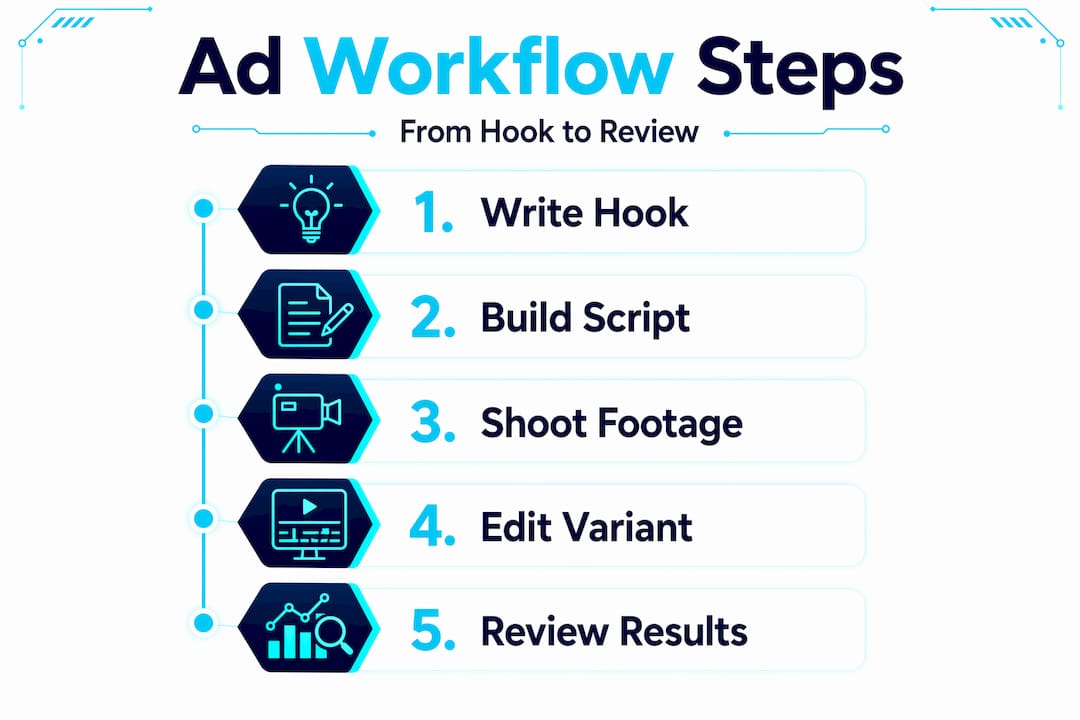
For deeper guidance on writing high-converting ad scripts, the link provides a full breakdown of AI-assisted scriptwriting techniques aligned with direct-response principles.
Troubleshooting and optimizing with hook rate and hold rate data
Once your variants run, the numbers tell you exactly what to fix. This is where most marketers stop being creative and start being analytical, and that shift is what separates campaigns that scale from campaigns that stall.
Hook rate is calculated as 3-second video views divided by total impressions, multiplied by 100. A hook rate above 25% is healthy. At 30%, you have a good performer. Above 35%, you have something worth scaling. Below 25% means your opener is failing before the viewer even sees your offer.
Hold rate measures 15-second plays divided by 3-second plays, multiplied by 100. For cold traffic, a healthy hold rate sits between 15% and 25%. Below 10% signals a retention problem in the body of your ad, not the hook.
The 2x2 diagnostic matrix works like this:
- Low hook rate, low hold rate: Your opener failed. Nobody stopped, and those who did left immediately. Rebuild the first frame completely.
- Low hook rate, high hold rate: Your opener is weak but your body content is strong. Test bolder visual or text hooks while keeping the body identical.
- High hook rate, low hold rate: You hooked them with something that did not match what followed. This is a bait-and-switch problem. Align your hook promise with your body content.
- High hook rate, high hold rate: You have a winner. Diagnose CTA performance next and scale budget.
Common pitfalls beyond the matrix include slow opening sequences that rely on logo reveals, weak CTA framing that tells viewers what to do without explaining the cost of not doing it, and body sections that meander without a clear value proposition in the first 10 seconds.
Fix your hook rate before you touch hold rate. Hook rate is the upstream metric. A broken opener will distort every other number in your data.
Pro Tip: Review competitor video ads by analyzing their timeline structure. Note when they introduce their core claim, when they show social proof, and when they place their CTA. Use this as a benchmark, not a template. Then apply the same review to your own ads at scroll speed with the sound off, exactly as a real viewer would experience them.
For more on how interactive video elements can improve both hook and hold rates with warmer audiences, that resource is worth reviewing alongside your metrics.
Measuring success and iterating your workflow
A one-time test is a data point. A repeatable testing pipeline is a competitive advantage. Here is how to build the latter into your video ad production workflow.
-
Set up custom columns in Meta Ads Manager. Create a calculated metric for hook rate (3-second views divided by impressions) and a second one for hold rate (15-second views divided by 3-second views). Place these columns next to CPA and ROAS so you can see creative health and business performance side by side.
-
Run each variant to 1,000 impressions minimum before making decisions. Cutting variants too early based on 200 impressions produces noise, not signal. Once each variant clears 1,000 impressions, kill any with hook rates below 25%.
-
Iterate by layer. After identifying your winning hook, test body edits next. Change only one variable at a time. Then test CTA framing last. This sequence mirrors the campaign moment hierarchy where hooks are prioritized before body and CTA optimization.
-
Scale only proven patterns. When a hook and body combination consistently produces hook rates above 35% and hold rates above 20%, that structure becomes your creative template for the next campaign. Do not reinvent from scratch. Adapt what works.
-
Prevent AI generation drift at scale. When using AI tools to produce new variants, always feed the same structured brief, reference images, and approved copy elements. Treat generative AI as a structured supply chain, not a magic button, to maintain brand consistency across dozens of variants.
Pro Tip: Create a simple creative scorecard. For every variant you produce, log the hook rate, hold rate, CPA, and one sentence describing the hook type. After 20 variants, patterns emerge. You will start to recognize which hook formats work for your specific audience before you even run them.
My honest take on what actually works in 2026
I have watched marketing teams spend weeks perfecting the visual design of a video ad while leaving the hook as an afterthought. Then they wonder why the campaign underperforms. In my experience, the teams that win in 2026 treat the first three seconds as a creative project in itself, completely separate from the rest of the ad.
What surprises most people I talk to is how much muted viewing changes the game. Once you genuinely internalize that 85% of your ad impressions play without sound, your entire approach to the first frame shifts. Text placement, visual contrast, and facial expressions carry the full weight of your opener. Audio becomes enhancement, not delivery.
I am also skeptical of teams that adopt AI tools without structure. I have seen campaigns where the fifth AI-generated variant looked like a completely different brand from the first. That is not a tool problem. That is a process problem. Locking your visual assets, brand colors, and copy frameworks before you generate anything is what keeps your campaign coherent at scale.
The uncomfortable truth is that most underperforming video ads do not have a creativity problem. They have a sequencing problem. Fix your hook first. Then your body. Then your CTA. In that order, every time. The data always confirms this hierarchy. Trust it even when your instincts pull you toward redesigning everything at once.
— iBoy
Let Quickadvideo handle the heavy lifting
If this workflow feels like a lot to manage manually, that is because it is. Quickadvideo was built specifically to remove the production bottleneck from this process. You paste in your product URL, and the platform generates persuasive video ads using proven direct-response frameworks in minutes, with no editing skills or camera required.
Quickadvideo supports UGC, cinematic, and viral story formats, so you can produce the multiple hook variants this workflow demands without multiplying your production time. The platform publishes directly to TikTok, Instagram, YouTube, and Facebook, keeping your testing pipeline moving fast. For teams serious about scaling their video advertising strategies, Quickadvideo removes the friction between having a great brief and having a live, testable ad. Explore the available AI video generation models to find the format that fits your next campaign goal.
FAQ
What is a good hook rate for video ads on Meta?
A hook rate above 30% is considered good on Meta, and above 35% signals a scalable creative. Below 25% means your first three seconds are failing to stop the scroll and need a rebuild.
How many hook variants should I test?
Run at least five hook variants with identical body content, giving each variant a minimum of 1,000 impressions before drawing conclusions. This gives you enough data to identify which opener resonates without wasting budget on inconclusive results.
Why does my hold rate drop after the first few seconds?
A drop in hold rate between seconds 8 and 15 typically indicates a mid-roll dead zone. Adding a pattern interrupt, such as a visual cut, text callout, or tonal shift, every two seconds in this window significantly improves retention.
How do I prevent brand inconsistency when using AI video tools?
Lock your creative “bones” before generating any variants. This means defining your brand colors, approved imagery, tone of voice, and copy frameworks in a structured brief. Feed this brief consistently into every AI generation session to maintain visual and messaging coherence across your campaign.
What is the right order to fix a failing video ad?
Always fix hook rate before hold rate, and hold rate before your CTA. Hook rate is the upstream metric. If viewers are not stopping for your opener, no amount of mid-roll polish or CTA optimization will rescue the campaign.
Recommended
- How to craft effective video messaging for higher conversions | QuickAdVideo Blog
- AI product video workflow: faster output, higher sales | QuickAdVideo Blog
- Step by Step Video Ads: Easy E-Commerce Growth Guide | QuickAdVideo Blog
- AI video scripts explained: your guide to high-converting ads | QuickAdVideo Blog
Related Posts

Why Use Templates for Video Ads: Scale Smarter
Discover why use templates for video ads to streamline production. Boost efficiency and scale your campaigns without losing creativity!

The Role of Data-Driven Video Ads in Boosting ROI
Discover the role of data-driven video ads in boosting ROI. Learn how analytics enhance engagement, optimize campaigns, and drive results.

Ways to Repurpose Marketing Videos for Maximum Reach
Discover effective ways to repurpose marketing videos and maximize your reach. Unlock new content ideas and boost engagement today!