
Why Use Templates for Video Ads: Scale Smarter
QuickAdVideo Team
Author
Video ad production has a dirty secret: most of the time spent is not on creative thinking. It is on resizing, reformatting, exporting, and rebuilding the same basic structures from scratch. Knowing why use templates for video ads is not just a production hack. It is a strategic shift that separates teams running five campaigns at once from teams grinding through one. Video content drives 82% of all internet traffic, and 85% of consumers say video ads convinced them to buy. The pressure to produce more video, faster, is real. Templates are how serious marketers answer that pressure.
Table of Contents
- Key takeaways
- Why use templates for video ads
- Real benefits of video ad templates
- How templates protect, not limit, creative strategy
- Putting video ad templates to work in your workflow
- My take: templates are a competitive moat, not a shortcut
- Scale your video ads with Quickadvideo
- FAQ
Key takeaways
| Point | Details |
|---|---|
| Templates slash production time | Agencies report 60-80% reduction in production time while maintaining consistent output quality. |
| Creativity stays intact | Fixed brand elements and variable creative layers let you innovate without breaking brand guidelines. |
| Testing velocity multiplies | Templates let you isolate variables and identify winning creatives up to 10x faster than manual methods. |
| Personalization scales efficiently | AI-driven templates enable personalized video content that drives 200% higher engagement than generic ads. |
| Data drives refinement | Performance tracking tied to templates allows you to retire underperformers and double down on what converts. |
Why use templates for video ads
A video ad template is a pre-structured framework that contains the reusable building blocks of your ad. Think of it less like a cookie cutter and more like a professional stage set: the walls, lighting rigs, and camera positions are fixed, but every performance that happens on that stage is different.
At the modular level, templates typically include:
- Visual layout — aspect ratios, safe zones, and motion graphic positions for each platform
- Brand assets — logo placement, color palettes, approved fonts, and audio identifiers
- Copy zones — headline fields, body text areas, and call-to-action overlays that swap out per variant
- Structural logic — scene order, transitions, and timing presets built around proven formats like UGC or cinematic styles
When you update one element inside a template, every variant built from it updates automatically. That is where the real leverage hides. A team launching a new product no longer rebuilds 12 platform-specific versions from scratch. They swap the product footage and copy into the template, and the system handles the rest.
Modern platforms have taken this further with AI. Instead of manually adjusting each field, AI-driven tools read your inputs, match them to a template framework, and generate finished, platform-ready video in minutes. Templates enable 10-20x more video variants at a fraction of traditional production costs, which is why agencies and solo operators alike have shifted toward template-first workflows.
Pro Tip: Before selecting a template, map out the fixed elements your brand always needs (logo, color, tone) versus the variable elements you want to test (headlines, hooks, offers). This separation is the foundation of every scalable template system.
Real benefits of video ad templates
The advantages of templates in advertising are not theoretical. The data from agencies running at scale tells a clear story.
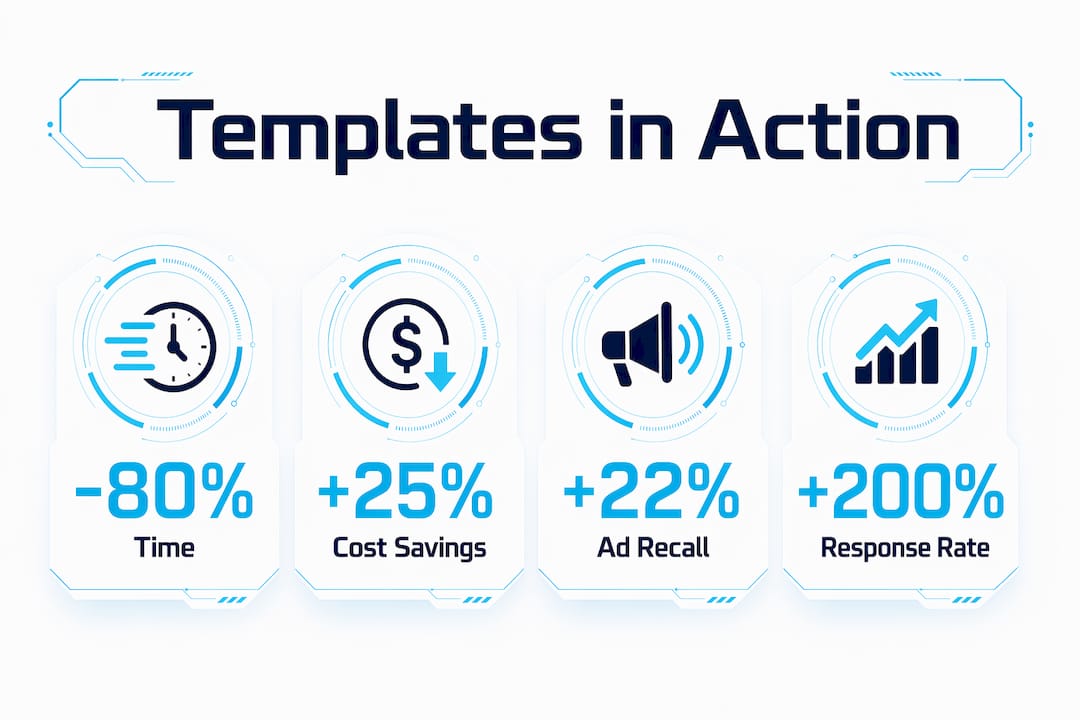
The biggest single benefit is time. Advertising agencies using template frameworks reduce production time by 60-80% while maintaining brand consistency. A team that used to ship 8 to 12 ads per week can now ship 40 to 60 variants in the same time using template libraries and batch workflows. That is not a modest improvement. It is a fundamental change in what a lean team can accomplish.
Cost efficiency follows directly from that time reduction. Automating repetitive video tasks saves marketing teams 15-25 hours per week, translating to real labor savings even when accounting for tool subscription costs. For business owners who have priced out traditional video production, the contrast is sharp. A single custom video from an agency can cost thousands. A template-powered workflow can produce dozens of polished variants for a fraction of that.

Brand consistency is another concrete win. Brands that enforce consistent brand kits see a 22% lift in ad recall and a 15% reduction in attribution errors. Templates make consistency automatic rather than something that depends on everyone remembering to check the style guide.
Finally, templates unlock personalization at scale. Personalized videos that mention specific accounts drive 200% higher engagement than generic content. Without a template system, producing personalized video at volume is not realistic for most teams. With one, it is a batch process.
How templates protect, not limit, creative strategy
The most common objection to using templates is that they will make every ad look the same. This concern gets the relationship between structure and creativity exactly backwards.
Think about how great writers work. They do not invent a new sentence structure for every paragraph. They use the grammar and conventions of language as a framework, then pour their own ideas into that structure. Templates work the same way. The structure is not the creative. The creative is what you put inside the structure.
Successful template systems separate fixed brand elements from variable test elements, which is what prevents both brand drift and creative stagnation. Your logo position, color scheme, and audio branding never move. Your hook, your offer, your visual storytelling, and your call to action are all fair game for experimentation.
“Templates amplify execution, letting marketers focus on messaging and audience understanding rather than manual production.” — AI Video Templates for Marketing Campaign Launches
This is where the strategic advantage really shows up. When you are not spending three hours per ad on production mechanics, you spend that time thinking about what actually moves your audience. What hook stops the scroll? What proof point closes the gap between interest and purchase? Templates do not answer those questions for you. They give you the time and space to answer them yourself.
The practical result is that templates accelerate A/B testing dramatically. Templates increase testing velocity by identifying winning creative elements up to 10x faster than manual processes. You can isolate a single variable, say the opening five seconds of your ad, run two versions against each other, and get statistically meaningful data in days instead of weeks. That is how you build creative intelligence that actually improves campaign performance over time.
The best video ad campaigns are built around effective video messaging that puts the right emotional hook in front of the right audience. Templates do not interfere with that. They make executing on it faster and cheaper.
Putting video ad templates to work in your workflow
Knowing the theory is one thing. Knowing how to implement it without creating a mess of outdated template versions and inconsistent outputs is where most teams struggle. Here is a practical sequence that works.
-
Audit your existing ad formats. Before building a template library, catalog every platform, aspect ratio, and ad format you currently run. TikTok vertical, Instagram square, YouTube pre-roll, Facebook feed. Each needs a dedicated template, not a one-size-fits-all compromise.
-
Define your brand constants. Document every element that must never change: logo size and position, color hex codes, approved fonts, and audio branding. These become the locked layer in your templates. No one touches them without sign-off.
-
Identify your variable zones. Decide which elements are explicitly meant to rotate: the headline, the opening hook, the background visuals, the offer copy, and the call to action. Label these clearly so anyone on your team knows exactly what they can and cannot change.
-
Build a minimum viable library. Start with three to five core templates covering your highest-volume formats. Perfect those before expanding. A small library used consistently beats a massive one used inconsistently.
-
Integrate batch processing. Once your templates are stable, move to batch production sessions where your team produces multiple variants in a single workflow rather than one ad at a time. This is where the volume gains really compound.
-
Track template performance separately. Template performance tracking enables data-driven refinement and retirement of underperforming formats. Tag every ad with its source template so you know which structures convert and which do not.
One common pitfall to watch for: over-templating your creative. If every ad you run looks structurally identical, audiences will tune out the format itself. Rotate between two or three distinct template structures to maintain pattern interruption.
Template systems that include operational guardrails also prevent wasted spend. Automated exclusion rules built into your templates can stop you from serving remarketing ads to people who just purchased, a small detail that saves real budget at scale.
Pro Tip: Connect every template directly to a specific campaign objective before you build it. A template designed for brand awareness should look and sound different from one designed for direct purchase. Blending these goals inside one template usually means doing neither well.
Learning how to automate video content production as part of your template workflow is the next step after your library is stable. Automation compounds the time savings you are already getting from templates.
My take: templates are a competitive moat, not a shortcut
I’ve spent years watching marketing teams make the same mistake. They treat template adoption as a cost-cutting measure. Something you do when budgets shrink. That framing misses the point entirely.
In my experience, the teams that adopt templates earliest gain a compounding advantage that has nothing to do with cost. They run more tests. They gather more data. They learn what works faster than competitors who are still rebuilding the same ad from scratch for the fourth time that month. By the time a manually-produced team runs three campaign variations, a template-powered team has run fifteen and already knows which three to scale.
What I’ve learned is that creative quality does not decline with templates. It improves. When your team stops wrestling with production logistics, they start thinking harder about the actual message. The strategic thinking that used to get squeezed out by production time suddenly has room to breathe.
The mistake I see most often is marketers building templates reactively, after a campaign is already in flight. Do it before. Build the framework, define the variables, lock the brand constants. Then let execution move at the speed your marketing actually demands.
— iBoy
Scale your video ads with Quickadvideo
If the case for templates resonates and you are ready to put it into practice, Quickadvideo makes the transition straightforward. The platform is built specifically for marketers and business owners who need to produce high-converting video ads without a production team behind them.

You input your product URL, and Quickadvideo’s AI generates finished video ads using proven direct response frameworks in minutes. Choose from multiple creative models, including UGC, cinematic, and viral story formats, each built as a ready-to-deploy template you can customize and publish directly to TikTok, Instagram, YouTube, or Facebook. It is AI-powered video creation without the learning curve, the agency fees, or the turnaround time. If you are serious about scaling your video ad output, this is where to start.
FAQ
Why should marketers use templates for video ads?
Templates reduce video ad production time by 60-80% while maintaining brand consistency across all formats and platforms. They let marketers focus on strategy and messaging instead of repetitive production tasks.
Do video ad templates hurt creative quality?
No. Templates separate fixed brand elements from variable creative layers, which actually accelerates experimentation. Teams using template frameworks test winning creative elements up to 10x faster than those working manually.
How many video variants can a team produce with templates?
Manual production typically yields 8 to 12 ads per week. Teams using template libraries with batch workflows can produce 40 to 60 variants in the same timeframe without adding headcount.
What elements should be locked in a video ad template?
Brand constants such as logo placement, color palettes, approved fonts, and audio identifiers should always be locked. Consistent brand kits lift ad recall by 22% and reduce attribution errors by 15%.
Can templates support personalized video ads at scale?
Yes. AI-driven video templates are specifically designed for scalable personalization. Personalized videos drive 200% higher engagement than generic content, and templates make producing them in volume realistic for any team size.
Recommended
Related Posts

The Role of Data-Driven Video Ads in Boosting ROI
Discover the role of data-driven video ads in boosting ROI. Learn how analytics enhance engagement, optimize campaigns, and drive results.

Create Persuasive Video Ads Workflow That Converts
Learn how to create persuasive video ads workflow that transforms your ideas into optimized, high-converting campaigns. Get started today!

Ways to Repurpose Marketing Videos for Maximum Reach
Discover effective ways to repurpose marketing videos and maximize your reach. Unlock new content ideas and boost engagement today!