
Ways to Repurpose Marketing Videos for Maximum Reach
QuickAdVideo Team
Author
You spent thousands of dollars producing a marketing video. You launched it, got a solid week of traction, and then it quietly disappeared from your audience’s feed. Sound familiar? The real missed opportunity is not the video itself but everything you failed to extract from it. The ways to repurpose marketing videos are more numerous and more effective than most marketing teams realize, and in 2026, platforms are actively rewarding creators who do this thoughtfully. This article gives you a concrete framework, platform-specific tactics, and the policy guardrails you need to multiply every video’s impact without starting from scratch.
Table of Contents
- Key takeaways
- Ways to repurpose marketing videos: a strategic framework first
- 1. Cut short clips for short-form platforms
- 2. Transform webinar recordings into a 30-day content campaign
- 3. Build a social media series from thematic highlights
- 4. Embed video on landing pages and product detail pages
- 5. Convert video audio into a podcast or audio snippet
- 6. Extract still images and animated GIFs for social sharing
- 7. Use video content inside email marketing sequences
- Comparing repurposing methods: effort, risk, and return
- Best practices to optimize repurposed videos for 2026 algorithms
- Situational recommendations for different marketer types
- My honest take on where video repurposing is actually headed
- Ready to create and repurpose videos faster with AI?
- FAQ
Key takeaways
| Point | Details |
|---|---|
| Volume comes from one asset | A single 60-minute webinar can generate 47+ assets including clips, quotes, and blog posts. |
| Short clips outperform long ones | Videos under 30 seconds on LinkedIn see a 200% lift in completion rates versus longer formats. |
| Platform risk is real | Over 12.4 million channels were removed in 2025 for reused content violations on YouTube alone. |
| Originality is non-negotiable | Surface-level edits no longer pass YouTube’s policy; unique narrative or analysis is required. |
| Track everything with UTM | Revenue attribution from repurposed clips is only measurable when UTM parameters are consistently applied. |
Ways to repurpose marketing videos: a strategic framework first
Before you start cutting clips and posting everywhere, you need a decision framework. Repurposing video content without a plan produces noise, not reach.
Here is what to evaluate before choosing any repurposing method:
- Platform authenticity policies. YouTube has grown significantly stricter. Platforms penalize content that looks recycled without added value, and basic commentary is no longer sufficient to qualify as original.
- Audience format preferences. Your LinkedIn audience consumes content differently than your TikTok followers. A raw product demo clip might land well on Instagram Reels but bomb on LinkedIn without a professional framing narrative.
- Resource constraints. Time, budget, and tools all shape which methods are realistic for your team. A startup with one editor should not attempt seven simultaneous repurposing workflows.
- Engagement and conversion goals. Repurposing for brand awareness looks different than repurposing for direct response. Know which metric you are optimizing before you start.
- Over-recycling risk. Posting the same clip across five platforms with zero customization is content farming. Platforms flag it, audiences tune out, and your brand equity erodes.
Pro Tip: Build a repurposing brief for each source video before production ends. Decide which moments are clip-worthy, which quotes are pull-worthy, and which platforms each asset targets. This saves hours of post-production guesswork.
1. Cut short clips for short-form platforms
The most immediate way to extend a video’s life is to extract 15 to 60 second clips and publish them on TikTok, Instagram Reels, YouTube Shorts, and LinkedIn. But clipping is not just trimming. Each clip needs its own hook, its own context, and its own caption.
Vertical video formats achieve up to 90% higher completion rates than horizontal ones on mobile-first platforms. If your original video was shot horizontally, crop strategically or add dynamic text overlays to fill the vertical frame. The first one to three seconds must be platform-specific. What stops a scroll on TikTok is a bold statement or visual surprise. What earns a LinkedIn pause is a professional insight or a surprising data point.
2. Transform webinar recordings into a 30-day content campaign
One of the most underused ways to reuse videos is the webinar-to-campaign conversion. A single 60-minute webinar can produce 10 to 15 video clips, 6 to 16 image quotes, an SEO blog post, and more, totaling over 47 distinct assets without any additional filming.
The process works like this: transcribe the webinar, identify the five to eight strongest insight moments, clip each one, write a unique caption for each platform, pull standout quotes for designed social cards, and use the transcript as the skeleton for a long-form blog post. That is a full month of content from a single recording session. This approach is particularly powerful for how to repurpose sales video content because webinars naturally contain conversion-focused messaging that translates well across formats.

Pro Tip: Timestamp your webinar transcript during editing. This lets your team instantly locate quote-worthy moments instead of scrubbing through the full recording every time.
3. Build a social media series from thematic highlights
Instead of treating each clip as a standalone post, group related clips into a named series. A product brand might create a “Behind the Product” series from manufacturing footage. A SaaS company might build a “Customer Win Wednesday” series from testimonial videos.
Series-based repurposing creates two compounding advantages. First, audiences who enjoy one episode actively seek out the next. Second, predictive content series reduce production bottlenecks because your team always knows what comes next. You are not reinventing the wheel each week. You are filling a pre-built editorial structure.
4. Embed video on landing pages and product detail pages
This is one of the highest-ROI creative video uses that most marketing teams ignore entirely. When you embed a product demo or explainer video directly on a landing page, you are giving visitors the information they need to convert without making them read through paragraphs of copy.
The key is selecting the right clip for the right page. A short testimonial clip works on a checkout page. A full product walkthrough works on a features page. A founder story clip works on an about page. Think about how to optimize marketing videos for context, not just platform. The video format guidance you use for effective video messaging on social media applies equally to your own web properties.
5. Convert video audio into a podcast or audio snippet
Strip the audio from your best-performing video content and publish it as a podcast episode or audiogram. This works exceptionally well for interview-style videos, thought leadership pieces, and webinar recordings where the value is in the conversation, not the visuals.
An audiogram, which is a short audio clip paired with a static or animated visual, performs well on Instagram Stories, LinkedIn, and Twitter. It reaches the segment of your audience that consumes content in the car, at the gym, or during a commute. You are not creating new content. You are making existing content accessible in a new context.
6. Extract still images and animated GIFs for social sharing
Video footage is an untapped library of high-quality still images. Pull frames from your most visually compelling moments, add a caption or data point, and you have ready-made social posts. Product close-ups, behind-the-scenes candids, and speaker reaction shots all perform well as standalone images.
GIFs go one step further. A three to five second loop of a product feature demonstration, a satisfying before-and-after reveal, or a speaker’s emphatic gesture can outperform a static image in engagement. These transform marketing footage into micro-content that fits naturally in comment threads, email campaigns, and Slack communities.
7. Use video content inside email marketing sequences
Most email marketing teams treat video as an afterthought. The smarter move is to build repurposed clips directly into your drip sequences. A welcome sequence might include a founder introduction video. A product nurture sequence might include a feature walkthrough. A re-engagement campaign might open with a high-energy testimonial clip.
You typically cannot autoplay video inside most email clients, so use a thumbnail image linked to the hosted video. A well-designed thumbnail with a play button can significantly lift click-through rates compared to a standard text-heavy email. Pairing this with UTM tracking on each video link shifts your reporting from vanity metrics to actual pipeline contribution.
Comparing repurposing methods: effort, risk, and return
Not every method is equal. Here is an honest look at how the main approaches stack up.
| Method | Creative effort | Platform policy risk | Audience reach | Conversion potential |
|---|---|---|---|---|
| Short clips (TikTok, Reels) | Medium | Medium (needs originality) | High | Medium |
| Webinar content campaign | High | Low | Medium | High |
| Thematic social series | Medium | Low | Medium to High | Medium |
| Landing page embeds | Low | None | Low (owned channel) | Very High |
| Podcast/audiogram | Low | Low | Medium | Low to Medium |
| Image and GIF extraction | Low | None | Medium | Low |
| Email video sequences | Low | None | Low (owned list) | High |
The methods with the highest conversion potential, specifically landing page embeds and email sequences, require the least creative effort. The methods with the highest reach, short clips and social series, require the most platform-specific customization to avoid triggering reused content reviews.
A critical warning here: 12.4 million YouTube channels were removed in 2025 for inauthentic content violations. If you are flagged and want to clear your channel status, simply unlisting or privatizing flagged videos is not enough. You need to fully delete flagged content to reset your channel’s standing with reviewers.
Pro Tip: If you use AI tools to assist with repurposing tasks like captioning, scripting, or post-production fixes, treat AI as a production assistant rather than the creative lead. Platforms can detect AI-generated content that lacks a distinct human voice, and creators who balance AI with their own perspective consistently outperform those who fully automate output.
Best practices to optimize repurposed videos for 2026 algorithms
Platform algorithms have matured significantly, and the rules for repurposing video content have changed along with them.
- Add substantial original value. YouTube now requires that repurposed content include deep analysis, unique narrative, or significant educational depth. A voiceover with minimal commentary will get flagged. A full reframing of the original footage with your own commentary, examples, and conclusions will not.
- Customize hooks by platform. The first one to three seconds must be written and edited specifically for each platform. What works on TikTok (bold claim, visual disruption) is different from what works on LinkedIn (insight lead, professional framing). Learn more about AI-assisted video workflows that let you produce platform-specific versions faster.
- Use captions and metadata every time. Captions are not just an accessibility feature. They are a discoverability tool. Accurate captions increase watch time and help algorithms categorize your content correctly. Add searchable keywords to your video descriptions and titles without keyword stuffing.
- Apply UTM parameters to every linked video asset. If you cannot measure where your video traffic is converting, you cannot defend your repurposing budget. Consistent UTM tagging across email, social, and paid channels lets you build a real attribution model.
Pro Tip: Review your top five performing videos from the past 12 months before building your repurposing pipeline. High performers have already proven audience resonance. Repurposing proven content is lower risk than repurposing average content.
Situational recommendations for different marketer types
The right repurposing strategy depends on your industry, budget, and campaign goals.
-
B2B marketers with webinar libraries. Your highest-leverage move is a webinar-to-clip-to-blog pipeline. Pull three to five insight clips per webinar, post them on LinkedIn with original commentary, and embed the full recording in a follow-up nurture email. This approach deepens credibility with prospects who are already in your funnel.
-
E-commerce brands with product footage. Focus on landing page embeds and short Reels first. A 20 second product demo on a product detail page paired with a matching Instagram Reel drives both conversion and discovery simultaneously. For ideas on scaling this, explore creative e-commerce video content that converts.
-
Startups with limited budgets. Prioritize image quote extraction and audiogram creation. Both require minimal editing tools, and both extend your content reach into channels you are not currently occupying. Short on design resources? Use free tools to overlay text on video frames and export as static images.
-
Agencies managing multiple client accounts. Build a repeatable repurposing template for each client category. A defined workflow for webinar campaigns, one for product launches, and one for social series eliminates the decision fatigue that slows teams down.
Pro Tip: Never repurpose a video in the same format across every platform without customizing the caption and hook. Content farming, even unintentional, signals low quality to platform algorithms and to audiences who follow you on multiple channels.
My honest take on where video repurposing is actually headed
I’ve watched marketers treat repurposing as a volume game for years, and I’ve seen it backfire at scale. The assumption is that more clips equal more reach. In practice, I’ve found the opposite is often true.
What I’ve learned from working through YouTube’s reused content crackdowns is that the penalty for lazy repurposing has never been steeper. The channels that survived 2025’s wave of removals were not the ones posting the most. They were the ones posting with the most editorial discipline. Each asset had a reason to exist, a distinct angle, and a human voice behind it.
My take going into 2026 is that the winners in repurposing video content will be the marketers who think narratively, not mechanically. Instead of asking “what can I clip from this?” ask “what story does this clip tell on its own?” That reframe changes everything about how you select moments, write captions, and choose platforms.
AI will keep getting more capable as a production tool, and I think that is genuinely useful. But the marketers who rely on AI to do the thinking, not just the doing, will produce content that feels hollow. The brands that pair smart AI video creation with strong editorial judgment are the ones building durable audience relationships.
My prediction: the next major shift will not be a new platform or a new format. It will be a return to creator-led storytelling as the primary differentiator between content that builds trust and content that just takes up feed space.
— iBoy
Ready to create and repurpose videos faster with AI?
If you are spending hours producing one video and then letting it collect dust, the problem is not the content. It is the workflow. Quickadvideo was built specifically for marketers and e-commerce sellers who need high-converting video content without the production overhead.
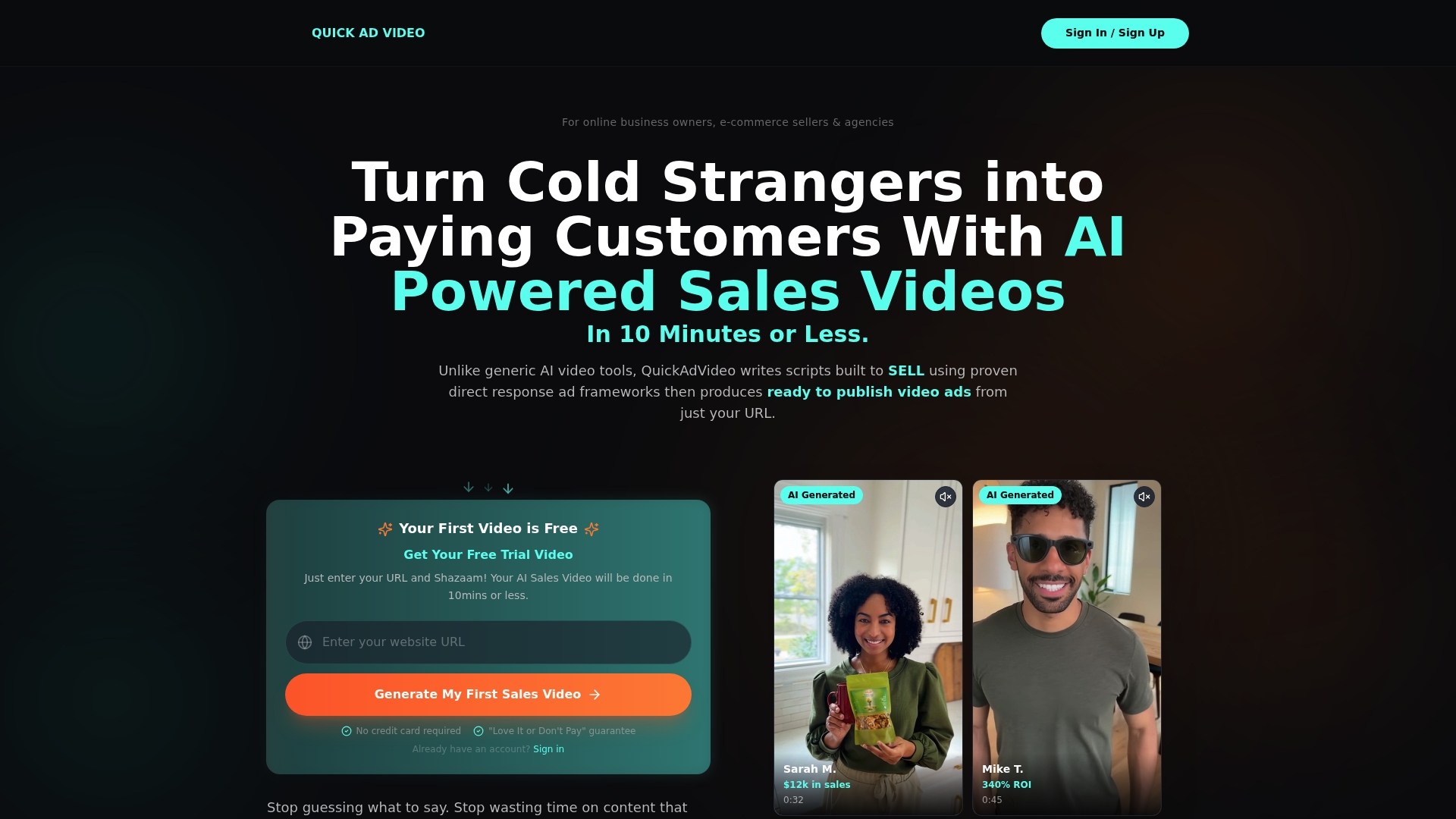
You paste in a product URL. Quickadvideo generates a persuasive sales video in minutes using proven direct response frameworks. Then you take that asset and apply every repurposing strategy in this article: clips, embeds, audiograms, email thumbnails, and more. The platform supports UGC, cinematic, and viral story formats so your repurposed assets match the tone each channel demands. Explore the full AI video generator and see how fast your content pipeline can actually move. If you run ads, the advertising-focused models are worth checking out specifically.
FAQ
What are the best ways to repurpose marketing videos?
The highest-impact methods include cutting short clips for TikTok and Reels, embedding video on product pages, transforming webinars into 30-day content campaigns, and using video thumbnails in email sequences. Each method multiplies a single video’s reach across multiple channels.
How do I repurpose video content without violating YouTube’s policies?
You must add substantial original value, such as unique commentary, narrative reframing, or in-depth analysis. Surface-level edits and basic overlays no longer satisfy YouTube’s reused content policy as of 2026.
How many assets can I realistically create from one video?
A single 60-minute webinar can generate over 47 distinct assets including clips, image quotes, blog posts, and audiograms. Even a shorter product video can yield five to ten derivative assets with the right repurposing workflow.
What video format performs best when repurposing for mobile platforms?
Vertical video consistently outperforms horizontal formats on mobile-first platforms, with completion rates up to 90% higher. Always crop or reformat horizontal footage before publishing on TikTok, Instagram Reels, or YouTube Shorts.
How should I track the ROI of repurposed video content?
Apply unique UTM parameters to every repurposed video link across email, social, and paid channels. This lets you connect video engagement directly to traffic, conversions, and pipeline contribution rather than relying on vanity metrics like views or likes.
Recommended
Related Posts

Why Use Templates for Video Ads: Scale Smarter
Discover why use templates for video ads to streamline production. Boost efficiency and scale your campaigns without losing creativity!

The Role of Data-Driven Video Ads in Boosting ROI
Discover the role of data-driven video ads in boosting ROI. Learn how analytics enhance engagement, optimize campaigns, and drive results.

Create Persuasive Video Ads Workflow That Converts
Learn how to create persuasive video ads workflow that transforms your ideas into optimized, high-converting campaigns. Get started today!