
Why use AI for ad videos: unlock higher revenue
QuickAdVideo Team
Author
AI-driven ad videos can reduce costs by up to 99% compared to traditional production, yet many e-commerce brands still assume AI-generated content looks cheap or underperforms. That assumption is costing them real money. This article breaks down exactly how AI is reshaping video ad creation, what the performance numbers actually look like, how personalization works at scale, and where human strategy still makes the difference. Whether you’re a solo dropshipper or managing a portfolio of brands, understanding AI video ads isn’t optional anymore. It’s the competitive edge separating growing stores from stagnant ones.
Table of Contents
- How AI is transforming video ad creation for e-commerce
- Personalization at scale: unlocking engagement and conversions
- Performance metrics: CTR, CPA, and ROAS with AI UGC ads
- When AI works—and when human strategy matters
- The overlooked truth about AI ad videos: fast, scalable, but strategic
- Get started with AI video ads for e-commerce success
- Frequently asked questions
Key Takeaways
| Point | Details |
|---|---|
| Extreme cost reduction | AI video ads can reduce production costs by up to 99%, making high-converting content affordable to all e-commerce brands. |
| Personalization powers engagement | AI enables scalable personalization in ad videos for higher engagement and conversion rates. |
| Superior performance metrics | AI-produced UGC ads outperform traditional ones on CTR, CPA, and ROAS, driving more revenue. |
| Hybrid strategies optimize results | The best outcomes often come from combining AI automation with human branding and storytelling expertise. |
How AI is transforming video ad creation for e-commerce
Traditional video ad production is expensive, slow, and unforgiving. A single professional shoot can run anywhere from $10,000 to $50,000 once you factor in talent, equipment, editing, and revisions. Timeline? Easily three to six weeks. For a small e-commerce brand testing new products or seasonal offers, that model just doesn’t work.
AI changes the entire equation. AI video creation delivers 90-99% cost savings and dramatically faster turnaround, with most videos ready in hours rather than weeks. AI-generated ads now cost between $100 and $1,000 per video, putting professional-looking content within reach for businesses of every size.
Here’s how AI and traditional production actually compare:
| Factor | Traditional production | AI video creation |
|---|---|---|
| Average cost | $10,000–$50,000 | $100–$1,000 |
| Production time | 3–6 weeks | Hours to 1 day |
| Iterations | Expensive and slow | Fast and low-cost |
| Scalability | Limited | Very high |
Beyond cost, the speed advantage unlocks something traditional production never could: rapid creative testing. You can produce five different hooks, test all of them over a weekend, and scale the winner by Monday. That cycle used to take months.
Here’s what AI video production enables that traditional approaches simply can’t match:
- Launch new ads within hours of a product going live
- Test multiple creative angles without burning through your budget
- React to trending formats on TikTok or Instagram in real time
- Produce localized or segmented versions at scale
The rise of advertising with generative AI is also leveling the playing field. Small brands can now run polished, high-converting ads that compete directly with major retailers. The quality gap that once favored big-budget advertisers is shrinking fast.

If you’re comparing creative approaches, understanding UGC ads vs traditional video marketing is a solid starting point. And if you want to see how video marketing ROI stacks up in a real e-commerce context, the data tells a compelling story.
Personalization at scale: unlocking engagement and conversions
Running the same video ad to every customer is like emailing everyone the same promotion regardless of what they browsed. It works, but it leaves enormous revenue on the table. AI solves this by tailoring video content to specific audience segments, behaviors, and purchase intent signals.
Personalized AI video ads can dynamically adjust product features, pricing callouts, seasonal messaging, and even the tone of the voiceover based on who’s watching. A customer who browsed your product page three times gets a different ad than someone seeing your brand for the first time. That kind of targeting used to require a team of designers and a massive budget. Now it’s automated.
Here’s what AI-driven personalization can actually customize:
| Element | What AI personalizes |
|---|---|
| Product shown | Based on browsing or purchase history |
| Offer or discount | Matched to customer segment or funnel stage |
| Tone and pacing | Adjusted for platform (TikTok vs. YouTube) |
| Seasonal messaging | Triggered by date, region, or campaign |
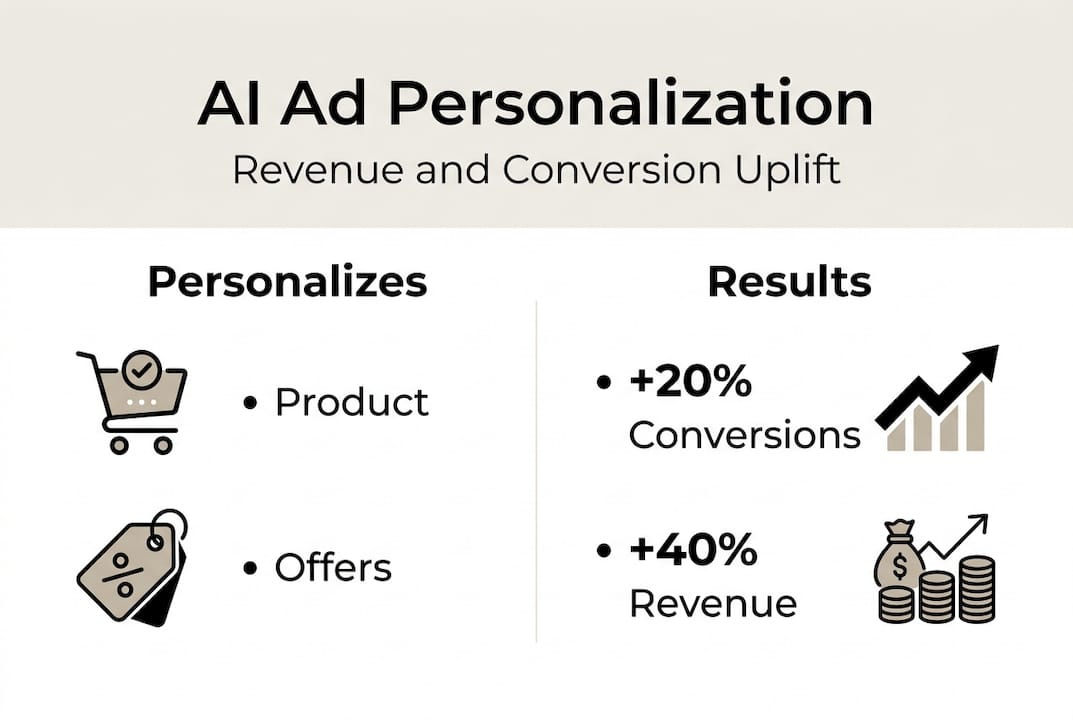
The results back this up. Personalization drives conversions up by 20% and can generate as much as 40% more revenue per campaign. These aren’t marginal gains. They’re the difference between a profitable ad account and a breaking-even one.
Practically speaking, you don’t need a data science team to implement this. Most AI video platforms let you define audience segments during the creation process. You choose a persona, input your product URL, and the AI builds messaging aligned to that specific buyer type.
Pro Tip: Build at least three persona-specific video variants for each product: one for cold audiences who don’t know your brand, one for warm audiences who’ve engaged before, and one for retargeting people who almost converted. This alone can significantly improve your cost per acquisition.
The AI ad personalization impact on engagement is well documented, and you don’t need to run complex experiments to start seeing it. A step-by-step AI video guide can help you structure your first personalized campaign, and getting started with AI video ads walks you through the setup process from scratch.
Performance metrics: CTR, CPA, and ROAS with AI UGC ads
Numbers don’t lie. If you’re managing an ad budget, you care about three metrics above everything else: click-through rate (CTR), cost per acquisition (CPA), and return on ad spend (ROAS). AI UGC ads consistently outperform traditional formats across all three.
AI UGC ads deliver up to 3x higher CTR, up to 72% higher ROAS, and 20-40% lower CPA compared to conventional video ads. Here’s what that looks like in practice:
- CTR: AI UGC ads average 1.8–3.2% vs. 0.8–1.5% for traditional ads
- ROAS: 3.5–6.2x for AI formats vs. 1.8–3.0x for traditional
- CPA: 20–40% lower, meaning you spend less to acquire each customer
- Meta campaigns: AI creative has shown +11% CTR and +7.6% higher conversion rates
These numbers reflect a fundamental shift in how audiences respond to content. UGC-style videos feel native to the feed. They don’t look like ads. That authenticity is why they get clicked more and convert better.
Here’s how to use these benchmarks in practice:
- Set your baseline. Know your current CTR, CPA, and ROAS before switching to AI creative.
- Run A/B tests. Compare AI UGC formats against your best-performing existing ads.
- Scale winners fast. Once an AI ad beats your control, increase budget and test new hooks.
- Monitor frequency. Even high-performing AI ads suffer fatigue. Rotate creative every 7-14 days.
- Match format to goal. Use UGC for conversion campaigns, cinematic ad models for brand awareness.
Pro Tip: When scaling a winning AI ad on Meta, don’t increase the daily budget by more than 20% every 48 hours. Aggressive budget jumps reset the learning phase and tank performance.
If you’re thinking about the broader opportunity, building a UGC business around these formats is a growing trend in 2026, and the performance data makes a strong case for why agencies and brands alike are moving in that direction.
When AI works—and when human strategy matters
AI is not a creative director. It’s an exceptional executor. Understanding that distinction changes how you use these tools and what results you can realistically expect.
AI excels in e-commerce for direct-response campaigns but needs human oversight for brand authenticity. That’s not a limitation to apologize for. It’s a clear signal for how to structure your creative workflow.
AI is the right tool when you need to:
- Test multiple hooks rapidly without large production budgets
- Run performance-focused ads with clear CTAs and product benefits
- React to trends quickly with minimal turnaround time
- Scale winning creatives into dozens of variations
Human judgment becomes essential when your goal shifts from performance to perception. Emotional brand stories, origin narratives, cause-driven campaigns, and content that requires genuine human vulnerability don’t translate well through pure automation. Audiences feel the difference.
The AI video ad testing framework most successful brands use combines both: AI generates volume and tests hooks at scale, while human strategists define the brand voice, approve messaging, and identify emotional angles the AI would never surface on its own.
“AI scales efficiently, but authenticity comes from your brand. The winning formula is using AI for speed and volume, then applying human judgment to what actually resonates.”
Review the AI video ad best practices before you launch to make sure your workflow accounts for both sides of this equation. Brands that treat AI as a full replacement for creative thinking usually plateau. Brands that treat it as a creative accelerator keep growing.
The overlooked truth about AI ad videos: fast, scalable, but strategic
Here’s what most guides won’t tell you: the brands getting the best results from AI video ads aren’t using it to replace their creative process. They’re using it to stress-test ideas faster than any human team could.
The real advantage isn’t just cost or speed. It’s the ability to generate 20 versions of a concept, run them all against a cold audience over 72 hours, and know with statistical confidence which angle works before you spend serious money. That kind of rapid iteration used to be reserved for companies with massive testing budgets.
Hybrid AI-human approaches outperform pure automation for brand alignment. The data is clear, and the logic holds up. AI is brilliant at optimizing for signals. Humans are better at understanding meaning.
The brands we see winning in 2026 aren’t asking “should we use AI?” They’re asking “how do we combine AI speed with brand intelligence?” Keep an eye on AI video trends to stay ahead of the formats your competitors will be using next quarter. Strategy still wins. AI just makes it faster to find out if your strategy is right.
Get started with AI video ads for e-commerce success
You now have the data, the framework, and the strategic context to move from guessing to executing. AI video ads aren’t a future trend. They’re a current competitive advantage for e-commerce brands that act now.
QuickAdVideo is built specifically for this. Paste your product URL and get a polished, high-converting video in minutes. No editing skills, no camera, no creative team required. The AI sales video generator handles scripts, visuals, and voiceover automatically. Explore the full range of AI video models to find the format that fits your campaign goals, or use the AI video editor to fine-tune and publish directly to TikTok, Instagram, Facebook, or YouTube. Your next winning ad is closer than you think.
Frequently asked questions
How much can e-commerce brands save using AI for ad videos?
Brands can typically save 90-99% on production costs by switching to AI, paying $100–$1,000 per video instead of the $10,000–$50,000 that traditional shoots require.
How does AI improve ad video performance metrics?
AI UGC ads deliver up to 3x CTR, 20-40% lower CPA, and up to 72% higher ROAS compared to traditional video formats, making them far more efficient for performance-focused campaigns.
Can AI personalize video ads for individual customers?
Yes. AI adjusts messaging, product focus, and offer details based on audience segments, driving conversions up 20% and generating up to 40% more revenue through tailored ad experiences.
Are there situations where AI shouldn’t be used for ad videos?
AI suits direct-response campaigns well, but emotional storytelling and brand-defining narratives still benefit from human creative oversight to maintain authenticity and audience trust.
Recommended
- Getting Started with AI Video Ads: A Complete Guide | QuickAdVideo Blog
- QuickAdVideo - AI Sales Video Generator
- QuickAdVideo - AI Sales Video Generator
- Video marketing for e-commerce: ROI and strategies 2026 | QuickAdVideo Blog
- Video Editor - Create Playable Ads from Videos | PlayableMaker
- How AI transforms digital marketing: ROI, tools & results
Related Posts

Why Use Templates for Video Ads: Scale Smarter
Discover why use templates for video ads to streamline production. Boost efficiency and scale your campaigns without losing creativity!

The Role of Data-Driven Video Ads in Boosting ROI
Discover the role of data-driven video ads in boosting ROI. Learn how analytics enhance engagement, optimize campaigns, and drive results.

Create Persuasive Video Ads Workflow That Converts
Learn how to create persuasive video ads workflow that transforms your ideas into optimized, high-converting campaigns. Get started today!