
Why invest in video ads? Boost sales and ROI with AI
QuickAdVideo Team
Author
Shoppable videos convert 30% higher than standard product pages, yet plenty of e-commerce marketers still treat video ads as a “nice to have” rather than a revenue engine. That hesitation is expensive. The data is clear: video is the format consumers trust most before they buy, and AI has removed every excuse for not using it. This guide breaks down the market forces driving video ad investment, the psychology behind why it works, and the practical steps you can take right now to launch AI-powered video ads that actually move the needle for your store or agency.
Table of Contents
- The surge in video advertising: Market trends and ROI
- Why video ads work: Key drivers of engagement and conversion
- Maximizing ROI: How e-commerce brands leverage AI-powered video ads
- Common pitfalls and mistakes to avoid in video ad investment
- Our take: What most marketers miss about video ad investments
- Accelerate your growth with AI-powered video ads
- Frequently asked questions
Key Takeaways
| Point | Details |
|---|---|
| Video ads drive high ROI | Businesses using video ads see positive returns and increased sales compared to traditional ads. |
| AI makes video ads accessible | AI tools remove cost and complexity for all e-commerce brands to create compelling videos. |
| Short-form videos convert best | Videos under 60 seconds and shoppable features yield the highest engagement and conversion rates. |
| Avoid common video ad mistakes | Simple, targeted videos and regular analytics monitoring prevent wasted ad spend. |
The surge in video advertising: Market trends and ROI
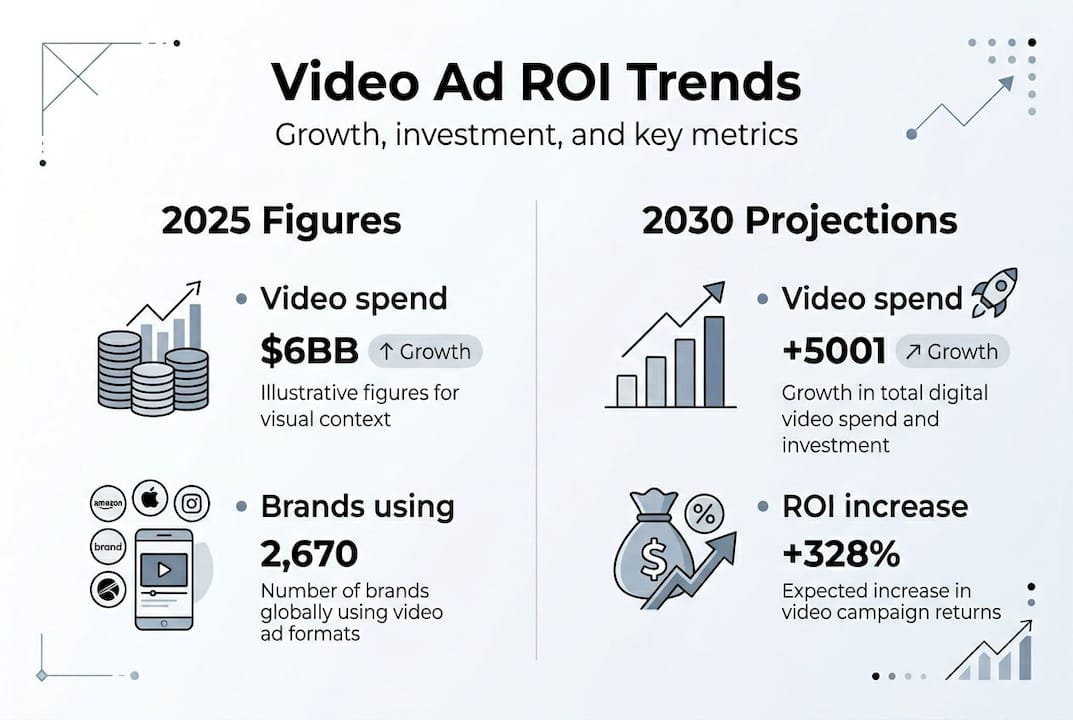
Video advertising is no longer a channel reserved for Fortune 500 brands with massive production budgets. It has become the dominant format across every major platform, and the numbers back that up decisively. Global video ad spend is projected to hit $214.76 billion in 2025 and climb to $338 billion by 2030. That is not speculative growth. It reflects where consumer attention already lives.
What is driving this surge? Three forces stand out:
- Platform prioritization. TikTok, Instagram Reels, and YouTube Shorts all actively reward video content with organic reach, making paid video ads more efficient.
- Consumer preference. Shoppers increasingly expect to see products in motion before committing to a purchase, especially on mobile.
- Measurable returns. Unlike brand awareness campaigns of the past, modern video ads tie directly to click-through rates, add-to-cart events, and purchases.
The adoption rate among businesses reflects this shift. 91% of businesses now use video marketing, and 93% of them report a positive return on investment. That is a near-universal success rate, which is rare in digital marketing.
| Metric | 2025 figure | 2030 projection |
|---|---|---|
| Global video ad spend | $214.76 billion | $338 billion |
| Businesses using video | 91% | Expected to grow |
| Businesses reporting positive ROI | 93% | Trending upward |
For e-commerce brands, the strategic implication is simple. If you are not investing in video ads, you are ceding ground to competitors who are. Staying current with the latest video ad trends is no longer optional. It is a baseline requirement for staying competitive in 2026.
Smaller sellers sometimes assume these numbers only apply to large advertisers. They do not. UGC video success stories show that lean, authentic video content from individual sellers and small brands consistently outperforms polished corporate ads in engagement and conversion metrics.
Why video ads work: Key drivers of engagement and conversion
Data tells you that video works. But understanding why it works helps you make smarter creative decisions rather than just copying what others do.
Video triggers faster trust signals than any static format. Within seconds, a viewer processes tone, movement, and authenticity in ways that a product image simply cannot replicate. That speed matters enormously in an environment where attention spans are short and scroll velocity is high.
“85% of consumers are convinced to buy after watching a product video.” This is not a soft engagement metric. It is a direct purchase intent signal that static ads rarely achieve.
Here is what specifically drives that behavior:
- Emotional resonance. Video communicates facial expressions, voice tone, and story arcs. These elements create emotional connection, and emotional connection drives decisions.
- Demonstration value. Showing a product in use answers objections before they form. A viewer who sees exactly how something works is far less likely to hesitate at checkout.
- Social proof amplification. When real people appear in video ads, whether through UGC or testimonial formats, viewers subconsciously transfer credibility from the person to the product.
- Recall advantage. People retain roughly 95% of a message delivered via video compared to about 10% when reading text. Better recall means stronger brand affinity over time.
The format also matters. UGC vs traditional video ads research consistently shows that authentic, lower-production content often outperforms expensive studio work because it feels more relatable and less like an interruption.

Pro Tip: Place your clearest call to action within the first 10 seconds of your video ad. Most viewers decide whether to keep watching or scroll away in that window. If your hook and CTA are buried at the end, you are losing buyers who never get there. Check out this AI video ad guide for proven hook structures that stop the scroll.
Maximizing ROI: How e-commerce brands leverage AI-powered video ads
Knowing that video works is one thing. Producing enough of it, fast enough, at a cost that makes sense for your margins, is where most e-commerce teams hit a wall. AI changes that equation completely.
AI video platforms eliminate the traditional bottlenecks: hiring videographers, writing scripts from scratch, editing footage, and waiting days or weeks for a finished asset. Instead, you input your product URL, select a format, and get a conversion-ready video in minutes. The creative process that once required a team now requires one person and a few clicks.
Shoppable videos convert 30% higher for direct sales, and AI tools make it straightforward to produce this format at scale. You can test multiple versions of the same product video with different hooks, music, or calls to action without multiplying your production costs.
Here is a practical framework for launching your first AI-powered video ad:
- Choose your format. Decide between UGC, cinematic, or viral story styles based on your audience and platform. Each serves a different funnel stage.
- Input your product URL. A good AI platform pulls product details automatically and generates a script built on direct response principles.
- Customize the output. Adjust tone, pacing, and visual style to match your brand without touching a timeline or editing tool.
- Publish directly. Push your finished video to TikTok, Instagram, YouTube, or Facebook without leaving the platform.
- Track and iterate. Monitor ROAS, click-through rate, and watch time. Use those signals to inform your next video.
Explore the range of AI video ad platforms available to find the format that fits your current campaign goals.
| Approach | Time to produce | Cost per video | Scalability |
|---|---|---|---|
| Traditional production | Days to weeks | $500 to $5,000+ | Low |
| AI-powered platform | Minutes | Cents to low dollars | Very high |
Pro Tip: Do not commit to one video format before testing at least two or three. What works for a skincare brand may fall flat for a tech gadget. Run small-budget tests across formats using 2026 video marketing trends as your guide, then scale what wins.
Common pitfalls and mistakes to avoid in video ad investment
Video ads fail more often from strategic errors than from bad creative. Knowing what to avoid saves you budget, time, and frustration.
Here are the most common mistakes e-commerce brands make:
- Prioritizing production value over audience fit. Spending thousands on a cinematic ad that does not match your audience’s expectations is a fast way to burn budget. Short-form videos consistently yield the highest ROI, and they rarely require expensive production.
- Ignoring mobile-first design. Over 70% of video content is consumed on mobile devices. If your video is not formatted vertically, uses small text, or relies on audio without captions, you are losing viewers before they even process your message.
- Skipping ROAS tracking. Return on Ad Spend is the single most important metric for e-commerce video campaigns. Without it, you are guessing. Set up conversion tracking before you spend a dollar.
- Running one version and calling it a test. A single video tells you almost nothing. You need multiple variants with different hooks, lengths, or formats to understand what your audience actually responds to.
- Overcomplicating the message. Viewers do not read video ads. They watch them once, quickly. If your core message is not obvious within five seconds, it is not obvious at all.
A solid video ad setup guide walks you through the technical and strategic groundwork before you launch. Getting that foundation right prevents most of the mistakes above.
Pro Tip: Start with a $10 to $20 daily budget per ad variant. Let the data accumulate for five to seven days before making decisions. Small, fast experiments beat large, slow ones every time. Browse cinematic ad examples to see how format affects performance across different product categories.
Our take: What most marketers miss about video ad investments
Here is the uncomfortable truth most video marketing content will not tell you: budget size and production quality are almost never the deciding factors in video ad success. The brands winning right now are winning because they test faster and learn faster, not because they spend more.
We have seen small e-commerce sellers with $500 monthly ad budgets outperform agencies running $50,000 campaigns, simply because the smaller operator was willing to try ten different angles in the time the agency spent approving one script.
Authentic storytelling beats cinematic polish almost every time. A founder talking directly to camera about why they built a product will outperform a studio-produced lifestyle video in the majority of e-commerce categories. Viewers are sophisticated. They can sense when something is genuine, and they reward it with their attention and their wallets.
The real edge in 2026 is iteration speed. AI tools make it possible to produce, test, and optimize video ads in a cycle that was impossible two years ago. Brands that embrace AI-driven ad best practices and treat every video as a learning opportunity will compound their results over time. Those waiting for the perfect video will keep waiting while their competitors scale.
Accelerate your growth with AI-powered video ads
If you have been putting off video ads because they seemed too complex, too expensive, or too time-consuming, the landscape has fundamentally changed. AI has made high-converting video production accessible to any e-commerce brand, regardless of team size or technical skill.
QuickAdVideo is built specifically for entrepreneurs and marketers who need results without the overhead. Simply paste your product URL, choose from UGC, cinematic, or viral story formats via the AI video generators, and publish directly to your preferred social platform in minutes. Flexible pricing options mean you can start with pay-per-use credits and scale to a subscription as your volume grows. No camera. No editor. No waiting.
Frequently asked questions
Do video ads really increase sales for e-commerce stores?
Yes. 85% of consumers report being convinced to buy after watching a product video, and shoppable video formats boost conversion rates by 30% compared to standard ads.
How does AI help with creating and optimizing video ads?
AI platforms automate scriptwriting, visual production, and format customization, cutting production time from days to minutes and making it affordable for businesses of any size to test multiple ad variants simultaneously.
What types of video ads have the highest ROI?
Short-form videos under 60 seconds and shoppable formats consistently deliver the strongest returns for e-commerce brands, especially on TikTok, Instagram Reels, and YouTube Shorts.
How quickly can I see results from video ad investment?
Most brands see measurable improvements in engagement and conversion rates within two to four weeks, particularly when using rapid A/B testing and data-driven iteration from day one.
Is video advertising only for big brands?
Not at all. AI-powered tools have leveled the playing field, giving small and mid-sized e-commerce businesses the ability to produce and scale professional video ads without large budgets or production teams.
Recommended
- Getting Started with AI Video Ads: A Complete Guide | QuickAdVideo Blog
- QuickAdVideo - AI Sales Video Generator
- QuickAdVideo - AI Sales Video Generator
- QuickAdVideo - AI Sales Video Generator
- How AI transforms digital marketing: ROI, tools & results
- How AI boosts digital marketing ROI and performance in 2026
Related Posts

Why Use Templates for Video Ads: Scale Smarter
Discover why use templates for video ads to streamline production. Boost efficiency and scale your campaigns without losing creativity!

The Role of Data-Driven Video Ads in Boosting ROI
Discover the role of data-driven video ads in boosting ROI. Learn how analytics enhance engagement, optimize campaigns, and drive results.

Create Persuasive Video Ads Workflow That Converts
Learn how to create persuasive video ads workflow that transforms your ideas into optimized, high-converting campaigns. Get started today!