
Why Cinematic Videos Transform Your Marketing Results
QuickAdVideo Team
Author
Most e-commerce videos are forgettable. They show a product spinning on a white background, list a few features, and end with a generic call to action. Viewers scroll past them in under two seconds. The problem isn’t the product. It’s the approach. Cinematic videos work differently because they use storytelling, sound design, and emotional pacing to pull viewers in and hold their attention long enough to make them care. If you’re running ads, launching products, or trying to build a brand on social media, understanding what cinematic video can do for your conversion rates changes everything.
Table of Contents
- What makes a video cinematic?
- Why do cinematic videos drive more engagement?
- Cinematic vs. standard marketing videos: A side-by-side comparison
- Practical steps to integrate cinematic storytelling in your marketing
- The overlooked power of cinematic marketing videos
- Elevate your marketing with cinematic video solutions
- Frequently asked questions
Key Takeaways
| Point | Details |
|---|---|
| Storytelling drives results | Cinematic videos build emotional connections that convert viewers to customers. |
| Higher engagement rates | Creative visuals and sound design capture attention and fuel brand loyalty. |
| Accessible to all businesses | AI tools and templates make cinematic marketing affordable for any e-commerce store. |
| Outperform standard videos | Cinematic marketing consistently delivers more views and sales than basic video content. |
What makes a video cinematic?
To set the stage for why cinematic videos work, let’s define what makes a marketing video truly cinematic.
A cinematic video is not just a pretty-looking clip. It combines narrative structure, intentional camera work, professional sound design, and emotional storytelling into a single cohesive experience. Think about the last ad that made you feel something. Maybe it made you laugh, made you nostalgic, or gave you a sudden urge to buy something. That was almost certainly a cinematic approach at work.
Standard marketing videos focus on information delivery. Cinematic videos focus on experience delivery. The difference matters enormously when you’re competing for attention on platforms like TikTok, Instagram, or YouTube, where the average viewer makes a decision to stop scrolling within one to three seconds.
Here’s a quick breakdown of how cinematic and standard marketing videos differ across their key elements:
| Element | Cinematic video | Standard marketing video |
|---|---|---|
| Story structure | Three-act narrative with emotional arc | Feature list or product demo |
| Lighting | Intentional, mood-driven lighting | Bright, flat, functional |
| Camera movement | Dynamic: tracking shots, close-ups, perspective | Static or minimal |
| Sound design | Layered: music, ambient sound, voice | Background music only |
| Pacing | Edited to match emotional beats | Cut for time, not impact |
| Emotional goal | Make the viewer feel something specific | Inform or remind |
Cinematic techniques like story arcs and high production values lead to more memorable marketing, which directly translates into stronger brand recall and better return on ad spend. That’s not a small thing when you’re paying per click.
The core elements that define cinematic quality in marketing videos include:
- Narrative arc: A clear beginning, middle, and end that builds emotional momentum
- Intentional lighting: Natural light, golden hour tones, or controlled studio lighting that sets a mood
- Camera movement: Slow zooms, dynamic tracking shots, or intentional close-ups that guide viewer focus
- Sound layering: Background score, ambient environment sounds, and voice narration working together
- Color grading: A consistent visual tone that reinforces brand identity and emotional feel
- Authentic performance: Real people or realistic scenarios that feel genuine rather than staged
- Pacing and editing rhythm: Cuts timed to music and emotional beats, not just information transfer
Pro Tip: You don’t need a Hollywood crew to add cinematic flair. Even filming with a smartphone in natural window light, using a free LUT (a color grading preset) in editing, and adding a carefully chosen music track will push your video several tiers above the average product clip.
Why do cinematic videos drive more engagement?
Now that you know what makes a video cinematic, let’s see why those elements work so well in marketing.

The human brain processes stories differently than it processes lists of facts. When someone reads a feature list, only the language processing areas of the brain activate. When someone watches a well-told story, the brain’s sensory, emotional, and motor areas all fire simultaneously. This is why a cinematic ad about a mother using your skincare product during a morning routine will outperform a clip showing your ingredient list every single time.
Neuroscience research consistently shows that emotional engagement is the single strongest predictor of whether a viewer will remember your brand and take action. When a video creates genuine emotion, whether that’s warmth, excitement, aspiration, or even humor, it triggers a release of cortisol and oxytocin. Those chemicals improve memory formation and increase trust. Trust is the foundation of every purchase decision in e-commerce.
“Videos that feel cinematic evoke emotion and trust, influencing purchase decisions in ways that standard product videos simply cannot replicate.”
The understanding of the psychology of video marketing reveals something counterintuitive: viewers don’t actually want to be sold to. They want to be understood. Cinematic storytelling communicates that you understand their life, their problem, and their aspirations. The product becomes the solution within a story they’re already emotionally invested in, rather than an item being pushed at them.
Watch time is one of the most powerful signals across every major platform algorithm. When viewers watch more of your video, the algorithm serves it to more people. Cinematic pacing and narrative hooks keep viewers watching longer than standard feature-focused videos. And longer watch time means:
- Higher organic reach on TikTok, Instagram Reels, and YouTube Shorts
- More shares because emotional content drives social sharing behavior
- More comments as viewers react to the story or characters
- Higher conversion rates because trust has been established before the call to action
- Lower cost per acquisition on paid ad platforms due to better engagement signals
One major research finding: video ads that use emotional storytelling generate purchase intent rates up to three times higher than purely rational, feature-based ads. For an e-commerce store running paid traffic, that gap in performance directly affects your profitability.
Cinematic vs. standard marketing videos: A side-by-side comparison
To bring this into clearer focus, let’s compare cinematic and standard marketing videos head-to-head.
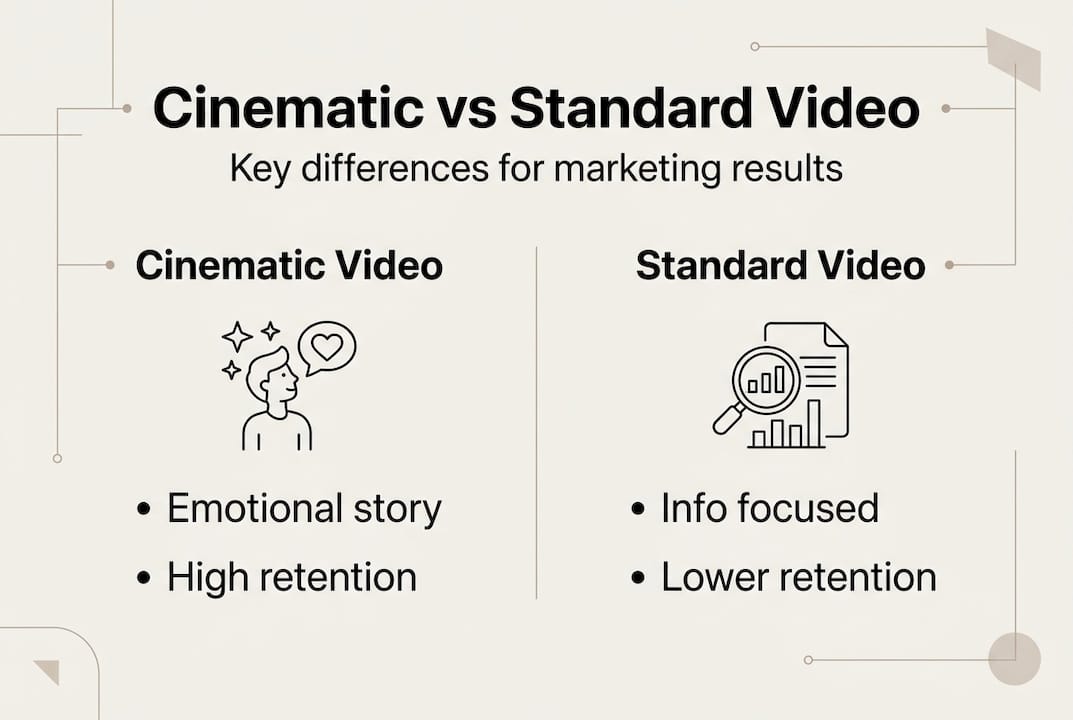
Standard videos often underperform compared to cinematic alternatives in terms of views and conversions. The numbers are stark. A standard product demo might achieve a 20% to 30% watch-through rate. A well-executed cinematic story ad routinely achieves 60% to 80% watch-through rates on the same platforms and audiences. That’s not a marginal improvement. It’s a fundamental shift in how your audience relates to your content.
| Feature | Cinematic video | Standard video |
|---|---|---|
| Viewer retention | 60% to 80% watch-through | 20% to 30% watch-through |
| Emotional impact | High, drives brand recall | Low, drives product awareness |
| Shareability | High, viewers share emotional content | Low, rarely shared organically |
| Trust building | Strong, story creates authenticity | Weak, feels like an advertisement |
| Production requirement | Moderate (story and pacing focus) | Low (camera and product focus) |
| Long-term brand value | High, builds audience loyalty | Low, transactional |
| Algorithm performance | Strong, engagement signals boost reach | Weak, low watch time hurts reach |
The good news is that the gap between these two approaches is narrowing, not because standard videos are improving, but because tools and templates now make cinematic production accessible. You can explore cinematic ads examples to see exactly what this looks like in practice for e-commerce products.
Here’s a practical numbered process to upgrade a standard marketing concept into a cinematic one:
- Start with a problem, not a product. Open your video by showing a relatable pain point your target customer experiences. This creates immediate identification before you introduce your solution.
- Build a character or situation. Even a 30-second video can establish a simple character. A busy parent, a fitness beginner, a small business owner. Give the viewer someone to root for.
- Introduce the product as the turning point. Your product enters the story as the solution, not the subject. This is a fundamental shift from “look at this product” to “here’s how this product changed things.”
- Use sound intentionally. Choose music that matches the emotional arc. Tension before the solution, resolution after. Layer in ambient sound to make the environment feel real.
- Close on transformation, not just product. End with the character’s life improved, not a product shot. The emotional payoff is what drives sharing and conversion.
- Grade your color and tighten your pacing. Apply a consistent color tone and cut to music beats. This alone elevates perceived production quality dramatically.
Take a hypothetical example: an e-commerce brand selling insulated water bottles. A standard video shows the bottle, lists its features, and ends with a price. A cinematic version opens on a hiker at dawn, gasping for water after a long climb. She reaches into her pack, pulls out the bottle, takes a long, satisfying drink, and smiles as the sun rises behind her. Same product. Completely different emotional response. The creative video ideas you build around storytelling will consistently outperform feature-driven content.
Practical steps to integrate cinematic storytelling in your marketing
With the benefits and differentiators understood, here’s how you can start using cinematic techniques in your own campaigns.
Investing in storytelling and production can yield measurable returns for e-commerce businesses, even when you’re working with a limited budget and no production team. The secret is focusing on structure and intention, not equipment. A thoughtfully written script with clear emotional beats will outperform an expensive but aimless production every time.
Here’s a step-by-step approach to building cinematic quality into your video marketing process:
- Write the story first, plan the visuals second. Your script is the foundation. Map out the emotional journey before you think about shots. What should your viewer feel at the 5-second mark? The 15-second mark? The final moment?
- Script emotional beats explicitly. Label each section of your script with the intended emotion. “Tension,” “curiosity,” “relief,” “excitement.” This keeps you accountable to the emotional arc during filming and editing.
- Plan your visual sequence intentionally. Decide which shots serve the story. Avoid filler footage. Every frame should push the narrative or the emotion forward.
- Use sound as a strategic layer. Choose your background music before you film. It will guide your pacing decisions and give you a target emotional tone to match in your visuals.
- Edit to rhythm, not just time. Cut on the beat. Use the music’s tempo to decide where transitions happen. This alone creates a sense of professional polish that viewers feel even if they can’t explain it.
- Measure and iterate. After publishing, track watch-through rate, engagement rate, and conversion rate. Compare these numbers against your previous standard videos. The lift will guide your next investment decision.
You can deepen your approach by reading guides on video messaging for conversions that break down script structure specifically for e-commerce. A full step-by-step video ads guide walks through the entire production process from concept to publishing, which is especially useful if you’re building this workflow for the first time.
Pro Tip: Use an AI-powered video creation platform to handle scripting and editing structure while you focus on the story concept. AI tools now generate cinematic-quality video scripts built on proven direct response frameworks, cutting production overhead by 80% or more while preserving the emotional arc that makes cinematic content effective.
The most important mental shift is treating your product launch videos, ad creatives, and social content not as commercials but as short films. Short films that happen to sell something. That reframe changes every decision you make in the production process.
The overlooked power of cinematic marketing videos
Here’s a frank take: most e-commerce brands avoid cinematic video not because they can’t afford it, but because they’ve convinced themselves it’s out of reach. “That’s for big brands with big budgets.” But that belief is costing them far more than a production budget ever would.
The real cost of non-cinematic video isn’t in production savings. It’s in being ignored. When your ad gets scrolled past in two seconds, that’s not a neutral outcome. You’ve paid for that impression and received nothing in return. Multiply that across thousands of impressions and you’re looking at a massive, silent drain on your ad budget.
Investing in video ads with cinematic quality isn’t a luxury decision. It’s a strategic one. AI tools have changed the math entirely. What once required a crew, a director, and a post-production team can now be accomplished by a single person with the right platform and a clear story idea.
The brands that consistently win in competitive e-commerce categories share one trait: they make people feel something. Not just informed. Not just aware. Something. Great brand moments are built on stories, not spec sheets. The brands still relying on feature lists and product shots in 2026 aren’t playing it safe. They’re falling behind.
Brands willing to invest in memorable, emotionally resonant video experiences don’t just outperform their competitors on individual campaigns. They build audiences that return, share, and advocate over time.
Elevate your marketing with cinematic video solutions
Cinematic video is no longer the exclusive domain of brands with six-figure production budgets. The tools exist right now to create emotionally compelling, professionally structured video content that drives real engagement and real sales, regardless of your team size.
QuickAdVideo is built specifically for e-commerce sellers and marketers who want cinematic-quality results without the traditional overhead. The AI sales video generator takes your product URL and produces a fully scripted, cinematic-style video in minutes, using proven direct response frameworks that are built to convert. You can explore the full range of AI video models including cinematic, UGC, and viral story formats to find the right creative approach for every campaign. Start creating videos that your audience actually watches from beginning to end.
Frequently asked questions
How are cinematic videos different from typical marketing videos?
Cinematic videos use storytelling, advanced visuals, and emotional resonance, while typical marketing videos often focus just on features and benefits. Cinematic techniques like story arcs and high production values lead to more memorable marketing and stronger brand recall.
Do cinematic videos really improve conversion rates?
Yes, they keep viewers watching longer and build trust, which leads to higher conversion rates. Videos that feel cinematic evoke emotion and trust, influencing purchase decisions in ways that standard product videos cannot.
Are cinematic videos expensive to produce for e-commerce?
No, new AI tools and templates make cinematic production affordable and scalable for businesses of any size. Platforms like QuickAdVideo generate cinematic scripts and video structures in minutes without requiring a production team.
Can small e-commerce brands benefit from cinematic video marketing?
Absolutely. Cinematic storytelling helps brands of all sizes stand out and connect emotionally with customers. Standard videos often underperform cinematic alternatives in views and conversions, meaning even a small upgrade in storytelling approach delivers measurable results.
Recommended
Related Posts

Why Use Templates for Video Ads: Scale Smarter
Discover why use templates for video ads to streamline production. Boost efficiency and scale your campaigns without losing creativity!

The Role of Data-Driven Video Ads in Boosting ROI
Discover the role of data-driven video ads in boosting ROI. Learn how analytics enhance engagement, optimize campaigns, and drive results.

Create Persuasive Video Ads Workflow That Converts
Learn how to create persuasive video ads workflow that transforms your ideas into optimized, high-converting campaigns. Get started today!