
Why AI video matters for e-commerce conversion
QuickAdVideo Team
Author
AI video has cut production costs by over 40% for many marketing teams, yet most e-commerce sellers still treat video as optional. That gap is exactly where your competitors are winning. Why AI video matters is not a philosophical debate about technology trends. It is a concrete business question with measurable answers in conversion rates, customer acquisition costs, and content output speed. This guide breaks down the real numbers, practical strategies, and honest trade-offs so you can make smarter decisions about where AI video fits in your marketing stack.
Table of Contents
- How AI video transforms e-commerce marketing
- AI video versus traditional video: key differences and what it means for your marketing
- How personalized AI videos boost conversions and engagement
- Practical AI video strategies for e-commerce marketers
- Why embracing AI video is essential — and what most marketers overlook
- Discover QuickAdVideo’s AI sales video solutions to fuel your marketing success
- Frequently asked questions
Key Takeaways
| Point | Details |
|---|---|
| AI video cuts cost | AI video production reduces costs by around 40%, making video marketing affordable for small and mid-sized e-commerce businesses. |
| Boosts conversions | Personalized AI videos can increase sales conversions up to 40% and drive much higher click-through rates. |
| Human review essential | Every AI-generated video script needs expert review to maintain accuracy, brand voice, and consumer trust. |
| Blend AI and humans | Combining AI efficiency with human creativity ensures brand differentiation and higher video quality. |
| Strategic adoption key | E-commerce marketers should adopt AI video with clear goals and workflows for maximum marketing impact. |
How AI video transforms e-commerce marketing
The financial case for AI video is hard to ignore. Traditional video production for a single product ad can run thousands of dollars and take weeks to produce. AI video tools compress that timeline to minutes and costs that rival a single paid media click. Xerox cut production costs by more than 50% using AI-powered video tools for global training content. If a company with Xerox’s resources can achieve that kind of savings at scale, the math for a lean e-commerce team is even more compelling.
The importance of AI video is not just about what you save. It is about what you can now do that was previously impossible. Small e-commerce brands can now produce a new product video every week without a production crew, a studio, or a professional editor. That volume matters because the algorithm rewards consistency, and your customers need multiple touchpoints before they buy.

The impact of AI in video shows up most clearly on landing pages. Pages with embedded video convert at 86% higher rates than text-only equivalents. That is not a marginal improvement. For an e-commerce store doing $50,000 in monthly revenue, an 86% lift in conversion efficiency on key product pages is a fundamentally different business.
Here is what AI video technology makes possible that traditional production cannot match at scale:
- High-volume output: Produce dozens of product videos in the time it once took to make one
- Rapid iteration: Test multiple hooks, scripts, and formats in days rather than months
- Personalization at scale: Dynamically insert customer names, locations, or product preferences into videos
- Consistent brand messaging: AI scripts built on proven direct response frameworks reduce guesswork
- Lower barrier to entry: No camera, no crew, no editing timeline required
The benefits of AI video compound over time. The more video content you produce, the more data you gather on what converts. That feedback loop is almost impossible to build when each video costs thousands of dollars to create.
AI video versus traditional video: key differences and what it means for your marketing
Traditional video production has genuine advantages that AI cannot replicate on its own. A founder-led brand story filmed authentically, with real emotion and real context, builds trust in a way that no AI avatar can fully replace. Human-led production offers brand differentiation, emotional depth, and the kind of creative risk-taking that earns shares and loyalty. Those advantages are real and worth preserving.
The trade-off is cost, time, and scale. A professionally produced video takes weeks, costs thousands, and produces one piece of content. AI video produces that same asset in minutes, for a fraction of the price, in as many variations as you need. AI vs traditional video is not a binary choice. It is a resource allocation decision.
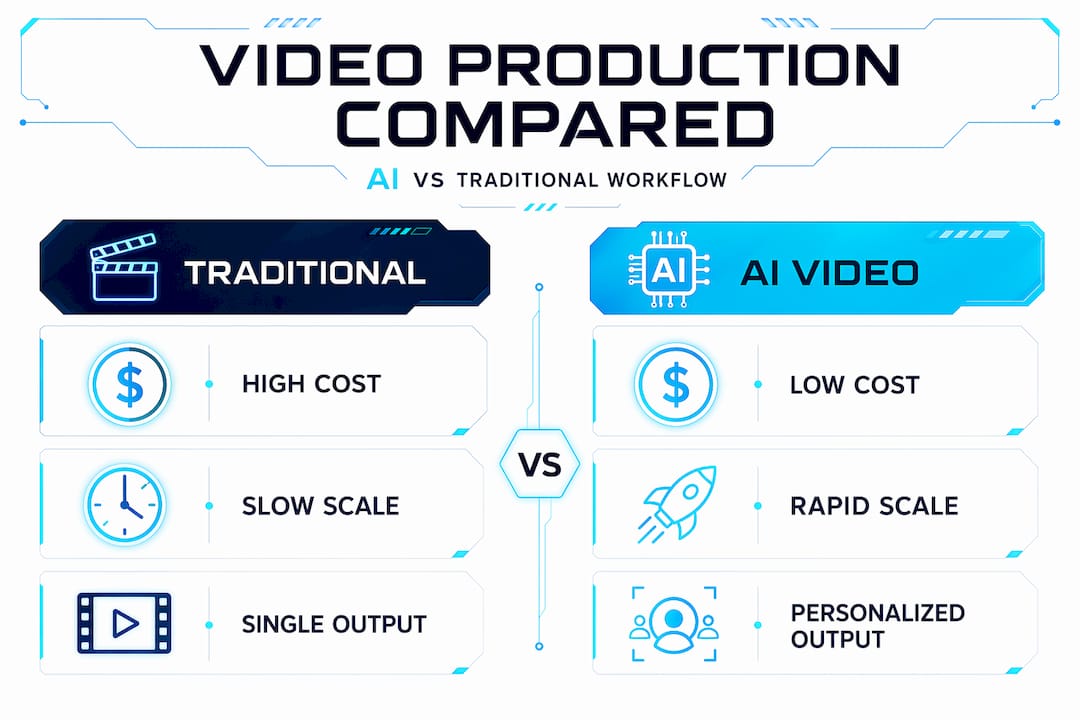
Here is a direct comparison to help you decide where to invest:
| Factor | Traditional video | AI-generated video |
|---|---|---|
| Production cost | $1,000 to $20,000+ per video | $10 to $100 per video |
| Production time | 1 to 6 weeks | Minutes to hours |
| Personalization at scale | Very difficult and expensive | Built-in capability |
| Emotional authenticity | High | Moderate, improving rapidly |
| Creative risk-taking | High | Limited without human input |
| Volume output | Low | Very high |
| A/B testing flexibility | Slow and costly | Fast and affordable |
One caution worth taking seriously: every AI script needs expert review before publishing to avoid inaccuracies that can damage credibility. AI is excellent at assembling content quickly. It is not always accurate about product claims, technical details, or regulatory requirements. A single misleading statement in a video ad can cost you far more than the production savings.
Pro Tip: Use AI video for your high-frequency, lower-stakes content like social media clips, product demos, and retargeting ads. Reserve traditional production for hero campaigns and brand storytelling that requires genuine emotional impact.
The most effective e-commerce marketing programs in 2026 are not choosing one or the other. They are using AI video to generate volume and traditional production to anchor brand identity.
How personalized AI videos boost conversions and engagement
Personalization is where AI video stops being merely efficient and starts being genuinely powerful. Standard product videos show every customer the same content. Personalized AI videos can dynamically incorporate a viewer’s name, location, browsing history, or purchase intent signals into the video itself. That difference in relevance directly affects whether someone buys.
The data from real campaigns backs this up. Orum’s 2026 B2B campaign using AI personalized videos achieved a 36% conversion rate with 523% higher click-through rates compared to previous email campaigns. While B2B and e-commerce contexts differ, the underlying psychology does not. Relevance converts. Generic content scrolls past.
AI-generated product demos lifted conversion rates by 40% according to 2026 marketing data. Product demos work because they reduce purchase anxiety. Customers who understand what they are buying and can see it in action are far more likely to complete a purchase. AI makes it possible to produce a demo-style video for every product in your catalog, not just your top sellers.
Here is how to build a personalized AI video workflow that actually drives results:
- Segment your audience first: Personalization without segmentation is just noise. Define 3 to 5 customer personas before you script anything.
- Start with your highest-traffic products: Apply personalized video to the product pages where even a small conversion lift pays for your entire AI subscription.
- Use dynamic text overlays: Even basic personalization like location-based messaging or first name insertion meaningfully increases engagement.
- Match video format to platform: Short vertical clips for TikTok and Instagram Stories, longer horizontal formats for YouTube and Facebook.
- Measure and iterate fast: AI video’s speed advantage is wasted if you do not track which versions convert and act on that data quickly.
The reason effective video messaging outperforms static ads at this scale is simple. Video communicates trust signals, product context, and emotional connection simultaneously. Personalization amplifies each of those signals by making the viewer feel seen rather than targeted.
Practical AI video strategies for e-commerce marketers
Knowing why AI video matters is different from knowing how to make it work in your actual marketing operation. Most teams that struggle with AI video adoption fall into one of two traps: they either produce a high volume of low-quality videos with no human review, or they over-engineer the process and lose the speed advantage entirely.
By 2026, an estimated 75% of marketing videos will be AI-generated or AI-assisted. The competitive pressure to adopt is real, but adoption without strategy is just noise. Here is a practical framework to help you use AI video effectively:
- Align tool selection to your goals: Not every AI video platform serves every use case. Choose tools built for your specific output needs, whether that is UGC-style social content, product demo videos, or direct response ads.
- Repurpose existing content first: Turn your best-performing blog posts, customer reviews, and email sequences into video scripts. You already know this content resonates.
- Build a human review checkpoint: Assign one person to review every AI-generated script before production. Fifteen minutes of review prevents costly mistakes and keeps brand voice consistent.
- Prioritize short-form product demos: For e-commerce, 30 to 60 second product demo videos consistently outperform longer content on paid and organic channels.
- Batch production for efficiency: Generate 10 to 20 video variations in a single session rather than producing one at a time. Batch workflows save significant time and allow better A/B testing.
Understanding the AI product video workflow that fits your team means accepting that some iteration is required. Your first five AI videos will probably be weaker than your last five. Build production into your weekly calendar like you would any other content task, and learn quickly from what the data tells you.
Pro Tip: Use your top-performing paid ad copy as the foundation for AI video scripts. If a headline converts in text, it almost always converts better in video. Your best copy is your best script.
Learning to automate video content at the workflow level, not just the production level, is what separates teams that scale with AI from those that stay stuck in one-video-at-a-time thinking.
Why embracing AI video is essential — and what most marketers overlook
Here is the uncomfortable truth about where AI video is heading: 79% of companies have already adopted AI agents, with 88% planning budget increases in 2026. The brands that are still debating whether to try AI video are not being cautious. They are falling behind.
But here is what most adoption articles leave out: access to AI video tools is no longer a differentiator. Within 12 months, nearly every competitor in your space will have access to the same platforms. The real differentiator will be creative direction, brand storytelling, and the strategic judgment to know which AI outputs are worth publishing.
The most common mistake we see is brands treating AI as a fully autonomous content department. AI video platforms democratize production but require creative direction to maintain brand authenticity. A platform that generates a script in 30 seconds does not know your brand voice, your customer psychology, or the specific language that builds trust with your particular audience. That knowledge is yours. The AI is the production engine. You are still the strategist.
The brands winning with AI video in 2026 share one trait: they invest the time they save on production into stronger creative briefs, sharper audience segmentation, and faster iteration cycles. They do not just produce more content. They produce better-informed content faster. That is a meaningfully different outcome than simply replacing a video editor with a subscription.
Understanding the full range of AI video benefits means accepting that the technology raises the floor of what is possible for every brand, but the ceiling is still set by human creativity and strategic thinking.
Discover QuickAdVideo’s AI sales video solutions to fuel your marketing success
The strategies in this guide are actionable today, but they require a platform built for the speed and scale that e-commerce video marketing demands.
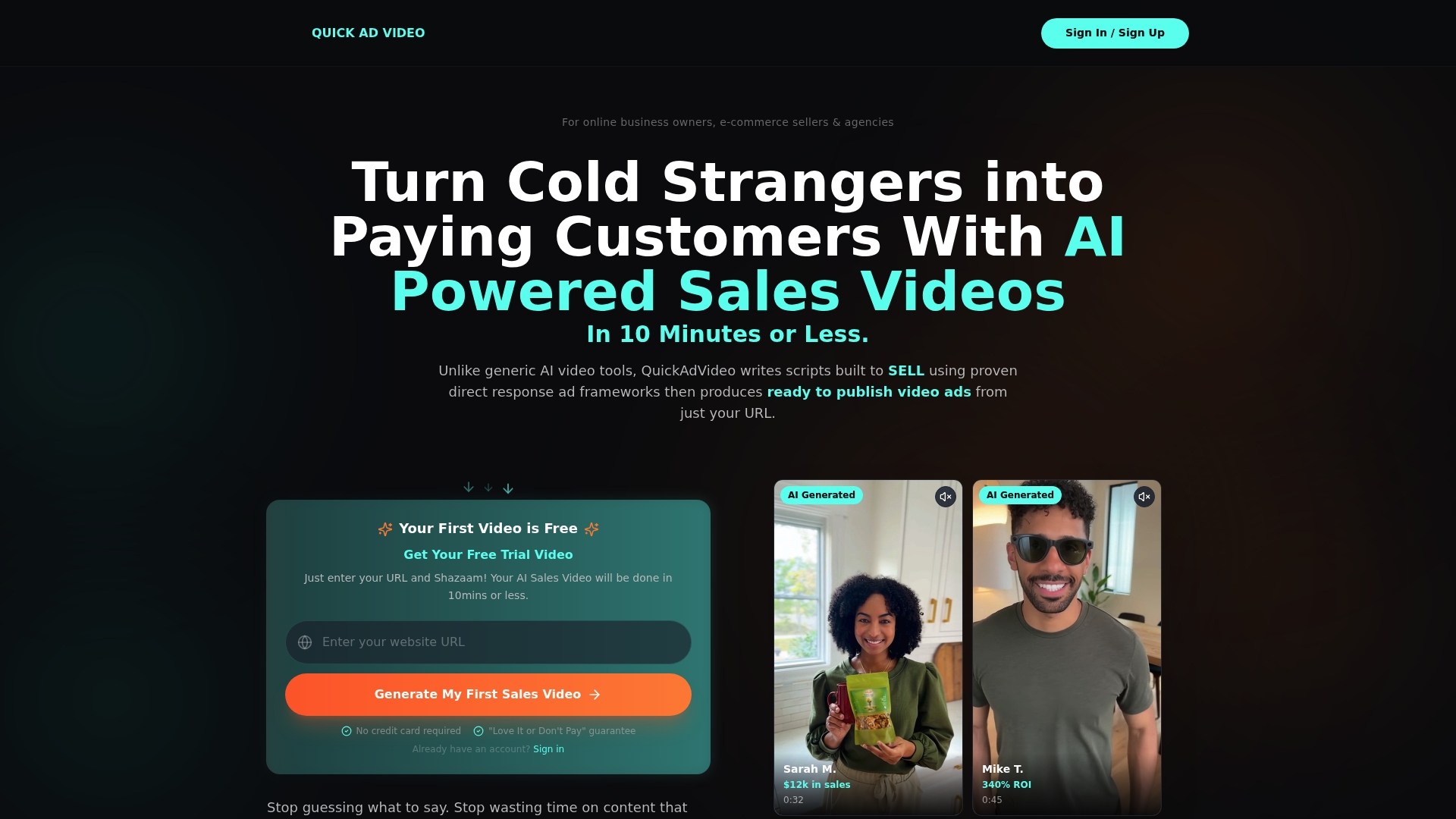
QuickAdVideo is built specifically for e-commerce sellers, dropshippers, and marketing agencies who need high-converting sales videos without the production overhead. Paste your product URL, choose your format, and get a professionally scripted, AI-generated video in minutes. From UGC-style social clips to cinematic product demos and viral story formats, the platform covers every format your marketing calendar requires. You can explore AI video models to find the format that fits your campaign goal, whether that is a product launch, a seasonal sale, or a retargeting ad. The combination of direct response AI scripting and fast production gives your team the volume advantage without sacrificing the quality your brand needs.
Frequently asked questions
Why is AI video important for e-commerce marketing?
AI video lowers production costs and allows e-commerce marketers to create personalized, high-converting sales videos at scale, with landing pages with video converting at 86% higher rates than text-only pages.
Can AI-generated videos replace traditional video production?
AI video enhances speed and scale but should be combined with human review and creativity, since AI scripts require expert review to avoid inaccuracies that affect credibility and brand trust.
How much can AI video improve conversion rates?
Personalized AI videos have been shown to lift conversions by up to 40%, and Orum’s AI videos achieved a 36% conversion rate with 523% higher click-through rates compared to previous campaigns.
What are common pitfalls when using AI for video marketing?
Relying solely on AI without human oversight leads to generic or inaccurate content that harms brand trust, and 72% of marketing teams require human review before publishing AI-generated video to protect quality.
How do I get started with AI video for my e-commerce business?
Start by selecting AI tools aligned with your marketing goals, repurpose existing high-performing content into video scripts, add a human review step for accuracy, and focus initial output on personalized product demos for your top-selling items.
Recommended
Related Posts

Why Use Templates for Video Ads: Scale Smarter
Discover why use templates for video ads to streamline production. Boost efficiency and scale your campaigns without losing creativity!

The Role of Data-Driven Video Ads in Boosting ROI
Discover the role of data-driven video ads in boosting ROI. Learn how analytics enhance engagement, optimize campaigns, and drive results.

Create Persuasive Video Ads Workflow That Converts
Learn how to create persuasive video ads workflow that transforms your ideas into optimized, high-converting campaigns. Get started today!