
Viral video strategies that drive real e-commerce growth
QuickAdVideo Team
Author
You spend hours producing a video, hit publish, and watch it stall at a few hundred views while a competitor’s shaky smartphone clip explodes across TikTok and fills their cart. That frustration is more common than you think, and it points to a real gap: most e-commerce sellers treat viral video as a lottery ticket instead of a repeatable system. This guide breaks down the mechanics, the prep, the execution, and the conversion strategy you need to turn video from a gamble into a predictable growth engine.
Table of Contents
- What makes a video go viral in e-commerce?
- Essential prep: Set goals, know your audience, choose your platforms
- Step-by-step process: Craft, launch, and amplify for viral spread
- Turn virality into growth: What to do when your video takes off
- Common mistakes and how to measure what matters
- A practical perspective: What most viral video guides don’t tell you
- Ready to put viral video strategy into action?
- Frequently asked questions
Key Takeaways
| Point | Details |
|---|---|
| Virality boosts growth | A structured approach to viral video can deliver powerful results for e-commerce businesses. |
| Prep is essential | Goal-setting, audience understanding, and platform targeting lay the foundation for viral success. |
| Conversion is the goal | Turning viral traffic into sales requires proactive capture and post-virality systems, not just attention. |
| Measure what matters | Retention and conversions—not raw view counts—drive real business impact. |
| Consistency beats luck | Building repeatable systems and consistent value leads to sustainable growth beyond one-hit wonders. |
What makes a video go viral in e-commerce?
Understanding viral mechanics is the foundation of everything else. Virality is not a single event. It’s a measurable pattern of content spreading faster than it would through organic growth alone, and the triggers look different on every platform.
The key ingredients fall into a few predictable categories. First, there’s the hook. You need a reason for someone to keep watching within the opening two to three seconds. Second, the algorithm has to favor your content: early engagement signals like comments, shares, and replays tell TikTok, Instagram, or YouTube Shorts to push the video to more feeds. Third, your content needs a clear call to action, especially in e-commerce where a view without a click is just brand awareness, not revenue.
Here’s the core tension: short-form video dominates social media spending and performance priorities across platforms, but most brands optimize for reach instead of conversion. That creates an opening for sellers who understand that going viral means nothing if your product page can’t close the deal. Buffer’s TikTok research confirms there is no universal definition of “viral,” but the tactics that work consistently include strong hooks, trend alignment, niche pattern replication, and sharp CTAs. Pair that with what e-commerce brands learn the hard way: you have to engineer virality proactively, not just hope for it, using early retention as the signal and a post-virality capture plan as the goal.
| Viral trigger | What it does for reach | Conversion booster equivalent |
|---|---|---|
| Attention-grabbing hook | Stops the scroll | Opens with problem the buyer faces |
| Trending sound or format | Boosts algorithmic push | Uses social proof within the trend |
| Pattern interrupt (surprise) | Earns the rewatch | Leads directly to product demo |
| Emotional storytelling | Drives shares | Ends with urgency or offer |
| Short runtime (under 60s) | Maximizes completion rate | Places CTA in the final 5 seconds |
Key signals to watch on any platform:
- First-second retention rate (are people staying past the hook?)
- Completion rate (are they watching all the way through?)
- Share-to-view ratio (are they telling others?)
- Click-through rate on embedded CTAs or links in bio
For creative video content ideas that combine these triggers, study your best-performing organic posts first. They already contain signal.
Pro Tip: Set up a split-test for your first three seconds. Record two or three different hooks for the same video and post them as separate uploads. The version with the highest 3-second retention rate is your winner. Use that format as your template going forward.
Essential prep: Set goals, know your audience, choose your platforms
Understanding viral mechanics is one thing. Laying the right foundation is what makes them work for you.
Before you film a single frame, you need to answer three questions: What do you want viewers to do? Who are you talking to? Where do they spend their attention? According to a solid video marketing strategy, goal setting, audience selection, platform choice, and defined metrics should all be locked in before production starts, not after.

| Business objective | Best platform fit | Primary metric |
|---|---|---|
| Direct product sales | TikTok Shop, Instagram Reels | Add-to-cart rate, conversion rate |
| Brand awareness | YouTube Shorts, TikTok | Reach, share count |
| Email/lead capture | YouTube, Facebook | Click-through, opt-in rate |
| Community building | Instagram, Facebook Groups | Comments, follower growth |
| Retargeting existing buyers | Facebook, YouTube | ROAS, repeat purchase rate |
Here’s a critical pre-production checklist to run through before every video:
- Define your single measurable goal for this video (sales, sign-ups, or awareness).
- Identify the top three pain points of your ideal customer related to this product.
- Choose one primary platform based on where your target audience is most active.
- Research the top three trending formats or sounds on that platform this week.
- Write your CTA before you write your hook. Knowing where you want people to go shapes everything else.
- Map out what happens after the click: landing page, product page, or lead magnet.
Skipping this prep is why most videos underperform. A good video marketing ROI strategy starts with this kind of upfront thinking, and it pairs naturally with crafting effective video messaging that speaks directly to a buyer rather than broadcasting to everyone.
Pro Tip: Build a one-page “video brief” for each campaign. Include the goal, target viewer, platform, hook concept, and CTA. If you can’t fill it out in under 10 minutes, your concept isn’t focused enough yet.
Step-by-step process: Craft, launch, and amplify for viral spread
Once your targets are clear and platforms chosen, here’s how to execute at a high level and maximize your odds of virality.
Following a structured production process removes the guesswork. Here’s a reliable sequence:
- Concept development. Start with one core message tied to a customer pain point or result. The tighter the concept, the more shareable the video.
- Storyboard. Sketch out the shot sequence. Identify where the hook lands, where the product is shown, and where the CTA appears. Even a basic thumbnail sketch beats winging it.
- Film. Prioritize good lighting and clear audio over cinematic equipment. Mobile cameras in 2026 shoot crisp vertical video. Authenticity often outperforms production polish on social platforms.
- Edit for retention. Cut anything that doesn’t advance the story. Jump cuts, on-screen captions, and pattern interrupts keep viewers watching. The edit is where most viral videos are actually made.
- Launch with strategy. Post at peak hours for your audience, use platform-native features (stickers, trending sounds, polls), and seed engagement by responding to comments within the first hour of going live.
- Amplify. Cross-post adapted versions to secondary platforms. Share in relevant communities. Ask micro-influencers in your niche to engage authentically.
The hook is where almost every drop-off happens. Buffer’s viral content research emphasizes that hooks, trend alignment, and clear CTAs are the mechanical levers you can actually control, even when organic spread is unpredictable.
Virality is not the end state. It’s the beginning of a conversion window. The brands that win are the ones ready to capture traffic, not just celebrate it.
That mindset shift changes everything. You’re not trying to go viral for the sake of views. You’re trying to build a moment where thousands of potential buyers land on your offer at the same time.
Consider interactive video ad formats as an amplification tool. Shoppable elements, polls, and clickable product tags turn passive viewers into active buyers without requiring them to leave the video experience.
Pro Tip: Batch produce 10 to 15 videos in a single filming session. Vary hooks, CTAs, and formats. Then schedule 3 to 5 posts per week to stay consistently in front of platform algorithms. Consistency compounds.
Turn virality into growth: What to do when your video takes off
Virality can create explosive growth if you’re ready to seize the moment. Here’s how to make sure your effort translates to business wins.
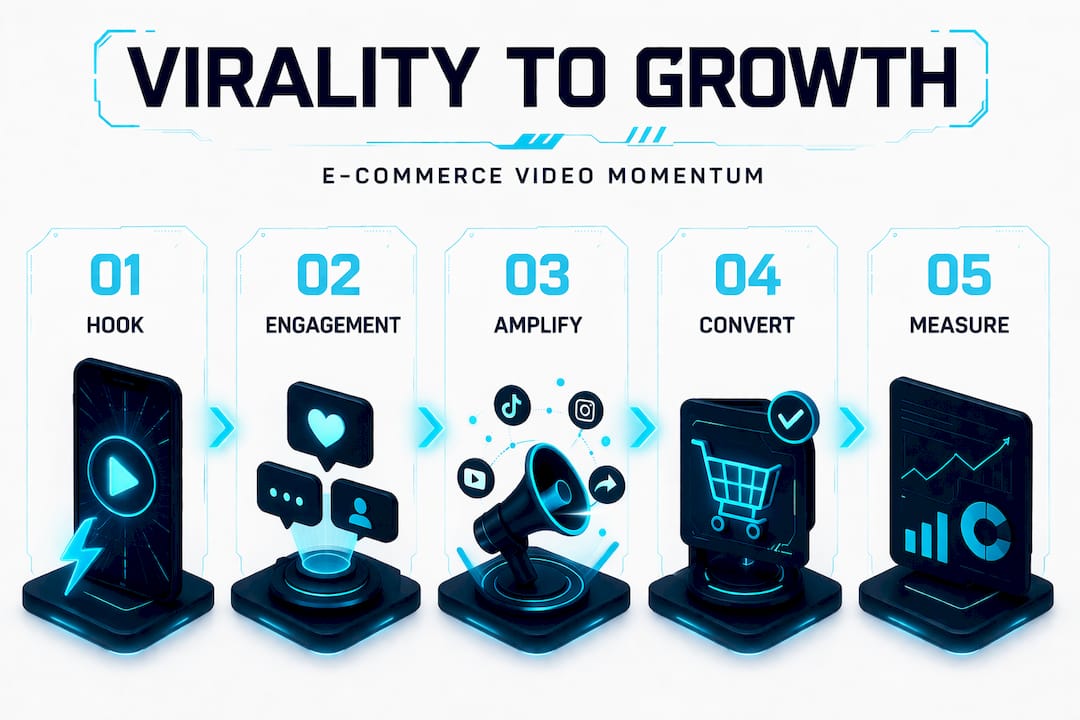
When a video starts spreading, most sellers celebrate instead of execute. The conversion window is short. Attention moves on within 48 to 72 hours in most cases. Your operational response in that window determines whether the viral moment becomes a revenue event or just a vanity metric.
Here’s what to do immediately when a video gains serious traction:
- Check your inventory and server capacity. A viral video sending 50,000 people to a product page that loads slowly will cost you real sales.
- Update your link in bio or pinned CTA. Drive viral traffic to a focused landing page, not your homepage.
- Activate retargeting ads. Anyone who visited but didn’t buy is now warm. Retarget them within 24 hours while the brand memory is fresh.
- Engage every comment quickly. Comments signal continued relevance to the algorithm. Engagement keeps the video in rotation longer.
- Launch a follow-up video. Capture the new audience segment with a second piece of content that deepens the story or shows a different product benefit.
For measuring the actual business impact, the K-factor framework is useful. K-factor models virality as infectivity times conversion, meaning the number of people each viewer refers multiplied by the percentage of referrals who convert. A K-factor above 1.0 means your content is growing on its own. Under 1.0, you’re growing, but relying on fresh pushes.
Understanding why video drives trust and actual sales helps you build videos that convert at every stage of this process, not just the top of the funnel.
Pro Tip: Set up automated email or SMS follow-ups that trigger within minutes of a visitor landing from your viral video. The response rate on immediate follow-up beats cold outreach by a wide margin. Preload those sequences before you launch, not after the surge hits.
Common mistakes and how to measure what matters
Even with the best tactics, mistakes are easy. Let’s cover how to maximize your results and avoid wasted effort.
The biggest mistake e-commerce sellers make is treating view count as the primary goal. Neil Patel’s research cited in Entrepreneur makes it clear: virality alone doesn’t guarantee long-term brand awareness, trust, or conversions. A video with 2 million views and zero add-to-carts is a marketing failure dressed up as a success story.
The metrics that actually move your business:
- Watch retention rate: Are viewers getting to your CTA? If 70% drop before the 15-second mark, your hook isn’t working.
- Shares per view: High shares mean the content resonates strongly and has organic distribution potential.
- Click-through rate: How many viewers take the next step? Low CTR means the CTA or landing page has friction.
- Conversion rate: Of the clicks, how many result in purchases or sign-ups? This is your real revenue metric.
- Return on ad spend (ROAS): If you’re promoting a video with paid spend, ROAS tells you whether the video is actually pulling its weight.
Common mistakes beyond obsessing over views:
- Ignoring platform nuances. A video that performs on TikTok may need different pacing, captions, and audio to land on Instagram Reels or YouTube Shorts.
- Lacking a follow-up system. One viral video without a retention plan sends people into your funnel with no one to catch them.
- Not tracking ROI from the start. Without baseline metrics, you can’t measure improvement over time.
- Copying competitors’ viral formats without understanding their audience. What works for a lifestyle brand won’t automatically translate to a technical product demo.
Buffer’s guidance reinforces this: set your own thresholds per platform based on your analytics, not borrowed benchmarks. The benefits of AI video content creation include faster iteration cycles, which means you can test more variables and find your own performance baseline faster.
Consider reading more about why video ads boost sales ROI to align your measurement framework with revenue goals from the start.
Pro Tip: Before your first campaign, record your baseline metrics for 30 days: average views, average engagement rate, and conversion rate from existing traffic. Every new video campaign should be benchmarked against that baseline, not against someone else’s viral success.
A practical perspective: What most viral video guides don’t tell you
Most viral video guides sell the dream of overnight success. One clip, one million views, one flood of orders. That narrative is seductive and almost always misleading.
The real engine behind consistent video growth is not a single viral hit. It’s the accumulation of data points from dozens of posts, each one teaching you something about your audience’s actual behavior. Every video you release is an experiment, and the brands winning in 2026 are the ones who treat it that way deliberately.
Here’s what years of watching real e-commerce campaigns play out actually reveals: the sellers who grow sustainably are not the ones who got lucky once. They’re the ones who built a testing rhythm. Three to five videos per week, each with a slightly different hook, CTA variation, or product angle. They analyze what stuck, double down on the pattern, and discard what didn’t. Virality, when it happens, is a byproduct of that consistency, not the goal itself.
There’s also a dangerous mindset that we see constantly: sellers who go viral once, get addicted to the spike, and spend the next six months chasing that high instead of building audience compounding. One viral moment gives you attention. A system gives you customers. Those are fundamentally different outcomes.
The other thing most guides skip: virality is meaningless without brand coherence. If someone watches your video, loves it, clicks through, and lands on a product page that feels disconnected from what they just saw, you’ve broken the experience. Cinematic videos for marketing can help bridge that gap by maintaining visual and emotional continuity from the video all the way to the sale.
Treat every viral moment as data. Ask yourself: who shared it, why, and what did they do next? Those answers shape your next ten videos better than any trend-chasing guide ever will.
Ready to put viral video strategy into action?
The strategies in this guide work, and the fastest way to implement them at scale is with the right tools behind you.

QuickAdVideo is built specifically for e-commerce sellers and online entrepreneurs who want to create high-converting video content without the production headache. Paste in your product URL and the platform generates a persuasive, direct-response sales video in minutes. No camera setup, no editing software, no creative block. Explore the full range of AI video generator models, including UGC, cinematic, and viral story formats designed for TikTok, Instagram, YouTube, and Facebook. You can also use the AI video editor to fine-tune hooks, CTAs, and pacing for maximum retention. The difference between experimenting and actually scaling is having a system that produces content consistently.
Frequently asked questions
How many views are considered viral for a business video?
There’s no universal threshold, but 1 million views is a common reference point. Buffer’s TikTok research confirms “viral” has no fixed definition, so set your own outcome benchmarks based on conversions, not just view counts.
Which video platforms work best for viral marketing in e-commerce?
Short-form platforms like TikTok, Instagram Reels, and YouTube Shorts lead the field. Short-form video continues to dominate social media spending and performance priorities across industries.
What’s the most important metric to track in viral video campaigns?
Watch retention and conversion rate together give you the clearest picture. Early retention combined with a conversion capture plan is what separates viral video that drives revenue from viral video that just drives traffic.
Should I chase every video trend to go viral?
Only when a trend aligns authentically with your brand and audience. Post-virality behavior matters more than the spike itself, so prioritize content that converts new viewers rather than content that just capitalizes on the moment.
How often should I post videos to maximize my chances of viral success?
Aim for 3 to 5 posts per week to stay visible and maintain algorithmic momentum. Consistent, valuable short-form content posted at frequency outperforms a single high-effort post every time.
Recommended
- Boost E-Commerce Sales with Creative Video Content Ideas | QuickAdVideo Blog
- Video marketing for e-commerce: ROI and strategies 2026 | QuickAdVideo Blog
- Why invest in video ads? Boost sales and ROI with AI | QuickAdVideo Blog
- Interactive video ads: boost engagement and conversions | QuickAdVideo Blog
Related Posts

Why Use Templates for Video Ads: Scale Smarter
Discover why use templates for video ads to streamline production. Boost efficiency and scale your campaigns without losing creativity!

The Role of Data-Driven Video Ads in Boosting ROI
Discover the role of data-driven video ads in boosting ROI. Learn how analytics enhance engagement, optimize campaigns, and drive results.

Create Persuasive Video Ads Workflow That Converts
Learn how to create persuasive video ads workflow that transforms your ideas into optimized, high-converting campaigns. Get started today!