
Viral video marketing: how e-commerce brands win big
QuickAdVideo Team
Author
Most e-commerce sellers assume going viral is like getting struck by lightning. You either get lucky or you don’t. But viral video marketing is actually a discipline rooted in psychology, strategic distribution, and deliberate content design. The brands winning big on TikTok and Instagram aren’t just lucky. They’re applying proven frameworks that make people want to share. This article breaks down exactly how virality works, what you can actually control, and how to use these principles to drive real sales for your e-commerce business.
Table of Contents
- Defining viral video marketing
- Why do videos go viral? The psychology and principles
- Video virality: metrics, myths, and what brands control
- How viral videos drive e-commerce sales and trust
- Common pitfalls and crisis moments in viral campaigns
- Perspective: The uncomfortable truth about viral video marketing
- Ready to launch your own viral video campaign?
- Frequently asked questions
Key Takeaways
| Point | Details |
|---|---|
| Viral video defined | Viral video marketing is about engineering authentic sharing for rapid reach, not luck. |
| Human drivers matter | Emotion, utility, and storytelling drive virality more than platform tactics. |
| Brands control strategy | You can’t guarantee virality, but you can optimize content for shareability and impact. |
| Trust boosts sales | Useful and entertaining videos build trust and increase e-commerce sales. |
| Prepare for downside | Rapid attention can be risky, so always plan for crisis response when aiming for viral campaigns. |
Defining viral video marketing
Viral video marketing is not just “posting a video and hoping for the best.” It’s a focused strategy built around creating content so compelling that viewers feel driven to share it with others. That organic sharing is the engine. Instead of paying for every impression, you engineer content that your audience essentially distributes for you.
“Viral video marketing is designed to spread organically through digital word-of-mouth, aiming for rapid peer-to-peer sharing rather than relying primarily on paid distribution.”
The key distinction between viral video marketing and general video marketing is intent and design. A standard product video might explain features well. A viral video makes someone stop scrolling, feel something, and immediately send it to a friend. That emotional trigger is what separates the two.
For e-commerce entrepreneurs, the benefits of cracking this approach are significant:
- Exponential reach at a fraction of the cost: One well-designed video can reach millions without a massive ad budget behind it.
- Brand authenticity: Organic shares carry social proof that paid ads simply can’t replicate.
- Compounding audience growth: Every new person who discovers your brand through a shared video becomes a potential repeat customer.
- Faster trust-building: When a friend shares your video, their endorsement transfers to your brand automatically.
Understanding viral e-commerce video strategies is the first step toward making this work systematically. And measuring what comes from that effort requires understanding video marketing ROI for e-commerce so you can refine over time.
Why do videos go viral? The psychology and principles
Once the concept is clear, let’s uncover the mechanics behind why some videos catch fire online while others disappear into the void.
The most useful framework for understanding virality comes from Jonah Berger’s STEPPS model. Engineering shareability using these psychological drivers gives you a repeatable system instead of a guessing game. Here’s how each element maps to e-commerce video content:
| STEPPS principle | What it means | Practical video example |
|---|---|---|
| Social currency | Makes the viewer look good for sharing | “This brand ships in 24 hours? No way.” Surprise-based reveals |
| Triggers | Content linked to everyday moments or habits | Cooking product shown during mealtime prep |
| Emotion | Evokes joy, awe, surprise, or even mild outrage | Heartfelt unboxing or unexpected product humor |
| Public | Visible behavior others can imitate | “Look what arrived today” hauls or challenges |
| Practical value | Teaches something genuinely useful | “3 ways to store this product you didn’t know” |
| Stories | Narrative arc with conflict and resolution | Founder story or problem-solution customer journey |
Beyond the STEPPS model, virality depends on how viewers receive the content, particularly through relatability, authenticity, humor, emotion, usefulness, and timing. Platform tactics like optimal posting times or trending audio matter less than the core psychological resonance of the content itself.
This is a critical insight. So many sellers obsess over the technical side: when to post, which hashtags to use, what format performs best on which platform. Those details matter, but they don’t save weak content. A video that hits the right emotional note at the wrong time still outperforms a perfectly timed video that feels flat.
Pro Tip: Design your e-commerce videos around one dominant emotion or one genuinely useful insight rather than trying to cram in every product feature. Single-focus videos are more shareable because they’re easier to contextualize when someone sends them to a friend.
For sellers running paid campaigns alongside organic content, exploring interactive video ads for engagement is worth your time because interactive formats naturally amplify STEPPS principles by making the viewer an active participant.
Video virality: metrics, myths, and what brands control
Understanding the psychological side is powerful, but you also need to be honest about what you actually control as a marketer.
Viral is a goal, not a guarantee. Marketers can optimize content for sharing, but they can’t fully control the unpredictable combination of audience mood, timing, and algorithmic chance that causes something to explode. Accepting this saves you from chasing vanity metrics and keeps your strategy grounded.
Here’s what you can control:
- The emotional hook in your first three seconds
- The clarity and quality of your storytelling arc
- The shareability design: captions, formats, subtitles for silent viewing
- The platform distribution setup, including posting time windows and initial seeding
- Your response plan once a video starts gaining traction
Here’s what you cannot control:
- Platform algorithm changes that deprioritize your content overnight
- Whether your target audience is in a sharing mood that week
- How an unintended audience might interpret or repurpose your video
- The timing overlap with unrelated news events that shift attention away
And here’s a reality check from short-form video research: not all engagement-driving variables, like posting frequency or trending audio, are consistent predictors of virality. Psychological fundamentals matter more than any single platform tactic.
Essential metrics to track for viral e-commerce campaigns:
| Metric | What it tells you | Why it matters for e-commerce |
|---|---|---|
| Shares and saves | How compelled viewers feel to spread or revisit content | Direct indicator of organic amplification |
| Watch-through rate | How long viewers actually stay | Low rate = hook or pacing problem |
| Engagement rate | Comments and interactions relative to views | High engagement = strong resonance |
| Click-to-site rate | How many viewers move to your store | The bridge between content and conversions |
| Revenue attributed | Direct or assisted sales from the video | The real bottom-line metric |
Sellers who explore cinematic videos in marketing often find that higher production feel paired with strong psychology produces better watch-through rates, even on casual platforms like TikTok.
How viral videos drive e-commerce sales and trust
Once you understand what you can influence, let’s discuss how viral videos translate to tangible business results.
The connection between viral content and actual purchases isn’t just anecdotal. Short video content can increase purchase intention, and this effect is partly mediated by consumer trust. In plain terms: videos that are useful or entertaining don’t just get views. They build the psychological safety customers need to click “buy.”

This matters more for e-commerce than almost any other industry. Customers buying online can’t touch the product. They can’t ask a salesperson questions. They rely on whatever digital signals are available to judge whether a brand is legitimate and whether the product delivers on its promise. A well-crafted viral video addresses all of that instantly.
Here’s how viral content builds trust step by step:
- Practical demonstrations show the product solving a real problem, removing the buyer’s fear that it won’t work
- Authentic user reactions (even scripted UGC) simulate the social proof of a friend recommendation
- Humor and relatability lower psychological defenses and create positive brand associations
- Story-driven content creates emotional investment in the brand before any sales pitch begins
Pro Tip: Don’t design every video for the purchase click. Design some for the save and the share. When someone saves your video to rewatch, or sends it to a friend, you’ve earned a warm lead with no additional ad spend. These micro-conversions compound over time into lasting brand authority.
Sellers focused on conversion optimization will find that understanding video messaging for conversions and using creative video content for sales gives them a structural advantage over competitors still relying on static product images.
Common pitfalls and crisis moments in viral campaigns
Beyond benefits, every e-commerce seller should be aware of the potential downsides and how to manage unexpected virality.
Virality is not always a gift. Sometimes a video spreads in ways you didn’t intend, attracting audiences who misinterpret the message or use it as material for criticism. Viral campaigns carry credibility risk and possible backlash, so assuming that any attention is good attention is a dangerous mindset.
“The moment your content reaches an audience you didn’t design it for, you’ve lost narrative control. What you do next determines whether the virality helps or hurts your brand.”
The most common pitfalls e-commerce sellers face include:
- Brand misinterpretation: A humor-based video gets taken out of context and signals the wrong values
- Comment section chaos: High visibility attracts trolls and negative commentary that discourages real buyers
- Stock or fulfillment crises: A video blows up and you can’t fulfill the sudden demand spike, damaging your reputation
- Competitor exploitation: Viral attention puts your product in front of competing brands who replicate or undercut you fast
Best practices for managing the unexpected side of virality:
- Set up real-time alerts for your brand mentions across all major platforms
- Prepare three response templates in advance: one for positive virality, one for misinterpretation, one for genuine backlash
- Assign a team member or agency contact to monitor comments during the first 48 hours of any campaign launch
- Have a clear internal decision tree for when to engage publicly and when to let commentary run its course
- Never delete comments in bulk without a documented reason. It often makes situations worse
Brands leaning on AI video content creation have an advantage here because they can produce response content or follow-up videos quickly without scrambling for creative resources.
Perspective: The uncomfortable truth about viral video marketing
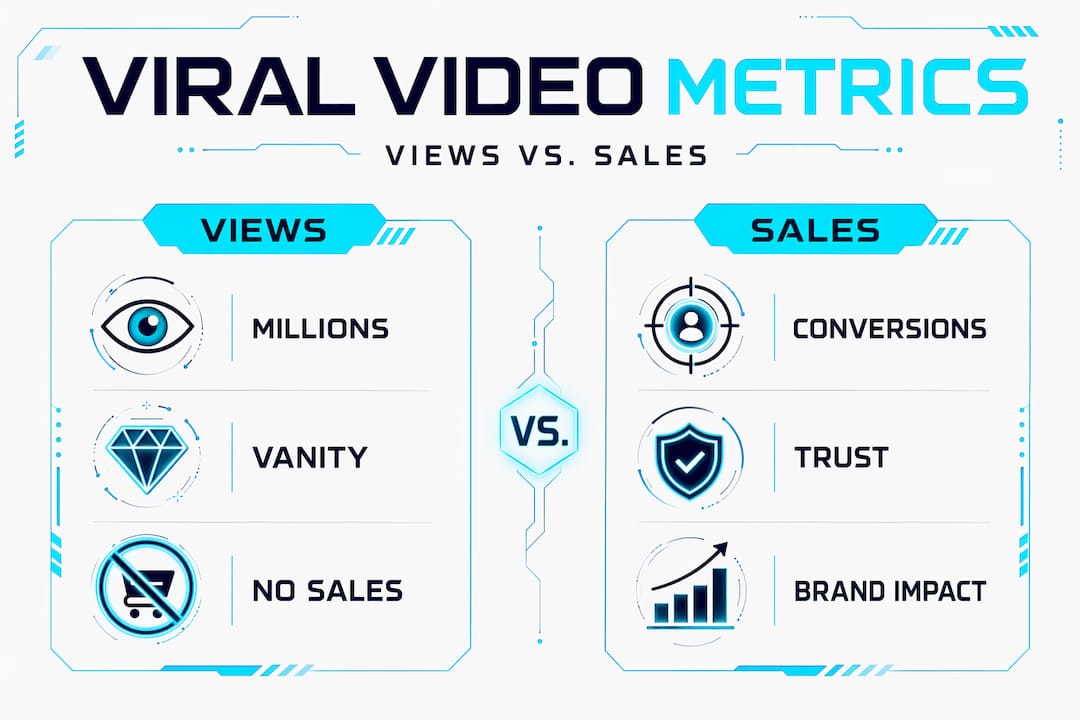
Here’s the take most marketing articles won’t give you: the obsession with going viral is quietly hurting a lot of e-commerce brands. They’re producing content designed for views instead of content designed for buyers. Those are very different briefs, and chasing the wrong one burns budget and energy without moving revenue.
The honest reality is that most videos don’t go viral. The percentage of intentionally produced marketing videos that achieve true exponential sharing is extremely small. Waiting for that lightning strike while neglecting consistent, strategic video output is a losing game. Brands that build durable video marketing programs, publishing content regularly that delivers practical value or genuine entertainment, consistently outperform brands that occasionally swing for virality and get frustrated when it doesn’t land.
There’s also the vanity metric trap. A video with 2 million views that drives no sales is not a success. A video with 40,000 views that converts 3% of viewers into buyers is a serious business asset. Virality and business impact are not the same thing, and conflating them leads to misallocated resources and confused teams.
The right mindset is to engineer shareable content as a consistent practice, not a one-off moonshot. Use the STEPPS framework. Study your best-performing content. Iterate. When one video does catch fire, your infrastructure is already in place to capture the demand. And if nothing goes viral this quarter, you still built a library of trust-generating content that compounds over time.
Every dollar spent investing in video ads with clear psychological design works harder than a budget chasing trending audio and arbitrary platform hacks.
Ready to launch your own viral video campaign?
Putting these principles into practice takes the right content tools, and that’s where QuickAdVideo closes the gap for e-commerce sellers. You don’t need a video editor, a production crew, or weeks of creative development to produce content built on proven viral frameworks.

QuickAdVideo’s AI-powered platform lets you paste your product URL and generate professional, psychologically optimized sales videos in minutes. From UGC-style clips to cinematic formats, you can see viral video templates designed specifically for product launches, social proof campaigns, and platform-native storytelling. If you’re ready to move beyond static ads, explore the full range of AI advertising solutions and start producing content that’s built to be shared, saved, and sold.
Frequently asked questions
What makes a video go viral versus just successful?
Viral videos spread rapidly through peer-to-peer sharing driven by emotional, relatable, or timely content, whereas successful videos may perform well against standard benchmarks without achieving the same organic exponential reach that defines true virality.
Can you guarantee a video will go viral?
No. Virality is a goal, not a guarantee, and while brands can optimize content for sharing, they can’t control unpredictable audience factors, platform algorithm shifts, or timing variables.
How does viral video marketing impact e-commerce sales?
Viral videos drive sales by building consumer trust and generating high-intent traffic. Research shows that usefulness and entertainment increase purchase intentions, partly because trust serves as the mediating bridge between content enjoyment and buying action.
What are the risks of viral video marketing?
Unexpected viral attention can attract backlash, misinterpretation, or audiences outside your target market, which is why viral campaigns carry credibility risk and require a prepared crisis response plan before any major campaign launches.
Recommended
- Viral video strategies that drive real e-commerce growth | QuickAdVideo Blog
- Video marketing for e-commerce: ROI and strategies 2026 | QuickAdVideo Blog
- Boost E-Commerce Sales with Creative Video Content Ideas | QuickAdVideo Blog
- Why invest in video ads? Boost sales and ROI with AI | QuickAdVideo Blog
Related Posts

Why Use Templates for Video Ads: Scale Smarter
Discover why use templates for video ads to streamline production. Boost efficiency and scale your campaigns without losing creativity!

The Role of Data-Driven Video Ads in Boosting ROI
Discover the role of data-driven video ads in boosting ROI. Learn how analytics enhance engagement, optimize campaigns, and drive results.

Create Persuasive Video Ads Workflow That Converts
Learn how to create persuasive video ads workflow that transforms your ideas into optimized, high-converting campaigns. Get started today!