
Video marketing for e-commerce: ROI and strategies 2026
QuickAdVideo Team
Author
Video has moved from a nice-to-have to a non-negotiable in e-commerce marketing. Brands that still rely primarily on static images and text are watching their competitors pull ahead with content that converts faster, builds trust quicker, and scales more efficiently. 91% of businesses now use video as a core marketing tool in 2026, with 82 to 93% reporting positive ROI. Whether you run a Shopify store, manage paid ads for clients, or are scaling a dropshipping operation, understanding how to use video strategically is no longer optional. This article breaks down the formats, frameworks, and emerging trends that are actually moving the needle.
Table of Contents
- Why video dominates digital marketing in 2026
- Video formats that drive e-commerce results
- Best practices for creating and distributing marketing videos
- Emerging trends: Short-form, AI and human creativity
- What most digital marketers get wrong about video ROI
- Accelerate your video marketing results with AI solutions
- Frequently asked questions
Key Takeaways
| Point | Details |
|---|---|
| Video maximizes ROI | Businesses using video see higher conversions, increased web traffic, and a measurable sales lift. |
| Short-form leads results | Short-form content is preferred by consumers and delivers the top ROI for most marketers today. |
| Creative velocity matters | Refresh your video creative regularly and favor authentic, rapid production over perfection. |
| AI plus human is best | The winning formula is scalable AI video creation enhanced by genuine human input for authenticity. |
Why video dominates digital marketing in 2026
The numbers tell a story that is hard to ignore. Global video ad spend has reached $236 billion, landing page conversions can increase by up to 80% with video, and websites using video see 41% more traffic. These are not marginal gains. They represent a fundamental shift in how buyers research and purchase online.
Why does video resonate so strongly with today’s online shoppers? It mirrors the in-store experience. When a customer can see a product in motion, hear someone explain its benefits, or watch a real person unbox it, the psychological barrier to purchase drops significantly. Text and images ask buyers to imagine. Video shows them.
One of the most persistent myths is that video is only for big brands with big budgets. That was true a decade ago. Today, a well-scripted 30-second clip shot on a smartphone can outperform a polished $10,000 production. Another common misconception is that video is technically complex. AI-powered tools have made creation accessible to anyone, regardless of editing skills or camera experience.
Short-form video is now the single highest-ROI format for 77% of marketers. If you are not producing short-form content consistently, you are leaving conversions on the table.
Here is why marketers are prioritizing video above other content types:
- Faster trust building: Viewers form impressions in seconds, and video accelerates credibility.
- Higher retention: People retain 95% of a message delivered via video versus 10% from text.
- Algorithm preference: TikTok, Instagram, and YouTube all reward video content with broader organic reach.
- Mobile alignment: Video is the native format for mobile browsing, where most e-commerce traffic now originates.
- Versatility: One video can be repurposed across ads, product pages, email campaigns, and social media.
For a deeper look at what is trending on social platforms right now, check out 2026 social video trends to stay ahead of algorithm changes.
| Metric | With video | Without video |
|---|---|---|
| Landing page conversion lift | Up to 80% | Baseline |
| Website traffic increase | 41% more | Baseline |
| Email click-through rate | 200-300% higher | Baseline |
| Time on page | Significantly longer | Shorter |
Video formats that drive e-commerce results
Not all video formats are created equal, and the wrong format at the wrong funnel stage can waste budget fast. Product demos, testimonials, unboxing, and how-tos boost conversions between 34 and 80% and are considered essential touchpoints across the customer journey.
Here is how each format maps to buyer intent:
| Format | Funnel stage | Primary goal | Avg. conversion impact |
|---|---|---|---|
| Product demo | Mid-funnel | Reduce hesitation | 34-50% lift |
| Customer testimonial | Bottom-funnel | Build trust | 40-72% lift |
| Unboxing video | Top to mid-funnel | Generate excitement | 30-45% lift |
| How-to or tutorial | Mid to bottom-funnel | Educate and convert | 50-80% lift |
| UGC-style ad | All stages | Authenticity and reach | Varies widely |
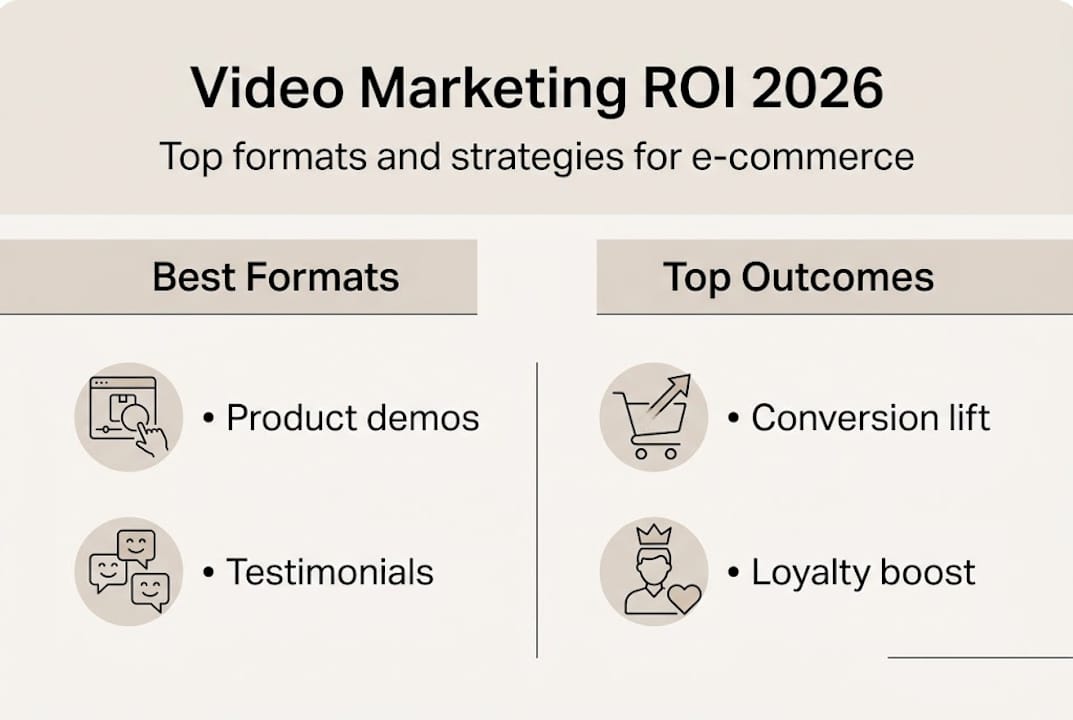
For agencies managing multiple clients, understanding the difference between UGC vs traditional video is critical for allocating production resources effectively.
Product demos work best when they focus on the problem being solved, not just the product’s features. Testimonials perform strongest when they feel unscripted. Unboxing videos tap into the psychology of anticipation and reward. How-tos build long-term SEO value while simultaneously reducing customer service inquiries.

According to HubSpot’s research on product videos, shoppers who watch product videos are significantly more likely to complete a purchase than those who do not.
Pro Tip: Match your video format to the platform’s native behavior. Testimonials and demos perform well on Facebook and YouTube where viewers are in a research mindset. UGC-style clips and unboxing videos thrive on TikTok and Instagram Reels where entertainment drives discovery.
Here is a quick-start checklist for integrating video across your e-commerce touchpoints:
- Add a 30 to 60 second product demo to your top three highest-traffic product pages.
- Collect one or two customer testimonial clips and run them as retargeting ads.
- Create a how-to video for your most commonly asked support question.
- Test an unboxing-style clip as a top-of-funnel awareness ad on TikTok or Instagram.
- Explore AI video generator options to produce multiple formats quickly without a production team.
Best practices for creating and distributing marketing videos
Having the right format is only half the equation. The strategy behind creation and distribution determines whether your videos actually generate revenue.
The foundation starts with goal clarity. Define your goals, audience personas, and content calendar before you produce a single frame. Multi-platform distribution matters too, with YouTube remaining the top platform for long-form discovery while TikTok and Instagram dominate short-form engagement. A/B testing hooks and CTAs, then measuring engagement and ROI, separates brands that scale from those that stagnate.
Here is a production planning checklist that works for both solo entrepreneurs and agency teams:
- Define one specific goal per video (awareness, click, purchase, or retention)
- Research the top three objections your target buyer has before purchasing
- Write a hook that addresses one of those objections in the first three seconds
- Script the CTA before you script the body of the video
- Optimize for mobile first: vertical format, large text overlays, captions always on
- Plan for at least three creative variations per campaign from the start
The first three seconds of your video are your entire ad. If you do not hook the viewer immediately, nothing else matters. Raw, human-feeling video consistently outperforms overly polished production in direct response campaigns.
The most common mistakes that kill video ROI are ad fatigue from running the same creative too long, skipping captions (which 85% of social videos are watched without sound), and treating video as a one-and-done asset rather than an iterative creative system.
Pro Tip: If your ad performance drops after two weeks, do not pause the campaign. Swap the creative. Refreshing just the hook or the opening five seconds can restore performance without rebuilding the entire video.
For a step-by-step breakdown of running your first campaign, the AI video ad guide walks through the full process. You can also reference this 2026 video production strategy for platform-specific distribution tactics.
Emerging trends: Short-form, AI and human creativity
The landscape is shifting fast, and the brands winning in 2026 are the ones who adapted early.
Short-form video delivers the highest ROI for 77% of marketers, is preferred by 66% of consumers, and 93% of brands report landing new customers through short-form content. These numbers explain why every major platform has reorganized its algorithm around short-form discovery.
Here is where each platform currently focuses its attention:
- TikTok: Authenticity-first, trend-driven, 15 to 60 second clips with strong hook culture
- Instagram Reels: Polished but relatable, strong for product discovery and influencer-style content
- YouTube Shorts: Growing fast, benefits from YouTube’s search infrastructure
- Facebook Reels: Older demographic, strong for retargeting and direct response
| Format | Avg. ROI rank | Best for | Consumer preference |
|---|---|---|---|
| Short-form (under 60s) | #1 for 77% of marketers | Awareness, acquisition | 66% prefer it |
| Mid-form (1 to 5 min) | #2 | Education, demos | Moderate |
| Long-form (5 min+) | #3 | B2B, tutorials | Niche audiences |
AI has fundamentally changed the production equation. What once required a videographer, editor, and copywriter can now be done in minutes with the right tool. But AI alone is not enough. The role of human creativity in scripting, tone, and emotional resonance remains irreplaceable. AI handles the speed and scale. Humans handle the nuance.
For more on how platforms are evolving, social media trends covers what is changing across TikTok, Instagram, and YouTube in real time.
Pro Tip: Do not over-produce. Authenticity beats perfection on every short-form platform. A shaky, genuine clip of a real customer reaction will almost always outperform a studio-shot product showcase in a TikTok feed. For a deeper look at why, UGC video marketing insights breaks down the psychology behind it.
What most digital marketers get wrong about video ROI
Here is the uncomfortable truth: most agencies and e-commerce brands are optimizing for the wrong thing. They obsess over production quality and underinvest in creative velocity.
The brands generating the best video ROI right now are not the ones with the biggest budgets. They are the ones producing more, testing faster, and iterating constantly. A 7 to 14 day creative refresh cycle is not a nice-to-have. It is the operational standard for any brand running paid video at scale.
AI makes this possible. You can produce five creative variations in the time it used to take to produce one. But the mistake is assuming AI removes the need for human judgment. Someone still needs to decide which angle resonates, which hook addresses the real objection, and which CTA matches the buyer’s mindset at that stage.
Done is better than perfect. In fast-moving markets, the brand that tests ten videos beats the brand that perfects one every single time.
The marketers who win treat video like a feedback loop, not a finished product. Every view, click, and skip is data. Use it. The real vs polished video debate is settled. Authentic wins. Now the question is how fast you can produce authentic content at scale.
Accelerate your video marketing results with AI solutions
Everything covered in this article points to one operational reality: the brands scaling fastest are producing more video, more often, with less friction. That is exactly what AI-powered tools are built for.
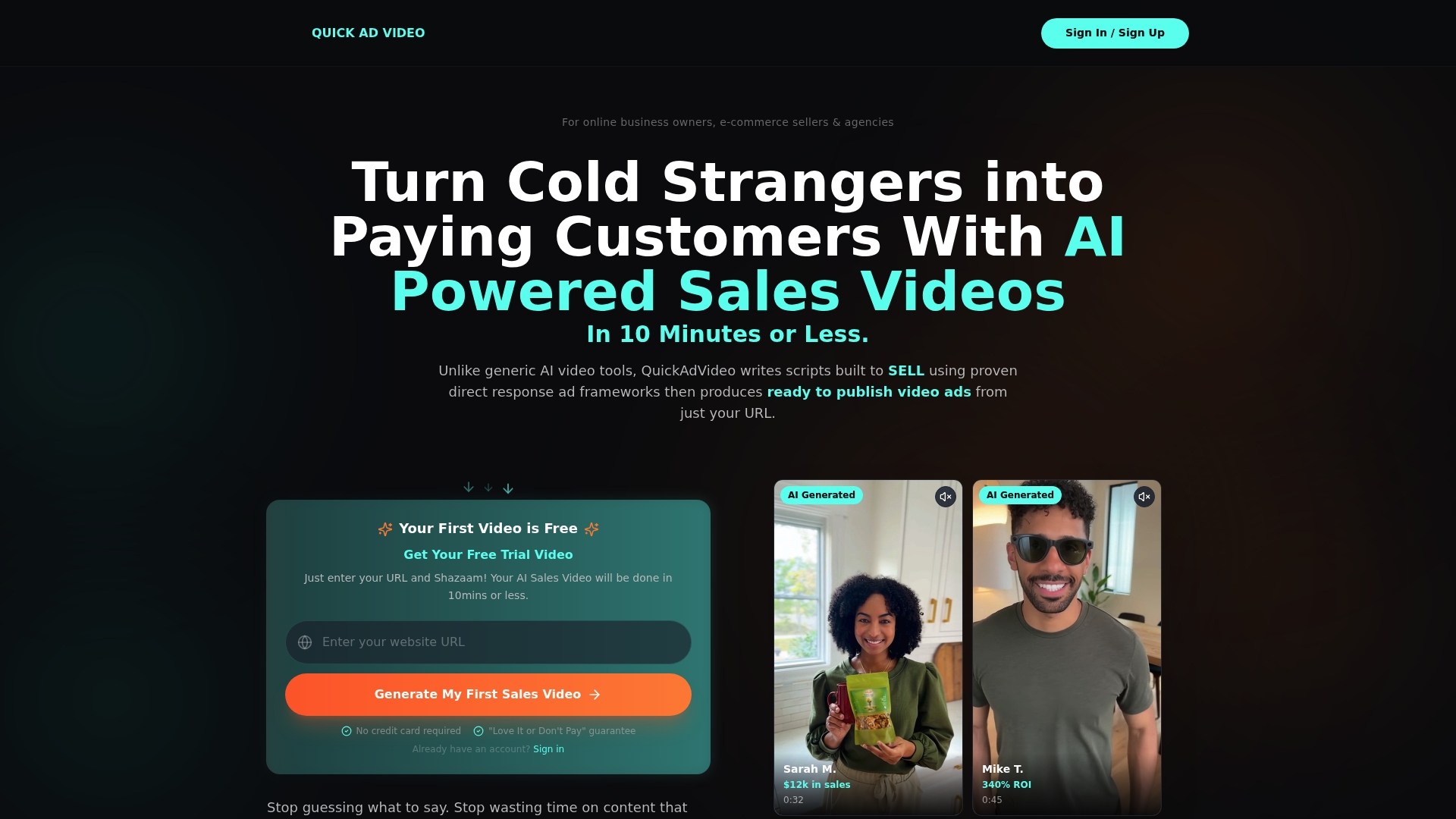
QuickAdVideo automates the production of high-converting sales videos using proven direct response frameworks. You input your product URL, and the platform generates persuasive video content in minutes, no editing skills or camera required. With multiple video generator models including UGC, cinematic, and viral story formats, you can match the right creative to the right platform and funnel stage instantly. QuickAdVideo publishes directly to TikTok, Instagram, YouTube, and Facebook, so your creative velocity stays high without adding headcount.
Frequently asked questions
What types of videos work best for e-commerce conversions?
Product demos, testimonials, unboxing videos, and how-tos consistently drive the highest conversion rates, with boosts of 34 to 80% depending on the format and placement.
How often should video ad creatives be refreshed?
To avoid ad fatigue, refresh your video creatives every 7 to 14 days for optimal performance, even if only the hook or opening seconds change.
Does short-form or long-form video perform better for e-commerce?
Short-form video delivers the highest ROI for 77% of marketers and is the top format for customer acquisition, though long-form works well for B2B or complex product education.
Should I use AI tools or hire a video team for marketing videos?
AI tools enable fast, scalable video production, but blending AI with human input produces the most authentic and effective marketing videos for sustained ROI.
Recommended
Related Posts

Why Use Templates for Video Ads: Scale Smarter
Discover why use templates for video ads to streamline production. Boost efficiency and scale your campaigns without losing creativity!

The Role of Data-Driven Video Ads in Boosting ROI
Discover the role of data-driven video ads in boosting ROI. Learn how analytics enhance engagement, optimize campaigns, and drive results.

Create Persuasive Video Ads Workflow That Converts
Learn how to create persuasive video ads workflow that transforms your ideas into optimized, high-converting campaigns. Get started today!