
Top video marketing types to maximize e-commerce sales
QuickAdVideo Team
Author
Choosing the wrong video format for your e-commerce brand is not just a wasted budget. It actively signals to your audience that you don’t understand what they need, and that destroys trust faster than almost any other marketing mistake. The explosion of video formats over the past few years has created a genuine selection problem for online sellers, dropshippers, and marketing agencies. Product demos, explainer videos, UGC testimonials, livestreams, shoppable content, and AI-personalized video are all competing for your time and money. This article breaks down each major type, gives you a decision framework based on your goals, and helps you match the right format to the right moment in your customer’s buying journey.
Table of Contents
- Criteria for choosing your video marketing type
- Most common video marketing types explained
- Emerging and advanced video marketing formats
- Comparison of video marketing types and best-fit scenarios
- Our perspective: What entrepreneurs miss in video marketing selection
- AI solutions for your next video marketing campaign
- Frequently asked questions
Key Takeaways
| Point | Details |
|---|---|
| Start with demos and explainers | Product demo and educational videos are proven best for online stores. |
| Match video type to your goal | Choose format based on where the viewer is in your sales funnel. |
| Experiment with emerging formats | Shoppable, AI-powered, and interactive videos can drive new engagement. |
| Use comparison tables for clarity | A side-by-side comparison helps you pick the right video for your business needs. |
| Focus on mechanics, not just content | How video is delivered matters as much as the format itself for successful campaigns. |
Criteria for choosing your video marketing type
Before spending a single dollar or hour creating video content, you need a decision framework. The format you choose should be driven by four core criteria: your business goal, your product’s complexity, your audience’s platform preferences, and the production resources you actually have available.
Here’s a practical way to think through each one:
-
Business goal. Are you trying to generate brand awareness, convert warm leads, or retain existing customers? Each goal requires a different video type. Awareness benefits from brand storytelling and short-form content. Conversion benefits from product demos and testimonials. Retention benefits from tutorials and how-to content.
-
Product complexity. A $15 phone case needs a 15-second scroll-stopping video. A $400 software subscription needs an explainer or walkthrough. Match the depth of your content to the cognitive effort your product requires from a buyer.
-
Audience platform preferences. A Gen Z audience primarily on TikTok consumes vertical, fast-paced content. A B2B audience on LinkedIn expects longer, more educational formats. Your video type must fit the platform where your buyer actually lives.
-
Available resources. Production difficulty varies enormously between video types. Animation and AR require the most technical overhead. UGC-style content and AI-generated videos require the least. Be honest about what you can realistically produce and maintain consistently.
Strong video messaging for conversions also depends on where your viewer is in the sales funnel. Top-of-funnel content should entertain or educate. Middle-of-funnel content should demonstrate and compare. Bottom-of-funnel content should reassure and close.
When it comes to what businesses actually produce, the data tells a clear story. Product videos led at 43% of all video content created by businesses in 2023, followed closely by educational and instructional videos at 38%. These two categories are your baseline. They are proven, widely adopted, and effective across industries.
Pro Tip: Don’t rush into livestreaming or interactive shoppable video until you’ve tested and optimized at least one product demo and one educational video. Master the basics before layering complexity into your strategy.
Most common video marketing types explained
With your decision criteria in place, let’s examine the most widely used video marketing types for e-commerce and what makes each one uniquely effective.
HubSpot identifies 12 types of marketing videos, ranging from demos to live video and personalized content. For e-commerce sellers, the five most impactful formats are:
-
Product demo videos. These show your product in action. They answer the single most important question a buyer has: “Does this actually work the way it claims?” Demo videos are most effective for physical products where functionality or size matters, like gadgets, fitness equipment, kitchen tools, or apparel. A well-produced demo reduces purchase anxiety and shrinks return rates.
-
Explainer and instructional videos. These break down how a product works or how to solve a specific problem using it. They work best for software, supplements, or any product with a learning curve. Explainers build confidence in buyers who are on the fence because they feel underprepared to use what they’re buying.
-
Testimonial and case study videos. These feature real customers sharing their experience. Social proof is a powerful conversion trigger, and video testimonials are significantly more convincing than written reviews because viewers can read body language and tone. For e-commerce brands, user-generated content (UGC) style testimonials perform especially well because they feel organic rather than scripted.
-
Brand storytelling videos. These communicate the values, mission, or personality behind your store. Brand storytelling is most effective at the awareness stage, especially for stores competing in crowded markets where product differentiation is hard. When buyers connect with your “why,” price sensitivity drops.
-
Animated and motion graphic videos. These use visuals rather than live footage to explain concepts or demonstrate products. Animation excels when your product is digital, intangible, or too technical to demonstrate easily on camera. The production cost has dropped significantly with AI tools, making animation more accessible than ever for independent sellers.
For fresh creative video content ideas that map to these formats, it helps to think about your product from the buyer’s perspective, specifically what questions they Google at 11pm before they decide to buy.
Understanding the psychology of video selling is equally important. Viewers form emotional responses within seconds of pressing play. The format you choose shapes whether your viewer feels informed, entertained, or reassured, and each emotion drives different buying behavior.
“Video marketing types often overlap with mechanics. Choose your format deliberately based on where and how it will be consumed, not just what you want to say.”
Pro Tip: For maximum conversion on product pages, pair a 30-second demo clip with a 90-second testimonial video. Together, they address both logical and emotional buying triggers without overwhelming the viewer.

Emerging and advanced video marketing formats
Now that you know the foundational types, let’s look at the next wave of advanced and AI-powered video marketing formats that are reshaping how e-commerce brands connect with buyers in 2026.
These formats are not just trends. They’re quickly becoming table stakes for competitive e-commerce brands:
- Shoppable videos. Viewers click directly on products featured inside the video to add items to their cart without leaving the content. This format dramatically compresses the buyer journey.
- Livestream commerce. Real-time video selling on platforms like TikTok Shop and Instagram Live creates urgency, interactivity, and community. Livestreaming is the fastest-growing format in e-commerce video.
- Short-form vertical videos. TikTok, Instagram Reels, and YouTube Shorts have made vertical video the default consumption format for mobile users. These 15 to 60-second videos are the most shared and the most likely to go viral.
- AI-personalized videos. Using customer data, AI generates tailored video messages at scale. Imagine a video that greets a returning customer by name, recommends products based on their purchase history, and includes a personalized discount. This format is emerging fast.
- 360-degree and AR/VR videos. These let shoppers virtually “try” products before buying. AR is especially effective for furniture, eyewear, and apparel. Adoption is growing as mobile AR becomes more accessible.
Shopify’s 2025 ecommerce video trends confirm that e-commerce strategy is increasingly centered on shoppable and interactive formats, alongside short-form and authentic UGC content.
According to the HubSpot video marketing report, the top performing video formats by engagement are short-form, long-form, and live streams, each serving a distinct strategic purpose for brands.
| Format | Primary goal | Avg. engagement level | Adoption pace |
|---|---|---|---|
| Short-form vertical | Awareness, reach | Very high | Rapid |
| Shoppable video | Direct conversion | High | Fast |
| Livestreaming | Conversion, community | High | Fast |
| AI-personalized video | Retention, upsell | Medium-high | Growing |
| 360/AR video | Consideration, trust | Medium | Gradual |
Understanding how interactive video ads function within e-commerce funnels is critical before you invest in shoppable formats. Interactive content doesn’t just engage viewers, it captures intent signals that can be retargeted.
To understand the full return potential of these formats, reviewing video marketing ROI strategies will give you a clearer picture of where advanced video pays off fastest. And if speed of production is your constraint, the AI video creation benefits for e-commerce brands in 2026 are genuinely significant.
Pro Tip: Experiment with adding a single clickable product link inside your next short-form video on TikTok or Instagram. Even a basic shoppable element can measurably increase conversion without requiring a full interactive video platform.
Comparison of video marketing types and best-fit scenarios
To solidify your decision, use this quick comparison and scenario guide to select your best-fit format.
| Video type | Best purpose | Ideal audience | Production difficulty |
|---|---|---|---|
| Product demo | Convert warm leads | Mid-funnel buyers | Low to medium |
| Explainer/instructional | Educate and persuade | Consideration stage | Medium |
| Testimonial/UGC | Build trust and social proof | Bottom of funnel | Low |
| Brand storytelling | Build awareness and loyalty | Top of funnel | Medium to high |
| Animated/motion graphic | Explain intangible products | Tech-savvy or B2B buyers | Medium to high |
| Short-form vertical | Drive traffic, go viral | Mobile-first audience | Low |
| Livestreaming | Real-time selling | Engaged community | Medium |
| Shoppable/interactive | Frictionless conversion | High-intent buyers | Medium to high |
| AI-personalized | Retention and upsell | Existing customers | Low (with AI tools) |
Here’s a quick scenario guide for matching your situation to the right format:
-
Launching a new physical product with no audience yet? Start with a short-form demo for TikTok and Instagram, then add a UGC testimonial within the first 30 days.
-
Selling a subscription service or software? Lead with an explainer video on your landing page and follow up with a case study video for retargeting campaigns.
-
Operating in a competitive niche where products look similar? Invest in brand storytelling to make your store’s personality the differentiator.
-
Running paid ads on Facebook or YouTube? Prioritize demo and testimonial formats, as these consistently outperform brand content in direct response campaigns.
-
Building a loyal repeat-buyer base? Layer in AI-personalized video for post-purchase flows and reactivation campaigns.
The data from Wistia’s State of Video survey makes one thing clear: product videos and educational content remain the most adopted baseline types across businesses of all sizes. 43% lead with product content, 38% with education. These aren’t glamorous numbers, but they reflect where real results come from.
If you’re evaluating whether it’s time to invest in video ads or follow a step-by-step video ads guide for scaling your e-commerce store, start by identifying which of the five scenarios above matches your current stage.
Our perspective: What entrepreneurs miss in video marketing selection
Here’s the uncomfortable truth most video marketing articles won’t say directly: the majority of e-commerce marketers pick a video format based on what they’ve seen competitors do, not on what actually fits their audience’s behavior. That’s copying style without understanding substance.
The biggest blind spot we see is this. Entrepreneurs obsess over the what of video, meaning the content type, and completely ignore the how and where, meaning the mechanics and platform context. A phenomenal testimonial video that auto-plays muted in a Facebook feed performs completely differently than the same video embedded on a product page where a buyer is already in purchase mode. The format didn’t change. The mechanics did. And mechanics can be the deciding factor between a 1% conversion rate and a 4% one.
AI-driven platforms have made it dramatically easier to test multiple formats quickly without massive production budgets. Where a traditional agency might need weeks to produce three different video concepts for split testing, an AI-powered workflow can produce those three variants in a single afternoon. This speed advantage is the real game-changer, not the novelty of any single format.
Another thing we see consistently: brands pile on more video types rather than deepening their execution in one or two proven formats. More is not better. A single, well-optimized product demo that’s been tested across three ad placements, refined based on watch-time data, and adapted into a vertical cut for Reels will outperform five mediocre video types spread thin across every platform. Strategic focus beats scattered volume every time.
Understanding what makes cinematic videos transform your marketing results isn’t just about production quality. It’s about the intentional pairing of visual style with the emotional state you want your viewer to arrive in when they hit your buy button. That intentionality, applied to whatever format you choose, separates brands that grow from brands that simply produce content.
AI solutions for your next video marketing campaign
You now have a clear framework for evaluating video marketing types, understanding which formats serve which funnel stages, and identifying where your e-commerce brand should focus first. The next step is execution, and that’s where speed and scale become critical.
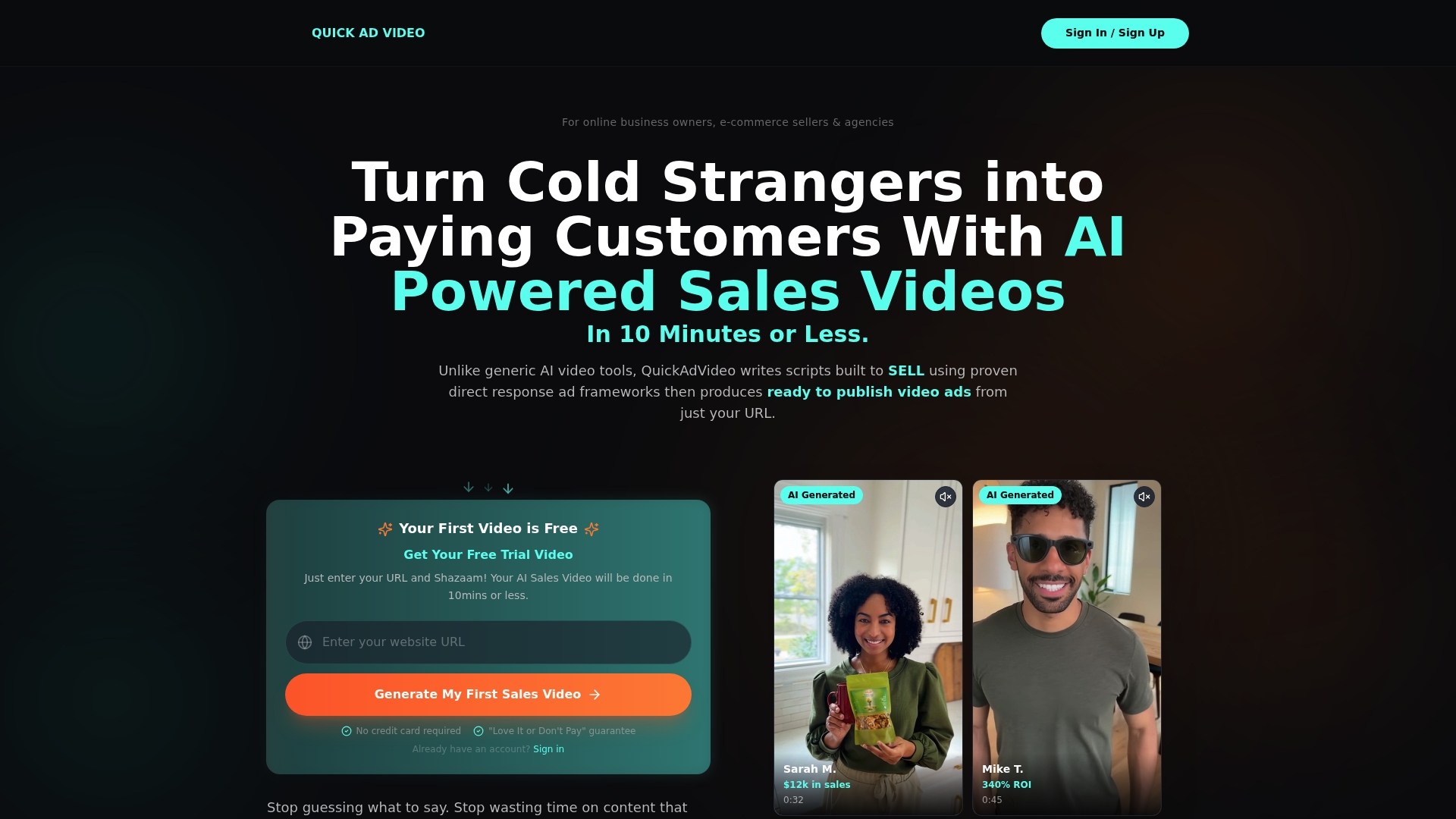
QuickAdVideo is built specifically for e-commerce sellers, dropshippers, and marketing agencies who need to move from concept to published video without the overhead of traditional production. Paste your product URL, select a proven video format from the available AI video generator models, and receive a fully scripted, visually produced sales video in minutes. Whether you need a high-trust UGC testimonial style, a scroll-stopping cinematic ad, or a viral story format for TikTok, the platform adapts to your marketing goal. The AI sales video generator publishes directly to TikTok, Instagram, YouTube, and Facebook, cutting your production workflow down from days to minutes.
Frequently asked questions
What is the best type of video to drive e-commerce sales?
Product demo and educational videos are the most effective starting points, with product videos leading at 43% and instructional videos at 38% of all business video production according to Wistia’s State of Video survey.
How does AI improve video marketing for e-commerce?
AI streamlines video creation, personalizes content at scale, and enables rapid format testing. AI-powered formats including vertical video and interactive shoppable content are among the fastest-growing trends in e-commerce video marketing.
Are short-form videos better than long-form for online stores?
Short-form videos typically dominate reach and engagement for awareness campaigns, while long-form content builds deeper trust for complex or high-ticket products. Both formats serve distinct strategic goals and work best when used together.
How do shoppable or interactive videos increase conversions?
Shoppable videos remove friction by letting buyers purchase directly inside the video experience. Interactive shoppable formats shift viewer behavior from passive watching to active buying, compressing the path to purchase significantly.
What types of marketing videos are trending in 2026?
Short-form vertical content, livestreaming, AI-personalized video, and interactive shoppable formats are the dominant trends. Shopify’s ecommerce trends confirm these formats are reshaping how brands attract, engage, and convert online shoppers this year.
Recommended
Related Posts

Why Use Templates for Video Ads: Scale Smarter
Discover why use templates for video ads to streamline production. Boost efficiency and scale your campaigns without losing creativity!

The Role of Data-Driven Video Ads in Boosting ROI
Discover the role of data-driven video ads in boosting ROI. Learn how analytics enhance engagement, optimize campaigns, and drive results.

Create Persuasive Video Ads Workflow That Converts
Learn how to create persuasive video ads workflow that transforms your ideas into optimized, high-converting campaigns. Get started today!