
Top video marketing tips to boost sales and engagement
QuickAdVideo Team
Author
Selling online has always had one unavoidable problem: your customers can’t pick up the product, feel its weight, or see how it looks under real light. That gap in sensory experience is where hesitation lives, and hesitation kills conversions. Strategic video marketing closes that gap faster than any other content format, and product videos boost buyer confidence by simulating the in-store experience online. This article walks you through a battle-tested playbook for turning passive browsers into paying customers using smart, targeted video strategies.
Table of Contents
- Understand your audience and define clear video goals
- Choose the right video types for each stage of the buyer journey
- Optimize video length and calls-to-action for outcome
- Maximize results: distribute and repurpose video content
- What most guides miss: the real key to ecommerce video success
- Ready to scale your video marketing impact?
- Frequently asked questions
Key Takeaways
| Point | Details |
|---|---|
| Know your audience | Effective video starts with clear goals and detailed understanding of your target customer. |
| Match video to funnel stage | Use product demos for decision stages and shorter social clips for awareness and engagement. |
| Optimize for conversion | Balance short videos for views with longer videos for sales actions and place strong CTAs strategically. |
| Repurpose and measure | Resize content for each platform and track conversion assists and engagement—not just views. |
| Focus on trust | Videos that build confidence can drive more actual purchases than visually flashy content. |
Understand your audience and define clear video goals
Now that you understand why video is essential for overcoming ecommerce obstacles, let’s start by identifying exactly who your videos should target and the results you expect. Skipping this step is one of the costliest mistakes e-commerce brands make. Producing videos without a clear audience in mind is like writing a sales email with no recipient. You end up with generic content that speaks to nobody and converts even fewer.
Start by building simple audience segments based on where buyers are in their decision process. A first-time visitor needs something different than a repeat customer comparing two options. Think about what your buyer knows about your product, what they fear about buying online, and what would make them trust you enough to click “Add to Cart.”
Once you know your segments, set specific goals for each video. Broad goals like “get more views” tell you nothing useful. Instead, aim for measurable outcomes:
- Awareness: Introduce a product to a cold audience on TikTok or Instagram Reels
- Engagement: Build brand familiarity through how-to or educational content on YouTube
- Conversion: Drive direct purchases with demo videos or testimonials on product pages
- Retention: Reduce post-purchase regret with onboarding or tutorial content via email
Matching video type to funnel stage is where video marketing ROI really starts to add up. A testimonial video buried on a landing page for cold traffic does little. That same testimonial placed as a retargeting ad for warm traffic? It can double your return on ad spend.
Pro Tip: Before scripting any video, write down one sentence that answers this question: “What should the viewer do or feel differently after watching this?” If you can’t answer it, your video doesn’t have a goal yet.
You can also pull inspiration from creative video content ideas that match your product category and audience type. The combination of sharp audience insight and precise goal-setting is the foundation everything else rests on.
Choose the right video types for each stage of the buyer journey
With your audience and goals clarified, the next step is to select the video formats that best serve buyers at every decision point. Not all video formats are created equal, and using the wrong format at the wrong time actively hurts conversion. A high-energy product launch video is exciting for new audiences but frustrating for someone who already wants a detailed walkthrough.
Here’s a practical breakdown of which formats work best at each funnel stage:
| Buyer journey stage | Best video type | Core question it answers |
|---|---|---|
| Awareness | Short-form brand or lifestyle video | “What is this product?” |
| Consideration | Demo, comparison, or how-to video | “How does it work and is it right for me?” |
| Decision | Testimonial, unboxing, or case study | “Can I trust this brand?” |
| Post-purchase | Tutorial or onboarding video | “Am I using this correctly?” |
Different video types reduce purchase uncertainty and serve distinct funnel needs, with demos, tutorials, comparisons, and unboxing videos each solving a specific buyer objection. Understanding this framework helps you stop guessing and start allocating your production budget intentionally.
Here’s how each format serves buyers in practice:
- Product demos: Show the product in real use. Answer the question “What does it actually do?” with visuals rather than text. This is especially powerful for anything with moving parts, multiple functions, or size considerations.
- How-to videos: Demonstrate ease of use before the purchase decision. If buyers worry about complexity, this format eliminates that fear.
- Testimonials: Real customers speaking honestly about their experience carry social proof that polished brand copy cannot replicate.
- Unboxing videos: They satisfy curiosity about packaging quality and presentation, which matters especially for gift products or premium items.
- Live selling videos: These create urgency and allow real-time Q&A, making them ideal for product launches and flash sales.
For a deeper look at how these formats tie into your overall financial returns, explore ROI strategies for ecommerce videos and the underlying psychology and ROI of product videos to understand what actually drives buyer behavior at a neurological level.
Pro Tip: If you sell a product with multiple use cases, consider creating a separate short video for each use case rather than one long video trying to cover everything. Specific beats generic every single time.
Optimize video length and calls-to-action for outcome
After selecting the best video types, it’s crucial to tailor both the length and the placement of your calls-to-action for the highest impact. Length is one of the most misunderstood variables in video marketing. Most brands default to keeping everything short because “attention spans are shrinking.” But that’s an oversimplification that costs sales.

Shorter videos often earn higher engagement rates, but longer video formats are capable of driving more conversions. This makes sense when you think about it. Watching a 90-second product demo tells you something. Watching a 6-minute deep-dive with a comparison, FAQ section, and real testimonials closes the sale.
Here’s a practical reference for matching length to outcome:
| Video length | Engagement rate | Conversion potential | Best use case |
|---|---|---|---|
| Under 60 seconds | High | Lower | Awareness ads, social feeds |
| 1 to 3 minutes | Medium-high | Medium | How-to, product demos |
| 3 to 7 minutes | Medium | High | In-depth demos, tutorials |
| 7 minutes plus | Lower | Highest (for warm traffic) | Case studies, webinars |
Use this checklist before publishing any video:
- Define the single goal of this video before production starts.
- Match the length to the funnel stage, not just personal preference.
- Write your CTA before you script the video body so it shapes the narrative.
- Place the CTA at the end for most conversion-focused videos. Interrupting the viewing experience reduces trust.
- Test two versions of your CTA copy: one action-oriented (“Get yours today”) and one benefit-oriented (“Start saving time this week”).
- Review the first 5 seconds. If they don’t hook the viewer, nobody reaches your CTA anyway.
The biggest mistake brands make is treating every video the same. A top-of-funnel awareness clip and a bottom-of-funnel product demo need completely different lengths, structures, and CTA placements. Treat them like different ad units, not just different lengths of the same thing.
For effective video messaging that genuinely moves buyers through the funnel, your script structure must match your goal. This means your opening hook, middle content, and closing CTA all need to pull in the same direction.
Pro Tip: For social media ads, front-load your key benefit into the first 3 seconds. On product pages, you have more time to earn the viewer’s attention before your CTA lands.
Maximize results: distribute and repurpose video content
Once your videos are produced and optimized, it’s time to get the most value from each asset by expanding their reach. Most e-commerce brands dramatically underutilize the videos they create. A single well-made product demo can fuel weeks of content across multiple platforms if you repurpose it intelligently.
76% of video teams resize their videos for different platforms, and repurposing core assets into social clips measurably increases overall content ROI. This is not just about resizing. It means re-framing the same core message for different contexts, audiences, and attention spans.
Here’s how to build a repurposing system that actually works:
- Turn long demos into short clips. A 4-minute product demo contains at least 4 to 5 shareable moments. Extract the most compelling 15 to 30 seconds and post them as standalone clips on TikTok, Instagram Reels, and YouTube Shorts.
- Create platform-specific versions. Square video (1:1) works on Instagram feed. Vertical (9:16) dominates TikTok and Stories. Horizontal (16:9) remains standard for YouTube. Never upload a horizontal video directly to TikTok without cropping.
- Pull audio quotes for podcasts or audiograms. If your video includes a strong customer testimonial, the audio alone can work as a short-form audio clip with a static or animated background.
- Repurpose into blog content. Add a transcript and key screenshots from your video to create a companion article that captures search traffic.
- Track the right metrics. Views are vanity. The metrics that matter are conversion assists (how many buyers watched a video before purchasing), click-through rate on your CTA, and watch time percentage (which tells you where viewers drop off).
Using interactive video ad tactics inside repurposed clips adds another layer of engagement, allowing viewers to click hotspots or answer polls without leaving the video experience. Pair that with the speed and scale that AI video content benefits now make accessible and you have a distribution strategy that doesn’t require a full creative team to execute.
What most guides miss: the real key to ecommerce video success
Having explored actionable tactics, let’s pause to rethink common advice and focus on what actually generates real sales impact. The most popular advice in video marketing right now is to chase engagement. Go viral. Get shares. Build a community. And while none of that is wrong in isolation, it becomes a trap when brands start optimizing for engagement instead of conversion.
Here’s the uncomfortable reality we’ve seen play out repeatedly: a brand produces a brilliantly entertaining video that gets hundreds of thousands of views and thousands of comments. Then the founder checks Shopify and the sales numbers barely moved. Why? Because the video was top-of-funnel content served to people who were never close to buying. Engagement metrics felt great. Revenue did not.
The real key is funnel alignment. Don’t optimize only for engagement rate. Match your video length and CTA placement to the specific funnel stage you’re targeting. A viral video strategy and a conversion video strategy are not the same thing, and trying to serve both goals with one piece of content usually means you serve neither goal well.
This is especially critical for e-commerce brands with smaller budgets. You can’t afford to spend production dollars on content that doesn’t move buyers toward a decision. Every video needs a job. Define that job before you start.
The brands we’ve seen succeed with video are not necessarily the ones making the most impressive-looking content. They’re the ones who understand that a clear, specific, well-placed product demo on a product page outperforms a cinematic brand story in terms of actual revenue impact. Creativity matters. Clarity and strategic alignment matter more.
Follow a step-by-step ecommerce video guide to make sure each video you produce has a defined role in your funnel before you invest a single minute in production.
Ready to scale your video marketing impact?
With proven video marketing strategies in hand, you’re ready to turn insights into action using streamlined tools. Knowing what type of video to create, how long to make it, where to place your CTA, and how to repurpose it across platforms is half the battle. The other half is actually executing at speed without burning out your team or budget.
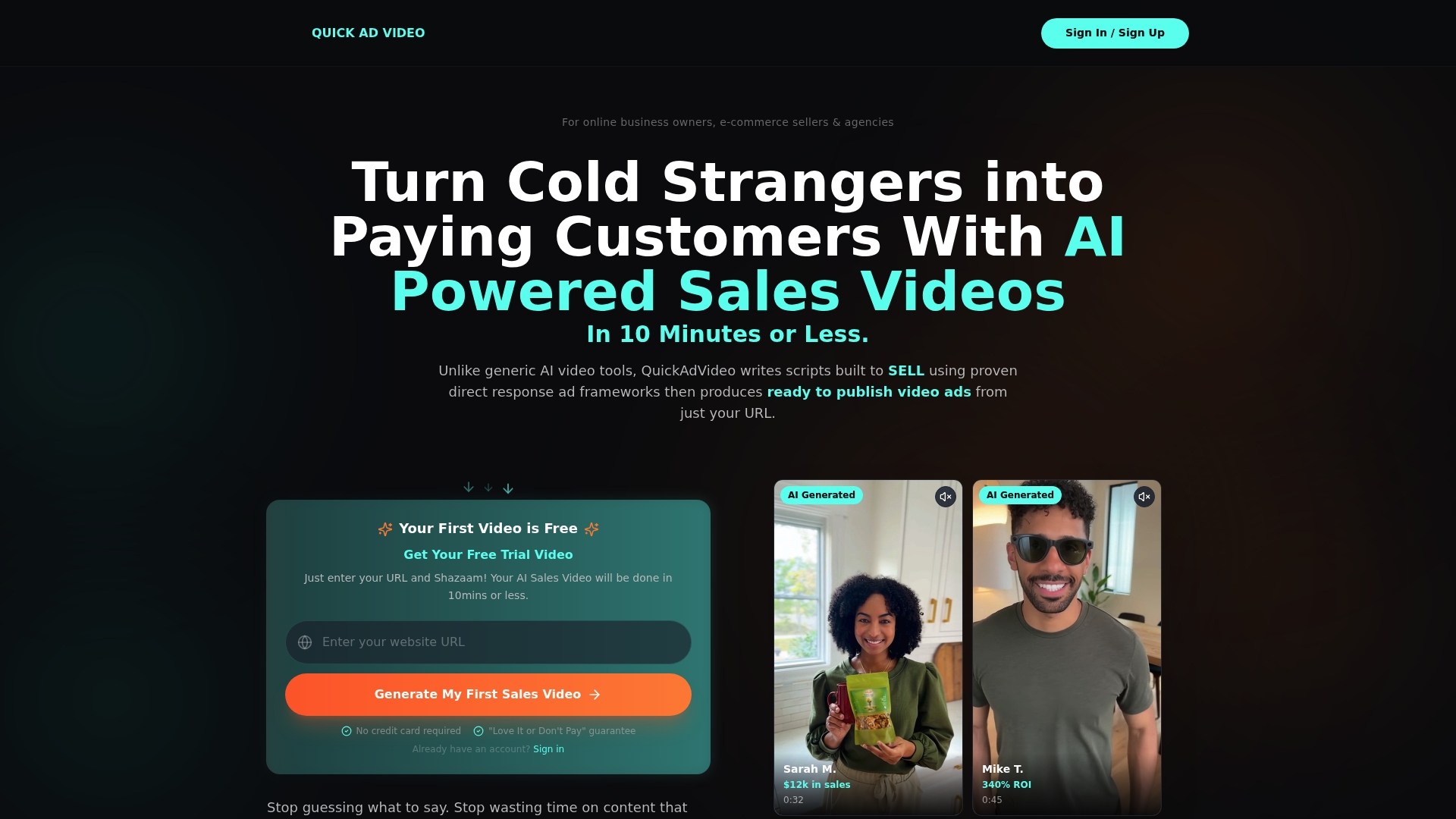
That’s exactly what QuickAdVideo was built for. As an AI sales video generator, it takes your product URL and transforms it into a high-converting sales video in minutes, without cameras, editors, or scripting experience. Whether you need UGC-style clips for TikTok, cinematic product demos for YouTube, or direct-response ads for Facebook, the platform’s video creation models are pre-built around proven conversion frameworks. You can explore the full range of formats through all AI video tools and find exactly what fits your current campaign stage. For e-commerce brands that need to move fast and spend smart, this is the practical next step.
Frequently asked questions
What video format works best for boosting e-commerce sales?
Product demo and unboxing videos are especially effective because they simulate the physical in-store experience and directly address buyer hesitation before purchase.
How long should my sales video be?
Shorter videos earn higher engagement while longer formats drive more conversions, so choose length based on whether your goal is reach and awareness or direct purchase action.
What metrics should I track to measure video marketing success?
Beyond views, prioritize conversion assists and social engagement because HubSpot’s 2026 data shows these metrics reveal how video content actually influences purchasing decisions.
How can I repurpose my ecommerce videos for more reach?
Resize videos to match each platform’s format and extract short clips from longer assets, since 76% of teams already follow this practice and report stronger overall content ROI.
Where should I place calls-to-action in my videos?
For product-focused content, end-of-video CTAs consistently outperform mid-roll placements because they let the viewer absorb the full value of the content before being asked to act.
Recommended
- Interactive video ads: boost engagement and conversions | QuickAdVideo Blog
- How to craft effective video messaging for higher conversions | QuickAdVideo Blog
- Boost E-Commerce Sales with Creative Video Content Ideas | QuickAdVideo Blog
- Why Cinematic Videos Transform Your Marketing Results | QuickAdVideo Blog
Related Posts

Why Use Templates for Video Ads: Scale Smarter
Discover why use templates for video ads to streamline production. Boost efficiency and scale your campaigns without losing creativity!

The Role of Data-Driven Video Ads in Boosting ROI
Discover the role of data-driven video ads in boosting ROI. Learn how analytics enhance engagement, optimize campaigns, and drive results.

Create Persuasive Video Ads Workflow That Converts
Learn how to create persuasive video ads workflow that transforms your ideas into optimized, high-converting campaigns. Get started today!