
Top social media ad formats to boost e-commerce sales
QuickAdVideo Team
Author
Picking the wrong ad format is one of the fastest ways to burn through a media budget without moving the needle. With new placements launching on TikTok, Instagram, Facebook, and YouTube every few months, the options keep multiplying while the margin for error stays the same. The brands that consistently win are not the ones with the biggest spend. They are the ones who understand exactly which format matches their product, their audience, and their campaign objective. This guide will walk you through the full landscape so you can stop guessing and start scaling.
Table of Contents
- How to evaluate social media ad formats for e-commerce
- Top 6 social media ad formats every e-commerce brand should know
- Side-by-side comparison of social media ad formats
- Best ad format for your campaign goals
- Our take: Why constant experimentation wins with social media ad formats
- Take your social media ads to the next level with QuickAdVideo
- Frequently asked questions
Key Takeaways
| Point | Details |
|---|---|
| Ad format choice drives ROI | Selecting the right ad format is critical to maximizing e-commerce campaign results. |
| Match formats to goals | Different social media ad formats excel for objectives like engagement, conversion, or awareness. |
| Comparison clarifies selection | A side-by-side look at formats helps you choose the best for your marketing needs. |
| Experiment for best results | Regular testing of new ad formats improves performance and uncovers new opportunities. |
How to evaluate social media ad formats for e-commerce
With the need for clarity established, let’s break down the evaluation process every marketer should use before committing a single dollar to a new ad format.
The first question to ask is always: what does this campaign actually need to accomplish? A brand awareness push requires a very different format than a retargeting campaign aimed at cart abandoners. Your four core goals in e-commerce advertising are brand awareness, audience engagement, lead generation, and direct conversion. Each goal points toward a different creative format, platform, and placement strategy. Trying to force one format to do all four jobs at once is how brands end up with average results across the board.
Once you know your goal, run each candidate format through a practical checklist:
- Mobile friendliness: Over 70% of social media browsing happens on a phone. If your ad format does not look great on a small vertical screen, you are already fighting an uphill battle.
- Platform distribution: A format that dominates on Instagram may underperform on Facebook or TikTok. Check native performance data per platform before scaling.
- Creative requirements: Some formats, like collection ads, need product photography plus video assets. Others, like image ads, need just a single compelling visual. Match the format to your current production capacity.
- A/B testing ease: Can you quickly swap out headlines, images, or CTAs within this format? The easier it is to test, the faster you can optimize.
- Funnel stage alignment: Awareness formats push broad reach. Retargeting formats demand specificity. Sending a cold audience to a purchase-focused ad is a common and expensive mistake.
Matching the format to your product category also matters more than most marketers admit. A single-image ad works beautifully for a minimalist product with strong visual appeal. A skincare brand with a multi-step routine, however, will almost always benefit more from video or carousel to explain the full value. Understanding your video marketing ROI strategies before you pick a format will help you set realistic benchmarks from the start.
Pro Tip: Reserve 20% of your quarterly budget specifically for testing formats outside your current mix. This keeps your strategy fresh and surfaces high-performers before your competitors find them.
Top 6 social media ad formats every e-commerce brand should know
Now that you know what to look for, let’s explore the essential ad formats you need to consider. Each one has a distinct strength, and knowing when to deploy each is what separates average campaigns from exceptional ones.
1. Image ads
The simplest format in the toolkit. A single static visual paired with copy and a CTA. Image ads are quick to produce, easy to test, and available on every major platform. They work best for flash sales, product spotlights, and brand recognition campaigns where a clean, strong visual can do all the talking. The downside is engagement. Static formats cannot compete with motion on a crowded feed, and click-through rates reflect that. Use image ads when speed and volume matter and when your visual is genuinely striking enough to stop a scroll.
2. Video ads
The highest-performing format in modern social advertising. Video ads deliver up to 88% more engagement compared to static formats, making them the go-to choice for product demos, storytelling, and emotional brand building. Video gives you time, motion, and sound to communicate benefits that a single image never could. A 15-second video can show a product being unboxed, used, and loved, which builds trust faster than any static alternative. The perceived barrier to entry is production cost, but AI-powered creation tools have changed that equation completely.

3. Carousel ads
A swipeable sequence of two to ten cards, each with its own image or video, headline, and CTA. Carousels are powerful because they reward curiosity. A user who swipes through three or more cards is telling the algorithm they are genuinely interested, which raises quality scores and lowers your cost per click over time. Use carousels to showcase a product lineup, walk through a step-by-step process, or tell a sequential brand story. Exploring creative video content ideas for each carousel card can transform a standard product listing into a compelling visual narrative.
4. Collection ads
Collection ads combine a hero video or image at the top with a grid of product images below, creating an instant mini-storefront within the feed. When a user taps, they are taken to a fast-loading, full-screen browsing experience without ever leaving the platform. This format is especially powerful for fashion, home goods, and lifestyle brands where discovery shopping is part of the purchase journey. The creative demand is higher, but the payoff in engagement and conversion rate is substantial.
5. Stories and Shorts ads
Full-screen vertical ads that appear between organic story content on Instagram, Facebook, TikTok, and Snapchat. They are immersive, interruptive in the best sense, and expire quickly, which makes them ideal for time-sensitive campaigns like limited-time offers, product drops, and flash sales. Stories ads require a vertical-first creative strategy. Brands that repurpose landscape video into a 9:16 frame without redesigning the layout typically see weak results. Native-looking stories ads that mimic organic content consistently outperform polished, clearly-corporate creatives in this placement.
6. Sponsored product listings
These appear natively inside marketplace feeds on platforms like Instagram Shopping, Facebook Marketplace, and Pinterest. They look like organic posts but are boosted with paid targeting to reach high-intent shoppers who are already in discovery mode. Because the audience is already shopping-oriented, conversion rates on sponsored listings tend to be strong with lower creative friction required. This format is less about storytelling and more about clear product imagery, competitive pricing, and strong reviews.
Pro Tip: Use carousel ads to test three or four different value propositions in a single campaign. Track which card gets the most swipes and clicks, then build your next standalone campaign around the winner.
Side-by-side comparison of social media ad formats
To help you apply what you’ve learned, here’s a comparative view of popular formats so you can match each one to your specific campaign priorities at a glance.
| Ad format | Engagement level | Creative demand | Relative cost | Best use case |
|---|---|---|---|---|
| Image ad | Low to medium | Low | Low | Brand awareness, flash sales |
| Video ad | High | Medium to high | Medium | Product demos, storytelling, conversions |
| Carousel ad | Medium to high | Medium | Medium | Product range, feature comparison |
| Collection ad | High | High | Medium to high | Discovery shopping, lifestyle brands |
| Stories/Shorts ad | High | Medium | Medium | Flash sales, announcements, Gen Z targeting |
| Sponsored listing | Medium | Low | Variable | Direct purchase intent, marketplace traffic |
The table above makes the trade-offs clear. Formats with higher creative demand tend to deliver higher engagement, but they also require more time, resources, and strategic thinking to execute well. That is why video ads and ROI have such a strong correlation in e-commerce: the investment in creation pays off through better downstream performance metrics.
One insight that often surprises marketers is that cost per click does not always correlate with cost per acquisition. A cheap click from a low-engagement image ad can cost more in total if it converts at 1%, while an expensive click from a well-produced video ad that converts at 5% delivers far better return. Always evaluate formats on cost per acquisition, not just cost per click.
Best ad format for your campaign goals
Seeing the distinctions, let’s match optimal ad formats to your unique marketing goals. The right format is always context-dependent, but these pairings give you a strong starting point.
- Brand awareness and reach: Video ads and Stories ads are the strongest choices. They maximize screen time, emotional impact, and memorable impressions. A 15 to 30-second video that tells a brand story will outperform any static format for top-of-funnel goals.
- Traffic and consideration: Carousel ads shine here. Multiple touch points within a single ad unit keep users engaged longer and give your product the space to make a layered, convincing case. Effective video messaging within the first carousel card can also significantly boost swipe-through rates.
- Direct conversions: Collection ads and sponsored product listings work best when purchase intent is already present. Pair them with retargeting audiences for maximum efficiency. A user who viewed your product page and then sees a collection ad is much closer to buying than a cold audience member.
- Customer retention and repeat purchase: Video ads with personalized messaging perform well for existing customers. Stories ads with exclusive loyalty offers also drive strong repeat behavior. The goal shifts from convincing to rewarding, and the creative should reflect that warmth.
- New product launches: Combine video ads for awareness with carousels for consideration, then transition to collection ads or sponsored listings as purchase intent builds. This multi-format funnel approach is detailed thoroughly in the step by step video ad guide if you want to map the full sequence.
“The biggest mistake in social advertising is treating ad format selection as a one-time decision. The format is a variable, not a constant. Your audience’s behavior, the platform’s algorithm, and your creative assets all evolve, and your format strategy must evolve with them.”
Quick testing tip: when entering a new product category or targeting a new audience segment, run three formats simultaneously with a small budget for seven to ten days. Use engagement rate and cost per link click as early signals, then shift spend toward the winner before scaling.
Our take: Why constant experimentation wins with social media ad formats
Once you’ve made an initial choice, here’s why your journey with ad formats is just beginning.
Most brands pick a format that worked once, then lean on it until performance decays. We have seen this pattern repeatedly. A dropshipping brand finds success with video ads, scales aggressively, and then watches ROAS drop over six months as creative fatigue sets in and the algorithm audience saturates. The instinct is to improve the video. The real problem is that they stopped testing new formats entirely.
The brands that sustain strong performance year over year treat their ad format mix like a portfolio. They have core formats that carry the bulk of spend and experimental formats that might become the next core performer. This is not about chasing every new placement the platforms release. It is about staying genuinely curious and allocating small, controlled budgets to test what the data says rather than what gut feeling says.
Here is the unconventional part: small format failures are actually valuable data. A Stories ad that underperforms tells you something about your audience’s behavior and content preferences. That information shapes better decisions across your entire strategy. Brands that never fail are brands that never test, and brands that never test get surprised when their one proven format stops working.
Platform behavior also shifts. Instagram’s algorithm in 2026 favors Reels placements more than static feed posts. TikTok’s native shopping ads are gaining traction. These changes do not always make the headlines, but they quietly redistribute engagement and reach across formats. Staying current with where the platforms are placing organic weight is a real competitive edge. Reading resources like the AI video ad guide will give you a running start on formats that are gaining algorithmic favor right now.
Pro Tip: Set a monthly calendar reminder to review format performance across all active campaigns. Compare month-over-month engagement and conversion metrics, and always have at least one new format in active testing. Small, consistent experiments compound into major strategic advantages over a full year.
Take your social media ads to the next level with QuickAdVideo
Understanding which ad formats drive results is only half the equation. The other half is being able to create those formats quickly, affordably, and at the quality level that modern audiences expect.
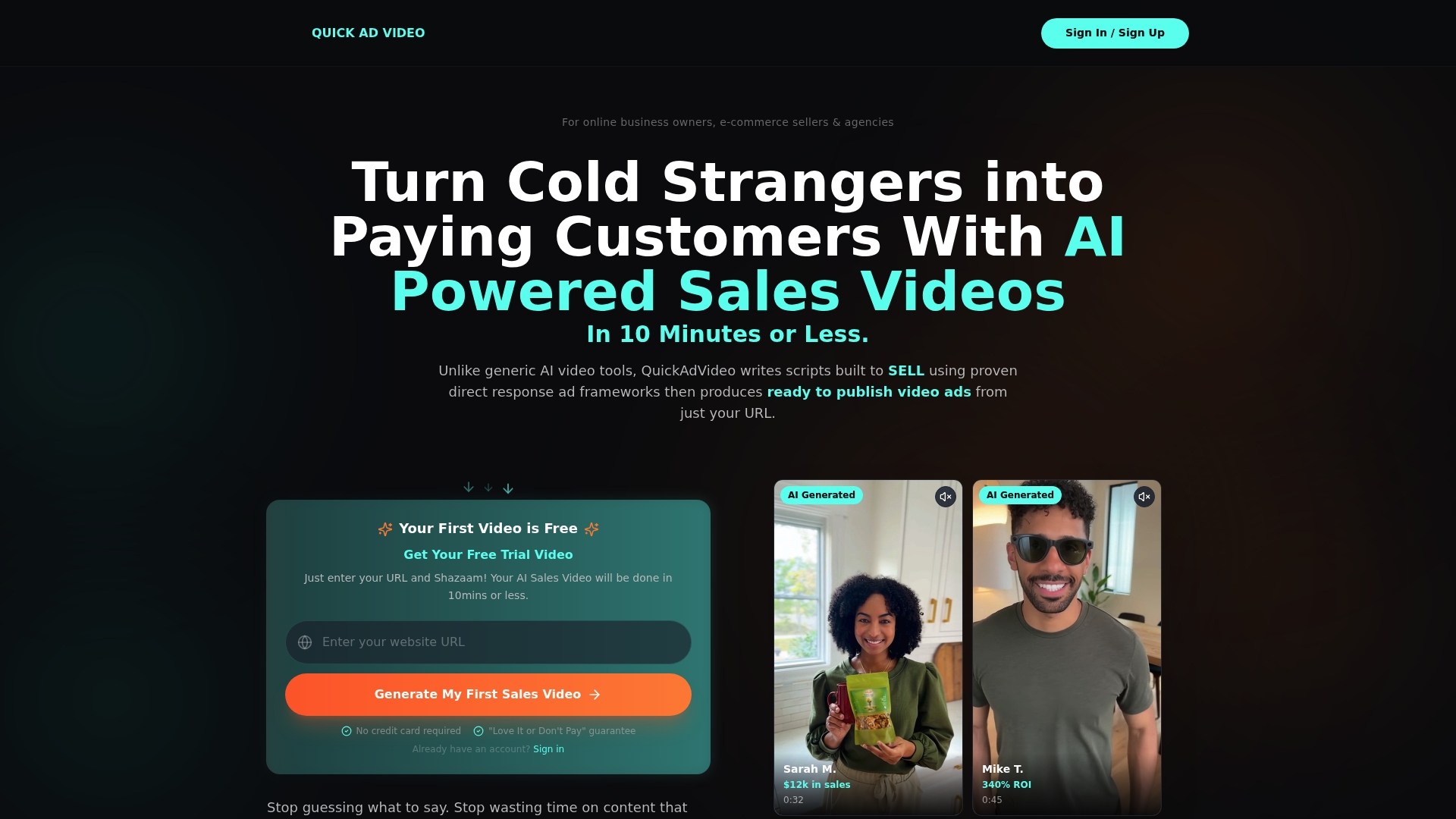
QuickAdVideo is an AI-powered video creation platform built specifically for e-commerce sellers, marketers, and agencies who need professional-quality video ads without the production overhead. You input a product URL, and the platform generates fully scripted, high-converting video content in minutes using proven direct response frameworks. Whether you need UGC-style testimonials, cinematic product showcases, or viral story formats, the AI ad format models cover every major campaign type. You get production-ready video ads for TikTok, Instagram, YouTube, and Facebook, all without a camera, editing software, or a full creative team. It is the fastest path from product page to live ad campaign.
Frequently asked questions
Which social media ad format delivers the highest ROI for e-commerce?
Video ads yield the highest ROI for e-commerce due to their engaging nature and ability to showcase products dynamically across every stage of the funnel.
How frequently should I change my ad format strategy?
Review and adjust your ad format mix at least once a quarter to stay aligned with platform algorithm changes, audience behavior shifts, and evolving campaign goals.
Are stories ads effective for lead generation campaigns?
Yes. Stories ads are highly effective for short-term lead generation because their full-screen, time-sensitive format creates urgency and drives immediate action from engaged audiences.
Is carousel or collection better for showcasing multiple products?
Carousels work best for highlighting individual products side by side, while collection ads create a seamless storefront browsing experience that feels more like shopping than advertising.
Do interactive ad formats always outperform static image ads?
Not always. Interactive formats generally deliver higher engagement, but a well-crafted image ad can outperform in specific contexts like retargeting warm audiences who already know the product.
Recommended
Related Posts

Why Use Templates for Video Ads: Scale Smarter
Discover why use templates for video ads to streamline production. Boost efficiency and scale your campaigns without losing creativity!

The Role of Data-Driven Video Ads in Boosting ROI
Discover the role of data-driven video ads in boosting ROI. Learn how analytics enhance engagement, optimize campaigns, and drive results.

Create Persuasive Video Ads Workflow That Converts
Learn how to create persuasive video ads workflow that transforms your ideas into optimized, high-converting campaigns. Get started today!