
Proven elements that make sales videos actually convert
QuickAdVideo Team
Author
Most business owners assume better cameras and slicker editing are the secret to higher conversions. They spend thousands on production, hire videographers, add motion graphics, and still watch their sales videos underperform. The uncomfortable truth is that persuasion, message clarity, and call-to-action placement drive results far more than production value ever will. This article breaks down exactly what separates high-converting sales videos from expensive content that looks great but fails to move people from viewer to buyer. You’ll walk away with a repeatable framework you can apply immediately.
Table of Contents
- Defining high-converting sales videos: Features and purpose
- The anatomy of a high-converting sales video
- Beyond video quality: Aligning message, audience, and CTA for conversion
- Automation and tools: Streamlining high-converting video creation
- Why most sales videos fail—and how to break the mold
- Unlock better conversions with automated sales video tools
- Frequently asked questions
Key Takeaways
| Point | Details |
|---|---|
| Not just video quality | Conversion depends more on persuasion and CTA clarity than high-end visuals. |
| Direct-response structure | A sales video needs a proven framework: hook, proof, mechanism, and a compelling call to action. |
| Audience-message fit | Align message relevance and CTA placement with where viewers are in their buying journey for better results. |
| Leverage automation | Modern tools can help you create and iterate high-converting videos quickly with template-driven approaches. |
Defining high-converting sales videos: Features and purpose
Not every marketing video is designed to convert. Brand videos build recognition. Explainer videos educate. Tutorial content builds trust over time. A high-converting sales video does something fundamentally different: it moves a specific person to take a specific action within a single viewing session.
That distinction matters because it shapes every decision you make about structure, length, tone, and pacing. Video messaging for conversions works when the message is engineered to produce a direct response, not just to inform or entertain. The moment you blur that intent, you dilute conversion potential.
Sales videos are built on direct-response principles borrowed from long-form copywriting. As Rob Palmer explains, VSLs are engineered for persuasion in a single viewing session and are not brand videos or generic explainers. That engineering is what makes them work at scale.
Here’s what distinguishes a high-converting sales video from everything else in your content mix:
- It targets one specific action. Whether that’s clicking a buy button, signing up for a trial, or booking a call, every second of the video exists to move the viewer toward that one outcome.
- It addresses audience intent directly. It meets viewers where they are emotionally and situationally, whether they’re pain-aware but solution-unaware, or already comparing options.
- It uses urgency and proof strategically. Scarcity, testimonials, and data aren’t decorative. They serve clear persuasive functions at specific points in the video.
- It’s written before it’s filmed. The script does the heavy lifting. Visual production simply delivers the message.
Understanding the psychology of video selling helps clarify why viewers respond to certain structures. Trust, emotional resonance, and perceived authority all operate below the conscious level. A well-structured sales video activates those triggers systematically.
“A sales video that converts isn’t trying to impress. It’s trying to persuade. Those are completely different objectives, and confusing them is the most common reason videos fail.”
The anatomy of a high-converting sales video
Once you understand what makes a sales video different from other content types, the next step is studying its internal structure. Every high-performing sales video follows a predictable persuasion sequence. Skip or weaken one element and you create a gap in the logic chain that stops viewers from taking action.
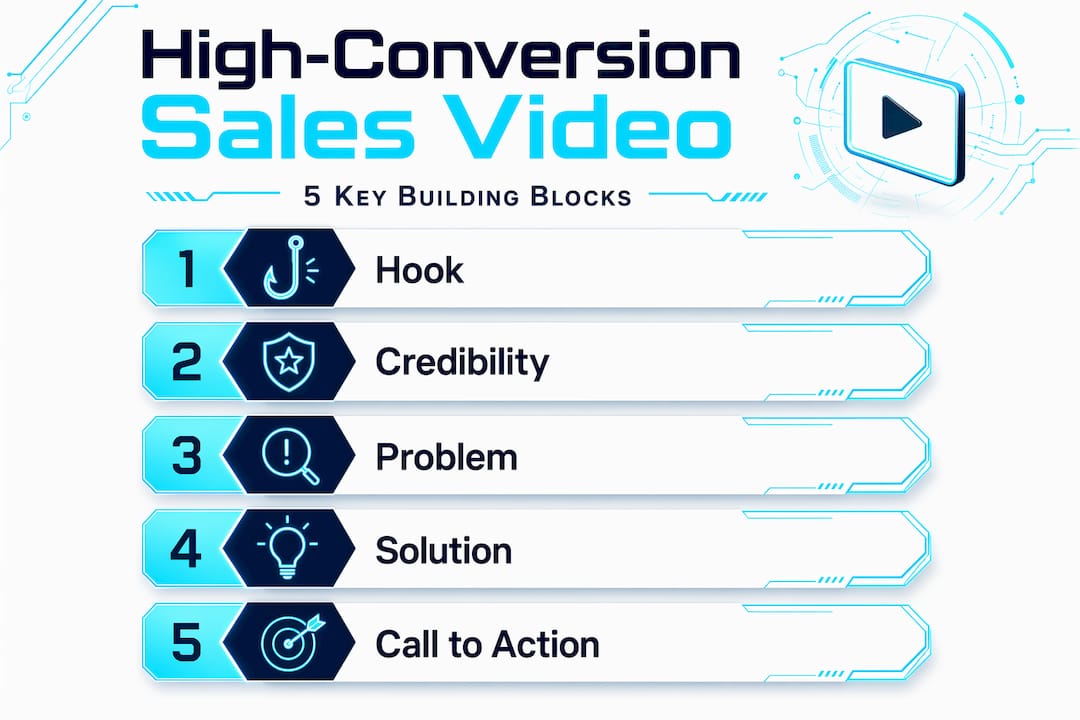
High-converting sales videos use a direct-response flow that moves from attention to desire to action, including a hook, problem agitation, credibility proof, a clear mechanism, and a specific call to action. Each step builds on the previous one. Remove any link and the chain breaks.
Here’s how the full anatomy works in practice:
- The hook (first 5 to 10 seconds). Your viewer decides almost instantly whether to keep watching. A strong hook addresses the viewer’s exact situation or pain point. “If you’re spending money on ads but your sales videos aren’t converting, here’s why” will outperform any generic opener every single time.
- Problem agitation. After the hook, you deepen awareness of the problem. You’re not being negative; you’re showing the viewer you understand their situation better than they do. This builds emotional connection and keeps them watching.
- The credibility bridge. Before you offer a solution, you establish why you or your product has earned the right to solve this problem. Results, case studies, credentials, or a simple compelling origin story all work here.
- The mechanism. This is your unique solution explanation. Not just “what” you offer but “why it works differently.” The mechanism differentiates your offer from every alternative and raises perceived value.
- Social proof. Testimonials, before-and-after scenarios, data, and third-party validation arrive here. By this point, the viewer is emotionally invested, so proof converts that investment into belief.
- The offer presentation. Now you present what they get, what it costs, and why the value exceeds the price. Anchoring is effective here; show the full value before revealing the price.
- The call to action. A single, clear, frictionless next step. Not “check out our website.” Something precise: “Click the button below to get instant access.”
| Video element | Psychological function | Common mistake |
|---|---|---|
| Hook | Captures attention and creates curiosity | Generic openers that fail to connect |
| Problem agitation | Builds emotional investment | Rushing past pain points too quickly |
| Credibility bridge | Establishes trust and authority | Skipping proof before the solution |
| Mechanism | Differentiates and raises perceived value | Describing features instead of outcomes |
| Social proof | Converts belief into confidence | Using vague or unspecific testimonials |
| Offer presentation | Justifies investment and anchors value | Leading with price before demonstrating value |
| Call to action | Directs behavior with clarity and urgency | Multiple CTAs that confuse the viewer |
One critical insight: video length should serve this structure, not the other way around. A two-minute video that skips problem agitation will almost always underperform a seven-minute video that nails every element. Completeness beats brevity when persuasion is the goal.
See how demo video conversion steps apply this same logic to product demonstrations, where the mechanism and proof phases carry extra weight.
Stat to know: In direct-response video marketing, skipping or weakening persuasive steps reduces conversions measurably. Every element in the sequence exists for a quantifiable reason.
Beyond video quality: Aligning message, audience, and CTA for conversion
You can have a beautifully produced video that follows every structural element perfectly and still get flat results. The missing variable is alignment. Your message has to match where your audience actually is in their buying journey, not where you assume they are.

High-converting video isn’t just about quality; it depends on intent alignment, meaning the match between audience stage, message relevance, and removing friction through CTA clarity and placement. A cold-traffic viewer who has never heard of your brand needs a completely different message than a warm retargeting audience who visited your sales page twice last week.
This is where most marketing teams make a costly mistake. They create one video and run it to all audiences, regardless of intent level. A cold audience needs more education, more proof, and more emotional resonance before they’re ready to act. A warm audience just needs a frictionless path to the action they’re already considering.
Here’s what strong alignment looks like in practice:
- Cold traffic: Lead with pain point identification. Build credibility early. Invest more in the hook and problem agitation phases.
- Warm traffic (visited page, watched content): Lead with social proof. Acknowledge their hesitation. Shorten the credibility-building section because it’s partially complete.
- Hot traffic (cart abandonment, trial users): Lead directly with the offer and remove objections. This audience already has intent; the job is removing the last obstacle.
Timing your CTA is just as important as writing it. Wistia’s research shows that early CTA placement drops conversions sharply because viewers aren’t yet invested enough in the outcome. Showing your “Buy Now” button before you’ve established value trains viewers to tune out.
The CTA itself needs three qualities to convert: specificity (“click the button below”), low perceived effort (“get instant access” not “complete your registration”), and urgency (“limited spots available” or “offer ends Friday”). Vague CTAs bleed conversions quietly. You may not notice it on any individual video, but across a campaign it adds up to thousands of lost dollars.
Pro Tip: A/B test your CTA language before testing anything else. Changing “Learn More” to “See How It Works” on the exact same video has been shown to lift click-through rates significantly because it better matches viewer intent at that moment.
Aligning content with intent is the single highest-leverage adjustment most brands can make without touching a single frame of existing footage.
Automation and tools: Streamlining high-converting video creation
Knowing the right structure and the importance of alignment is one thing. Executing it consistently across a full marketing calendar is another challenge entirely. This is where automation stops being a nice-to-have and becomes a genuine competitive advantage.
AI-powered video creation tools have matured significantly. They don’t just generate visuals; the best platforms now embed direct-response frameworks directly into the creation process. When the persuasion structure is built into the template itself, you’re much less likely to accidentally skip the credibility bridge or bury your CTA.
| Traditional production | AI-assisted production |
|---|---|
| Days to weeks per video | Minutes to hours |
| Requires creative expertise | Framework-guided creation |
| High per-video cost | Scalable with credits or subscriptions |
| Inconsistent adherence to structure | Proven templates reduce gaps |
| Manual publishing to platforms | Direct integration with social channels |
The production time reduction alone changes how you can approach testing. If you can produce four video variations in the time it used to take to produce one, you can test different hooks, different CTA placements, and different proof elements simultaneously. That data compounds your results faster than any single “perfect” video ever could.
Creative video content ideas for e-commerce illustrate how variation testing across formats like UGC style, cinematic, and narrative-driven video each captures different audience segments with the same core offer. Automation makes running those variations practical.
Pro Tip: Use AI tools not just to produce videos faster, but to enforce your persuasion framework. If the tool is built around proven direct-response templates, it acts as a quality check that keeps critical conversion elements intact across every video you produce.
Skipping or weakening persuasive steps reduces conversions in every format. Automation tools that embed structure prevent the casual drift that happens when teams produce videos quickly without a checklist.
Why most sales videos fail—and how to break the mold
After working with the mechanics and the tools, let’s have an honest conversation about why so many sales videos still miss the mark. The pattern is remarkably consistent. Businesses invest in production, hit publish, watch the metrics stay flat, and blame the platform or the ad spend. The real culprit is almost always the same: generic messaging that could apply to anyone and, therefore, moves no one.
Generic is safe. Generic doesn’t require you to take a strong position, make a bold promise, or understand your audience deeply enough to say something specific. But generic doesn’t convert. When a viewer watches your sales video and thinks “this could be for anyone,” the persuasion circuit breaks immediately.
The best-performing sales videos feel like they were made for one specific person with one specific problem. That specificity is what creates the “this is exactly me” moment that triggers emotional investment. It’s not a production trick. It’s a research and messaging discipline.
Cinematic impact insights show that visual quality contributes to perceived brand credibility, but it cannot replace message specificity. A beautifully shot video with a vague value proposition will be outperformed by a simple, direct video that nails the audience’s pain and solution with precision.
The second pattern is proof avoidance. Many business owners feel uncomfortable with aggressive social proof or fear that case studies sound “too salesy.” This hesitation is expensive. Viewers need evidence before they act. Removing proof from your sales video doesn’t make it more tasteful; it makes it less convincing.
The fix is simpler than most people expect. Start with specificity. Write your next script for your most valuable customer type, not a demographic average. Speak to their specific situation, reference their actual frustrations, and describe outcomes in their language. Then stack proof early and often. Results, names, numbers, before-and-afters. Make the evidence concrete and specific rather than general and vague.
Finally, test continuously. The brands generating consistent results from sales video aren’t smarter than you. They’re just running more iterations. One video is a guess. Ten variations with measured results is a system.
Unlock better conversions with automated sales video tools
Now that you see the real framework behind high conversions, here’s how to streamline video creation and start seeing results without getting bogged down in manual processes.
Knowing the persuasion structure is valuable. Having a system that builds it for you automatically is a genuine force multiplier for your business.
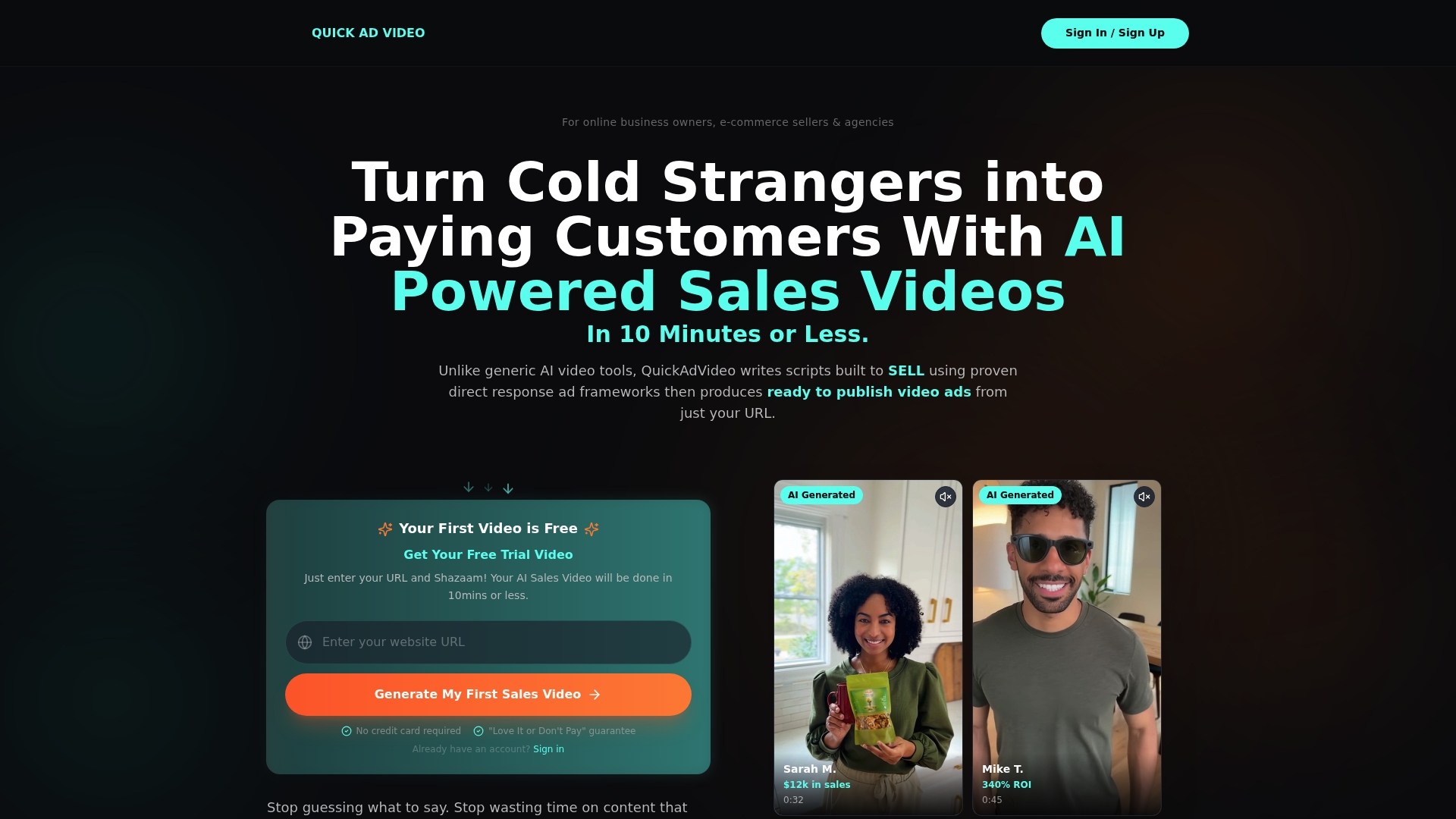
QuickAdVideo’s AI Sales Video Generator is built specifically for online business owners and marketers who want to put proven direct-response frameworks to work without hiring a production team. You paste your product URL, choose your format from a library of sales video templates including UGC, cinematic, and viral story styles, and get a fully structured, conversion-optimized video in minutes. No editing experience needed. No camera time required. Just a faster, more consistent path from product to high-performing sales video.
Frequently asked questions
What is the most important part of a sales video for conversions?
The most crucial part is the clear, persuasive call to action delivered after building credibility and aligning with audience intent. Every element in the direct-response persuasion flow builds toward making that CTA land effectively.
How long should a high-converting sales video be?
Most high-converting sales videos run between two and ten minutes, but the length should serve the persuasion flow rather than an arbitrary target. A shorter video that skips credibility or proof will almost always underperform a longer one that completes the full structure.
Can automated tools create effective sales videos?
Yes, many AI-powered tools now follow proven persuasive structures, making it easier to produce high-converting videos at scale. The key is choosing a platform that embeds the direct-response framework into the creation process rather than just generating visuals.
Where should the call to action appear in a sales video?
The CTA should appear after enough value and proof have been delivered, typically toward the end of the video. Research confirms that early CTA placement can drop conversions sharply because viewers aren’t yet invested in the outcome when they see it too soon.
Recommended
Related Posts

Why Use Templates for Video Ads: Scale Smarter
Discover why use templates for video ads to streamline production. Boost efficiency and scale your campaigns without losing creativity!

The Role of Data-Driven Video Ads in Boosting ROI
Discover the role of data-driven video ads in boosting ROI. Learn how analytics enhance engagement, optimize campaigns, and drive results.

Create Persuasive Video Ads Workflow That Converts
Learn how to create persuasive video ads workflow that transforms your ideas into optimized, high-converting campaigns. Get started today!