
Interactive video ads: boost engagement and conversions
QuickAdVideo Team
Author
Most marketers assume their standard video ads are doing enough. They’re not. Interactive video ads achieve 11% CTR compared to just 1.9% for standard video, which means passive viewing is quietly costing your e-commerce brand real revenue. If you’re still pushing non-interactive video content in 2026 and wondering why your conversion numbers feel flat, the format itself might be the bottleneck. This guide covers exactly what interactive video ads are, which formats work best for online sellers, what the performance data actually looks like, and the pitfalls you need to avoid before you spend another dollar on video.
Table of Contents
- What are interactive video ads?
- Key performance benchmarks and real-world impact
- Popular interactive elements and shoppable overlays
- Risks, edge cases, and best practices for success
- A fresh perspective: what most marketers miss about interactive video ads
- How QuickAdVideo empowers your interactive video success
- Frequently asked questions
Key Takeaways
| Point | Details |
|---|---|
| Interactive video advantages | Interactive video ads deliver dramatically higher engagement, completion, and conversion rates over standard formats. |
| Shoppable overlays boost sales | Clickable shopping features in videos can drive up to 5x more conversions for e-commerce brands. |
| Risk management matters | Careful planning and platform checks are essential to avoid higher costs and technical pitfalls. |
| Measure beyond engagement | Successful marketers focus on downstream conversions, ROAS, and using interaction data for retargeting. |
What are interactive video ads?
Standard video ads are a one-way broadcast. A viewer watches, maybe, and then scrolls past. Interactive video ads flip that dynamic completely by turning the viewer into an active participant.
Technically speaking, interactive video ads use standards like VPAID or SIMID to overlay clickable elements on standard video players. VPAID (Video Player Ad Interface Definition) and SIMID (Secure Interactive Media Interface Definition) are the protocols that allow ad units to communicate with the video player and trigger engagement actions. SIMID is the more modern, secure standard and is increasingly preferred because VPAID has known fraud vulnerabilities, which we’ll cover later.
The clickable elements these standards enable include:
- Hotspots: Clickable areas directly on the video frame, like tapping a product shown on screen to see its price or add it to a cart
- Branching narratives: Viewers choose their own path through the content, selecting storylines or product categories that match their interest
- Polls and quizzes: Quick questions embedded mid-video that gather preference data and keep viewers mentally engaged
- 360-degree views: Rotatable product views that let shoppers examine an item from every angle without leaving the ad
- End-card CTAs: Interactive calls-to-action at the video’s conclusion that can link directly to product pages or checkout
- Shoppable overlays: Product tags that appear over the video, allowing direct purchase without redirecting to another page
For e-commerce brands, understanding how these compare to standard video functionality is essential before committing budget. Here’s a quick side-by-side look:
| Feature | Standard video ad | Interactive video ad |
|---|---|---|
| Viewer engagement | Passive watching | Active participation |
| Click destinations | Single URL | Multiple, context-specific |
| Data collected | Views, completions | Clicks, choices, dwell time |
| Purchase path | Redirect required | In-ad purchase possible |
| Content personalization | None | Dynamic via branching |
| Production complexity | Low | Medium to high |
For e-commerce marketers running product launches, seasonal promotions, or retargeting campaigns, interactive formats are particularly well-suited because they replicate the “browse and decide” behavior of actual shopping. When someone can tap a jacket in your video to see colors, sizes, and price, that’s not an ad anymore. That’s a mini storefront. Learning the AI video ad basics and how automated video creation tools now support interactive elements makes this format more accessible than ever before.

Key performance benchmarks and real-world impact
Understanding the mechanics is essential, but evidence shows that performance metrics are the real game-changer. When you see the actual numbers, the case for interactive video becomes hard to ignore.
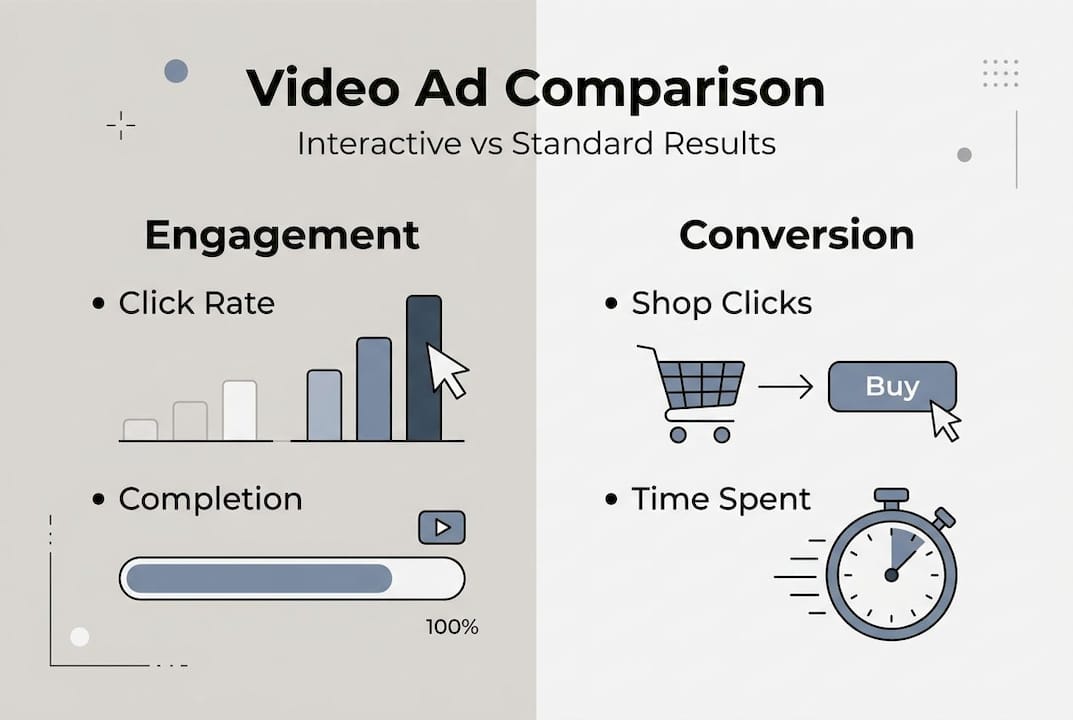
Here’s what the data shows across key performance indicators:
| Metric | Standard video | Interactive video | Lift |
|---|---|---|---|
| Click-through rate (CTR) | 1.9% | 11% | ~479% |
| Completion rate | 58% | 90% | ~55% |
| Engagement rate | Baseline | 3x baseline | 300% |
| Time spent with ad | Baseline | 3x longer | ~200% |
| Purchase intent (viewers) | 51% | 85% | ~67% |
| Conversion lift | Baseline | Up to 70% lift | Significant |
| Shoppable CTV conversions | Baseline | 5x better | 400% |
These benchmarks show 90% completion rates for interactive video versus 58% for standard formats, which matters enormously for e-commerce. A viewer who watches your entire ad is far more likely to remember your brand, trust your product, and follow through on a purchase.
The brand-level impact is just as compelling. Research found that 80% of brands saw increased brand awareness from interactive video campaigns, with 59% reporting higher engagement and 51% reporting higher conversions. Campaigns using interactive elements have also achieved up to 190% higher engagement compared to standard video formats.
For e-commerce specifically, here’s why these numbers translate to real revenue:
- Higher completion rates mean your full product story gets told, not cut short by a swipe
- 300% engagement increases generate more first-party data about what your customers actually want
- 85% purchase intent among interactive ad viewers creates a significantly warmer audience for retargeting
- 70% conversion lift directly affects your cost per acquisition and return on ad spend
The metric that often gets overlooked is time spent. Viewers spending three times longer with your ad means three times more product exposure, three times more brand recall, and three times more opportunity to build the trust that drives purchases. Think about what that means for a high-consideration product like electronics, skincare, or home furniture where shoppers need more information before they buy.
For campaigns focused on effective video messaging, interactive formats let you embed that messaging into a format viewers actively choose to engage with, rather than one they passively tolerate.
Popular interactive elements and shoppable overlays
With benchmarks in mind, let’s explore what interactive features drive the best results and how to use them.
Not every interactive element fits every campaign goal. Here are the most effective types, ranked from simplest to most complex:
-
End-card CTAs: The lowest lift starting point. A clickable button or product card appears at the video’s end with a direct action like “Shop Now” or “Add to Cart.” Works on almost every platform and requires minimal production changes.
-
Hotspots: Clickable product tags that appear mid-video, linked to specific items shown on screen. Ideal for fashion, home décor, and lifestyle brands where multiple products appear in a single scene.
-
Polls and quizzes: Embedded questions that ask viewers about their preferences, like “Which color would you choose?” or “What’s your biggest skincare challenge?” These feel like content, not advertising, which dramatically reduces resistance.
-
Branching narratives: Viewers choose their experience. A fitness brand might offer “I want to lose weight” or “I want to build muscle” as paths, then show relevant products for each. More complex to produce but extremely targeted.
-
360-degree product views: Rotatable views that let viewers examine products from all angles. Especially effective for footwear, furniture, electronics, and accessories where physical inspection typically drives purchase decisions.
-
Shoppable overlays: The most powerful e-commerce format. Product information appears directly over the video frame, and viewers can tap to purchase without leaving the ad environment. Shoppable CTV achieves up to 5x better conversions than standard video, making this the headline performer for online sellers.
Here’s how different elements stack up for e-commerce use cases:
| Interactive element | Best use case | Engagement impact | Conversion impact |
|---|---|---|---|
| Shoppable overlays | Direct product sales | High | Very high |
| End-card CTAs | Lead gen, product pages | Medium | High |
| Polls/quizzes | Data collection, awareness | Very high | Medium |
| Hotspots | Multi-product showcases | High | High |
| Branching narratives | Personalization, loyalty | Very high | Medium-high |
| 360-degree views | Consideration, detail | Medium-high | High |
The VPAID or SIMID overlay standards that power these elements have matured significantly, making shoppable overlays in particular far easier to deploy than they were even two years ago. Platforms like connected TV (CTV), YouTube, and Instagram now support them natively with minimal setup friction.
For creative video content strategies, combining hotspots with shoppable overlays tends to drive the strongest video marketing ROI for product-focused brands. If you’re building out your first campaign, check the video ads growth guide for a structured approach.
Pro Tip: Start with end-card CTAs and a single shoppable overlay before adding branching or quizzes. Viewers who encounter too many decisions at once tend to disengage rather than interact. One clear path beats three confusing options every time.
Risks, edge cases, and best practices for success
Using interactive elements delivers great results, but it’s just as important to know the risks and how to steer clear of common pitfalls.
Interactive video ads carry real trade-offs. Understanding them upfront saves you from expensive surprises mid-campaign. Here are the most significant risks:
- Higher CPM premiums: Interactive video inventory typically costs 30-70% more in CPM than standard video. If your margins are thin, you need to account for this in your ROAS calculations before you start.
- Viewability requirements: Interactive elements require viewability above 70% to trigger reliably. If your placements have low viewability scores, your interactive features may never activate, meaning you pay interactive CPMs for a passive experience.
- VPAID fraud exposure: VPAID-based ads carry known security vulnerabilities that bad actors exploit for ad fraud. Always specify SIMID when possible or work with vendors who explicitly mitigate VPAID fraud risks.
- Complex branching costs: Every additional branch in a narrative ad requires separate creative production. A three-path branching video can cost two to three times more to produce than a linear ad.
- Inconsistent platform support: Programmatic delivery of interactive video is not uniformly supported. Some publishers and SSPs (supply-side platforms) strip interactive elements entirely, serving your expensive interactive ad as a basic video. Always confirm platform support before committing spend.
“Interactive video excels mid-funnel for engagement and data collection, but it’s not the right tool for pure awareness plays. Over-engineering your creative with too many interactive paths actually confuses viewers. Fewer choices, better results. And integration costs frequently exceed production costs, so plan your tech stack before you plan your creative.” — Interactive Video Advertising best-practice research
The distinction between mid-funnel and top-of-funnel is worth emphasizing. If your goal is raw impressions and brand recognition for a cold audience, a polished standard video ad is often more cost-effective. Interactive formats shine when the viewer already has some awareness of your brand or product category, and needs the additional engagement to move toward a decision.
Platform compatibility is the technical risk most often underestimated. Before building an interactive campaign, confirm that your chosen DSP (demand-side platform), publisher, and device targets all support the specific interactive elements you’re planning. A shoppable overlay that never loads isn’t just wasted spend. It’s a broken experience that reflects poorly on your brand.
For maximizing ROI with AI video ads, the smartest approach is to test interactive formats on a proven placement before scaling. Start with one platform where you know viewability is strong, measure the full funnel, and expand only after confirming the lift is real.
Pro Tip: Before launching any interactive campaign, run a compatibility check with your ad server, DSP, and at least three target publishers. Ask explicitly whether SIMID is supported and whether interactive elements are preserved in programmatic delivery. This conversation takes 20 minutes and saves thousands of dollars.
A fresh perspective: what most marketers miss about interactive video ads
Before wrapping up, here’s an insight that separates top performers from everyone else.
Most marketers who try interactive video ads celebrate their engagement numbers and call it a win. High click rates, impressive completion rates, lots of poll responses. It feels like success. But engagement metrics alone are vanity metrics if they don’t connect to revenue.
The brands actually winning with interactive video measure the full funnel. That means tracking not just interaction rates and completions but downstream conversions and ROAS from each interactive element separately. Digital marketers should measure interaction starts, completions, downstream conversions, and ROAS while using first-party signals from interactions for retargeting.
That last point is where the real opportunity lives. Every poll answer, every hotspot click, every branching choice your viewers make is a declared preference signal. That data is yours. It tells you which products generate genuine interest, which customer pain points resonate, and which audience segments are closest to buying. Building retargeting audiences from interaction behavior consistently outperforms cookie-based retargeting because the intent signal is so much stronger.
The brands that treat interactive video as a data collection tool, not just a conversion mechanism, build compounding advantages over time. Their conversion-focused messaging improves with every campaign because they’re learning directly from buyer behavior, not guessing at it.
How QuickAdVideo empowers your interactive video success
Ready to apply what you’ve learned? Here’s how QuickAdVideo can help you succeed.
QuickAdVideo is built specifically for e-commerce brands and digital marketers who need high-performing video content without the production overhead. The platform’s AI-powered engine generates scripts and video assets built around proven direct response frameworks, so your foundation is strong before you add any interactive layer.
With QuickAdVideo’s range of interactive video models, including UGC, cinematic, and viral story formats, you can build the kind of compelling base content that makes interactive overlays and shoppable elements actually convert. The AI video editor makes it fast to customize assets for different placements and audiences, meaning your interactive campaigns stay agile as you test and optimize. From product launch to full-scale ad campaign, QuickAdVideo gives you the tools to execute at speed.
Frequently asked questions
What makes interactive video ads more effective than standard video ads?
Interactive video ads generate dramatically better results because viewers actively participate instead of passively watching. Interactive video achieves 11% CTR, 300% higher engagement, and up to 70% conversion lift compared to standard video formats.
Are there any risks or drawbacks to using interactive video ads?
Yes, the main risks include paying 30-70% higher CPM premiums, exposure to VPAID ad fraud, complex production costs for branching content, and inconsistent support across programmatic platforms. Always verify platform compatibility before launching.
What interactive elements drive the best e-commerce results?
Shoppable overlays consistently lead e-commerce performance, with up to 5x better conversions for shoppable CTV versus standard video. Polls and end-card CTAs also perform well, especially when the interaction paths are kept simple and direct.
How should digital marketers measure interactive video ad success?
Track the complete funnel: interaction starts, completion rates, downstream conversions, and ROAS per element. Using first-party signals from interactions for retargeting consistently outperforms cookie-based audience strategies and compounds value across campaigns.
Recommended
Related Posts

Why Use Templates for Video Ads: Scale Smarter
Discover why use templates for video ads to streamline production. Boost efficiency and scale your campaigns without losing creativity!

The Role of Data-Driven Video Ads in Boosting ROI
Discover the role of data-driven video ads in boosting ROI. Learn how analytics enhance engagement, optimize campaigns, and drive results.

Create Persuasive Video Ads Workflow That Converts
Learn how to create persuasive video ads workflow that transforms your ideas into optimized, high-converting campaigns. Get started today!