
How to create sales videos that convert with AI tools
QuickAdVideo Team
Author
Most sales videos get skipped in the first three seconds. You’ve put in the effort, you’ve got a great product, but the video sits online doing nothing while your competitors rack up sales. The problem usually isn’t your product. It’s the video itself. Shrinking attention spans mean you have roughly five seconds to hook a viewer before they scroll on forever. The good news is that AI-driven video creation tools have completely changed what’s possible, letting you produce professional, high-converting content in minutes rather than days. Here’s exactly how to do it right.
Table of Contents
- What you need to create high-converting sales videos
- Script frameworks: proven structures for sales videos
- Step-by-step: Creating your sales video with AI
- Troubleshooting and common mistakes in sales video creation
- Measuring results: Key metrics for sales video success
- Why authentic storytelling beats polished AI visuals
- Accelerate sales video creation with QuickAdVideo AI tools
- Frequently asked questions
Key Takeaways
| Point | Details |
|---|---|
| Focus on short videos | Sales videos perform best when kept between 30 and 90 seconds, grabbing attention quickly. |
| Use proven script frameworks | Employ formulas like AIDA or the 40-second structure to maximize engagement and ensure clear calls to action. |
| Leverage AI for efficiency | AI video generators speed up production, allow for personalization, and scale campaigns cost-effectively. |
| Monitor key metrics | Track engagement rates, conversions, and audience data to continuously improve video performance and ROI. |
| Prioritize authentic storytelling | Human insight and targeted messaging drive higher conversions than polished, automated videos alone. |
What you need to create high-converting sales videos
Before you record a single frame or type a single word into an AI platform, you need the right setup. The tools and formats you choose will determine how fast you can produce content and how well it performs.
AI video platforms are the backbone of modern sales video production. Tools like HeyGen, Synthesia, and Pictory handle text-to-video conversion, AI avatars, and personalization at scale without requiring you to re-record anything. This is a game-changer for e-commerce brands and agencies managing multiple products or clients simultaneously.
On the hardware side, you don’t need a Hollywood setup. A decent webcam (1080p minimum), a USB microphone, and a simple ring light will cover the basics if you want to include real footage. For most AI-driven workflows, your laptop is genuinely enough.
Choosing the right video format matters just as much as the tools you use. Consider these options based on your goal:
- Webcam (talking head): Best for personal connection, testimonials, and direct response ads
- Screen share: Ideal for software demos, tutorials, and SaaS product walkthroughs
- Hybrid/playlist: Combines multiple formats for longer VSLs (video sales letters) or course previews
- AI avatars: Perfect for effective video messaging at scale without appearing on camera
According to HubSpot’s research on video in sales, formats like webcam deliver personal touch, screen share excels at product demos, and AI avatars drive consistent branding across campaigns. The format you pick should match your audience’s expectations and where the video will live.
Here’s a quick format comparison to help you decide:
| Format | Best use case | Production time | On-camera required |
|---|---|---|---|
| Webcam | Testimonials, personal ads | Medium | Yes |
| Screen share | Demos, tutorials | Low | No |
| AI avatar | Scalable ad campaigns | Very low | No |
| Hybrid | VSLs, course previews | High | Optional |
Pro Tip: AI avatars give you consistency across every video without bad hair days or lighting issues. But don’t go 100% automated. Even a brief moment of authentic human presence, like a real voiceover or a genuine on-screen face, can lift conversions meaningfully. Learn more about the benefits of AI video content before committing to one format.
Script frameworks: proven structures for sales videos
With your tools selected, the next step is structuring video content to drive action. A beautiful video with a weak script is just an expensive screensaver.

Short-form videos between 30 and 90 seconds consistently outperform longer content for direct response. But length alone won’t save a poorly structured script. You need a proven framework that moves the viewer from curiosity to conversion without losing them halfway through.
The three most effective frameworks for sales videos are:
- AIDA (Attention, Interest, Desire, Action): Start by grabbing attention with a bold claim, build interest with relevant details, create desire with benefits and proof, then close with a clear action.
- PAS (Problem, Agitate, Solution): Open with a problem your viewer recognizes, amplify the pain of leaving it unsolved, then position your product as the obvious fix.
- The 40-second formula: A tight, punchy structure where the 40-second formula breaks down as: 0 to 5 seconds for your hook, 5 to 15 seconds for the core problem, 15 to 25 seconds for social proof, and 25 to 35 seconds for your CTA.
The 40-second formula works especially well on TikTok, Instagram Reels, and YouTube Shorts where viewers make split-second decisions about whether to keep watching. For longer VSLs or email campaigns, PAS tends to build more emotional momentum.
Here’s a data-backed look at how script structure affects performance:
| Script element | Time slot (short video) | Impact on conversions |
|---|---|---|
| Hook (bold claim/question) | 0 to 5 seconds | Determines 80% of view-through rate |
| Problem statement | 5 to 15 seconds | Increases relevance and retention |
| Social proof (review/stat) | 15 to 25 seconds | Builds trust and reduces skepticism |
| Call to action (CTA) | 25 to 35 seconds | Drives clicks and purchases |
When crafting video scripts, always write your hook before anything else. The hook is the single most important sentence in your entire video. If it doesn’t immediately address something your viewer cares about, nothing else matters.
Pro Tip: Your first line should not be “Hi, my name is…” That’s a skip trigger. Instead, open with a provocative question, a surprising fact, or a direct statement of a problem your audience feels right now. Check out creative video content ideas for hook inspiration across different niches.
Step-by-step: Creating your sales video with AI
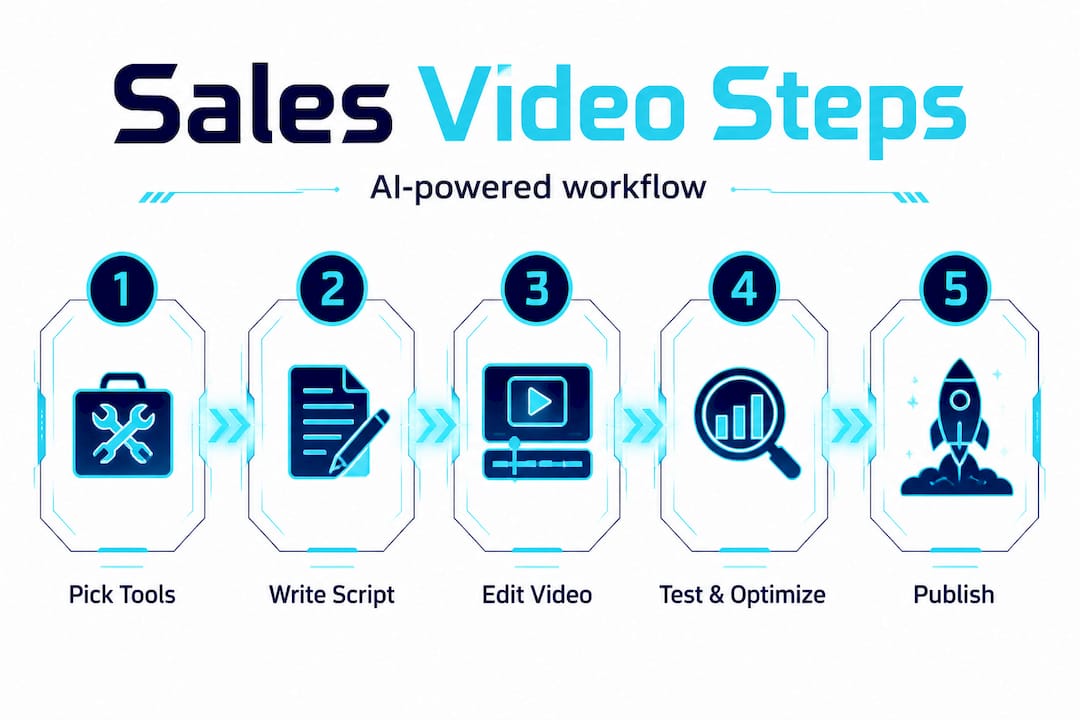
Once your script and framework are ready, it’s time to use AI tools to produce the actual video efficiently. Here’s a repeatable workflow you can follow for every video you create.
- Define your video type and goal. Are you making a product ad, a testimonial, an email intro video, or a VSL? The goal shapes every other decision.
- Write your script using a framework. Use PAS, AIDA, or the 40-second formula. Keep the language conversational and specific to your audience’s pain points.
- Select your AI video platform. Platforms like HeyGen, Synthesia, and Pictory each have strengths. HeyGen excels at personalized avatars, Synthesia is strong for corporate training and product explainers, and Pictory is excellent for turning long-form content into short clips.
- Customize visuals and branding. Upload your product images, brand colors, and logo. Choose a voice and avatar style that matches your brand tone. Consistency here is what separates professional-looking content from generic AI output.
- Finalize your CTA. Your call to action should be specific. “Shop now and get 20% off” beats “click here” every single time. Make it visible, make it urgent, and make sure it points to one destination only.
- Export and publish. Most platforms let you automate video content and publish directly to TikTok, Instagram, YouTube, and Facebook. Use native uploading where possible for better algorithmic reach.
“Deals are 127% more likely to close when video is part of the sales process, and reps using video book 4x more meetings than those who don’t.”
That statistic should make video creation a non-negotiable part of your workflow, not an occasional experiment. For a deeper walkthrough on workflow setup, the guide on getting started with AI video covers platform selection and first-campaign best practices in detail.
Pro Tip: Use AI video templates as your starting point but swap in real customer quotes, actual product screenshots, or a brief segment of authentic footage. This hybrid approach combines the speed of automation with the trust-building power of real human elements.
Troubleshooting and common mistakes in sales video creation
Even with powerful tools and frameworks, many creators repeat the same costly mistakes. Catching these early saves time, money, and a lot of frustration.
The biggest mistake is over-relying on AI avatars without injecting any personality. AI democratizes production but risks making your content bland and forgettable. When every brand uses the same avatar styles and templates, nothing stands out. Your differentiation comes from authentic insights, specific pain-point language, and human nuance that AI alone can’t generate.
Here are the most common mistakes and how to fix them:
- Generic scripts: Saying “our product is amazing” tells viewers nothing. Speak directly to a specific problem with specific language your audience uses.
- Weak or missing CTA: Every video needs exactly one clear action. Giving viewers three options means they’ll choose none.
- Poor pacing: Too slow in the opening, too rushed at the close. Match your pacing to the emotional arc of the script.
- Ignoring metrics: Publishing and walking away is the fastest way to waste your budget. Every video should be tracked from day one.
- No testing phase: Launching straight to a wide audience without small-scale testing is a gamble. A/B test thumbnails, hooks, and CTAs before scaling spend.
- Overproduction focus: Obsessing over perfect visuals while neglecting the message. Viewers buy based on what you say, not just how polished it looks.
The debate between UGC vs traditional video marketing is relevant here. UGC (user-generated content) style videos often outperform polished productions because they feel real. You don’t always need high production value. You need believability. That said, cinematic video marketing has its place for premium brands where the visual presentation is part of the value proposition.
Pro Tip: Before launching to your full ad budget, test your video with a small audience of 500 to 1,000 people. Look at 3-second play rate and 50% watch-through rate as early indicators of whether the hook and pacing are working. Optimize before scaling.
Measuring results: Key metrics for sales video success
Once your sales video is live, tracking results is essential to refine your approach and boost conversions. Vanity metrics like total views will make you feel good but won’t pay your bills.
Focus on these metrics that actually connect to revenue:
- Engagement rate: The percentage of viewers who interact with your video through likes, comments, shares, or saves. Average engagement rate for 3 to 5 minute videos sits at around 43%, which is a useful benchmark for evaluating your content’s pull.
- Watch time and completion rate: How far viewers get through your video reveals where you’re losing them. A drop-off at 15 seconds means your opening isn’t converting interest into attention.
- Conversion rate: The most critical number. Email capture forms connected to video content average a 23% conversion rate, while in-video CTAs average around 13%. Knowing your baseline helps you set realistic improvement targets.
- Click-through rate (CTR): Measures how many viewers took the action you asked for. Low CTR with high watch time usually signals a weak CTA.
- Demographics: Who is actually watching? If your video is being watched by the wrong audience, the smartest fix is distribution, not the video itself.
Stat to bookmark: Videos between 3 and 5 minutes drive the highest average engagement rates at 43%, but short-form content consistently delivers the best ROI for paid campaigns.
Reviewing video ROI strategies alongside these metrics gives you a complete picture of what’s working and what to cut. And for a broader look at why the investment is worth it, the data on video ads boosting ROI is compelling reading before you plan your next campaign.
Why authentic storytelling beats polished AI visuals
Here’s the perspective most marketing articles won’t give you: automation is not your competitive advantage. Authenticity is.
The market is flooding with AI-generated content. Every dropshipper, every agency, every solo entrepreneur now has access to the same avatar tools, the same templates, the same voice generators. If everyone uses the same tools the same way, you get a race to the bottom where nothing converts because nothing feels real.
The creators who are actually winning with video in 2026 are the ones using AI to amplify human strategy, not replace it. They prioritize targeted pain-point content that speaks directly to a very specific buyer, rather than chasing viral metrics that look great in a dashboard but don’t translate to sales. A video with 800 views and a 12% conversion rate is worth twenty times more than a viral video with 500,000 views and a 0.1% conversion rate.
The most effective messaging insights we’ve seen at QuickAdVideo consistently come from scripts where the creator clearly understands one specific customer and one specific problem. Not a broad audience. Not a general pain point. One person, one problem, one solution.
AI amplifies. Humans direct. If your strategy is weak, AI just produces weak content faster. The fix is to spend more time understanding your customer’s language, fears, and desires before you touch a single AI tool. Your script is where conversions are won or lost. Everything else is execution.
Accelerate sales video creation with QuickAdVideo AI tools
If this article has made one thing clear, it’s that the gap between knowing what makes a great sales video and actually producing one at scale is where most businesses get stuck. Time, resources, and technical skills become barriers fast.
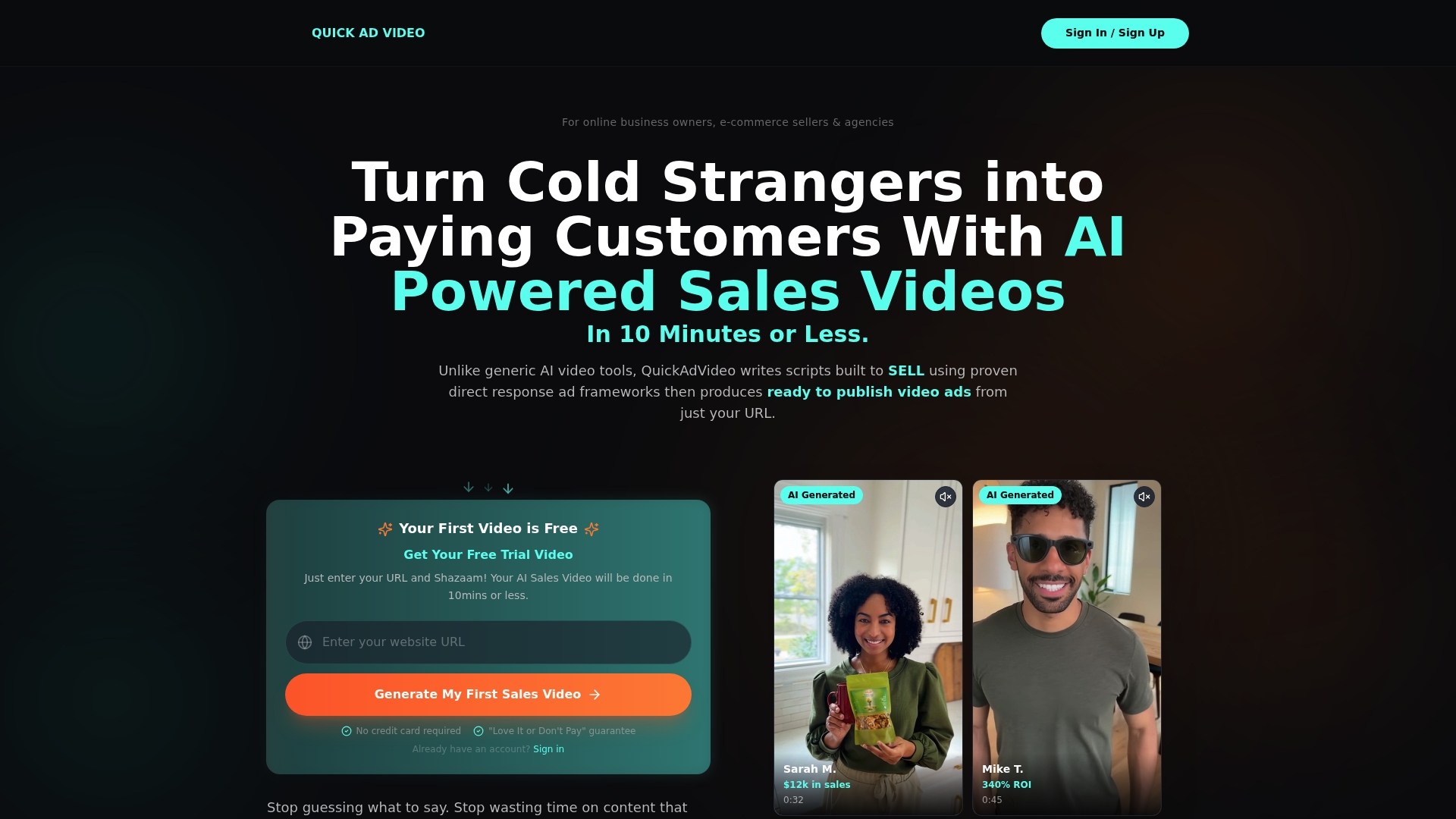
QuickAdVideo removes those barriers entirely. You paste in your product or service URL, and the platform generates a persuasive, direct-response sales video in minutes using proven AI scripts built on frameworks like the ones covered in this article. From the AI sales video editor to a full library of AI video generation models including UGC, cinematic, and viral story formats, you get everything you need to produce, test, and publish across TikTok, Instagram, YouTube, and Facebook without editing skills or camera experience. Visit QuickAdVideo to start creating videos that actually convert.
Frequently asked questions
What is the best length for a sales video?
Aim for 30 to 90 seconds for most direct response ads, with a strong hook delivered in the first 5 seconds to maximize audience retention and reduce drop-off rates.
Which AI tools help create sales videos quickly?
Platforms like HeyGen, Synthesia, and Pictory are top choices, each offering text-to-video, AI avatars, and personalization features that make fast, scalable production achievable without any technical expertise.
How can I measure my sales video’s effectiveness?
Focus on engagement rate, watch time, conversion rate, and audience demographics rather than raw view counts, since engagement rate averages 43% for mid-length videos and is a much stronger performance indicator.
Do AI-generated sales videos convert as well as traditional videos?
They can, but authenticity still drives conversions. AI videos that include human elements, specific pain-point language, and genuine insight consistently outperform fully automated content that prioritizes visual polish over real connection.
Recommended
Related Posts

Why Use Templates for Video Ads: Scale Smarter
Discover why use templates for video ads to streamline production. Boost efficiency and scale your campaigns without losing creativity!

The Role of Data-Driven Video Ads in Boosting ROI
Discover the role of data-driven video ads in boosting ROI. Learn how analytics enhance engagement, optimize campaigns, and drive results.

Create Persuasive Video Ads Workflow That Converts
Learn how to create persuasive video ads workflow that transforms your ideas into optimized, high-converting campaigns. Get started today!