
Business video trends that drive e-commerce growth
QuickAdVideo Team
Author
Video is moving faster than most brands realize. AI use in video production more than doubled year-over-year, jumping from 18% of professionals to 41% in a single year, with another 19% planning to start soon. That is not a slow evolution. For e-commerce marketers and business owners, that shift signals a real opportunity: the tools are maturing, adoption is accelerating, and those who understand the direction of travel right now will have a measurable edge over competitors still treating video as a nice-to-have.
Table of Contents
- Why video matters now more than ever
- Emerging business video trends every e-commerce brand should know
- Tactics that work: CTA placement and conversion insights
- Beyond trends: Strategy beats more content
- What most e-commerce marketers still miss about video trends
- Put the latest video trends to work in your business
- Frequently asked questions
Key Takeaways
| Point | Details |
|---|---|
| Video adoption rising | Most businesses continue to increase their video marketing budgets to boost results. |
| AI drives new trends | AI-powered tools and automation are reshaping how e-commerce brands produce and use video. |
| CTA strategy matters | Placing a call-to-action early in short videos increases conversion significantly. |
| Strategy over volume | Integrating video thoughtfully within your marketing funnel beats focusing on content quantity alone. |
Why video matters now more than ever
Some marketers quietly wonder if the video wave has crested. There are more videos online than ever, attention is fractured, and production costs have felt like a barrier. But the data pushes back hard on that thinking.
Video spending is not slowing down across the business world. Despite persistent economic uncertainty, only 5% of companies are cutting their video budgets in 2025, while 57% are actively investing more. That is an extraordinary signal. When a channel survives economic headwinds and actually grows, it is because it is delivering real, measurable value.
For e-commerce specifically, video fills roles that no other format can. A static product image can show what something looks like. Video shows how it moves, how it fits, how it solves a problem. That difference directly affects trust and purchase behavior. There is a reason why investing in video ads consistently shows up in ROI conversations for online sellers. Video is the closest thing to a live sales demo that a digital storefront can offer.
Here is what video actually does for e-commerce businesses right now:
- Builds product trust before a customer reaches the checkout
- Demonstrates features in ways that text and images cannot replicate
- Reduces return rates because buyers understand what they are purchasing
- Supports paid advertising with higher click-through and conversion rates
- Creates shareable social content that extends organic reach
57% of businesses are increasing their video budgets in 2025, while only 5% are reducing spending — a clear sign that video is delivering results, not just impressions.
The “oversaturation” argument also misses something important. Yes, there is more video content. But most of it is mediocre, misaligned, or missing a clear purpose. Brands that invest in strategic, well-structured video are not competing against all video. They are competing in a much smaller group of videos that actually convert.
Emerging business video trends every e-commerce brand should know
With video’s strategic importance clear, what specific trends are shaping the next wave of business video for e-commerce brands?
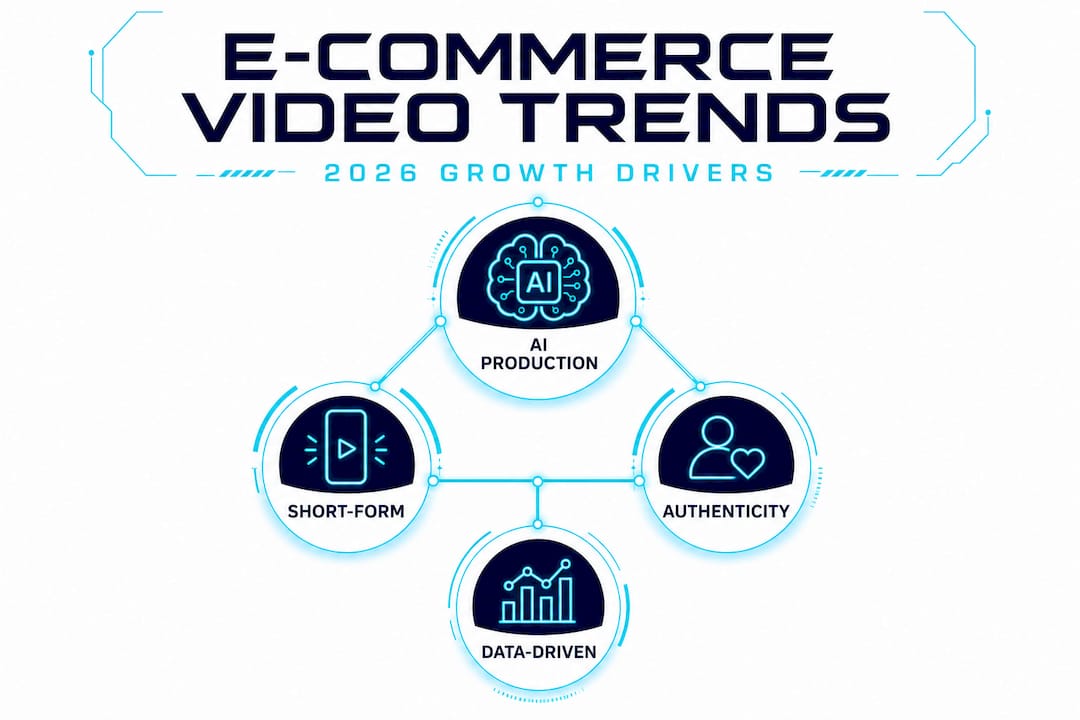
The shift in 2026 is less about one flashy format and more about a structural change in how video gets made, distributed, and measured. Here are the trends that matter most right now.
AI-powered creation is becoming the new standard. The AI use in video production statistic tells only part of the story. It is not just that more people are using AI. It is that AI is now producing content that was previously inaccessible to small and medium-sized e-commerce operations. Script writing, voiceover generation, scene assembly, even persona creation are all areas where AI has crossed a quality threshold that makes the output genuinely usable. The benefits of AI video content creation go far beyond cost savings. Speed, scalability, and consistency are just as valuable.
Short-form, mobile-first video dominates. Viewers on TikTok, Instagram Reels, and YouTube Shorts are not watching passively. They are swiping, deciding, and sometimes buying all within the same session. E-commerce brands that ignore vertical, short-form video are missing the highest-traffic real estate in digital media today.
Authenticity beats production polish. Consumers have developed strong radar for overly produced, corporate-feeling content. User-generated content (UGC) style videos, even when AI-assisted, consistently outperform glossy brand videos for trust and conversion. Relatability is a feature, not a compromise.
Data-driven video strategy is replacing gut instinct. More teams are using analytics to track watch time, drop-off points, CTA clicks, and actual revenue tied to video. Automating video content makes it easier to run multiple variations and let performance data make the decisions.
| Trend | What it means for e-commerce | Action to take |
|---|---|---|
| AI-powered production | Faster, cheaper, scalable video at volume | Use AI tools for product demos and ads |
| Short-form mobile video | Highest organic and paid reach right now | Prioritize 15-60 second vertical content |
| Authenticity over polish | UGC-style content converts better | Use conversational scripts and real-world scenarios |
| Interactive video | Embeddable CTAs and clickable elements boost buying intent | Test shoppable video formats |
| Analytics and ROI tracking | Ties video spend to actual revenue | Track watch time, CTA clicks, and sales per video |
Pro Tip: Do not try to chase every trend simultaneously. Pick the one or two shifts most relevant to your current marketing funnel stage and build from there. Spreading effort across every trend without depth leads to average performance everywhere.
Tactics that work: CTA placement and conversion insights
Understanding trends is crucial, but what specific tactics can directly boost e-commerce sales using video?
The single most actionable finding from recent video research is about call-to-action placement. It sounds simple, but most brands get this wrong. They treat the CTA as an afterthought, dropping it at the end of a video after viewers have already decided to scroll away.
CTAs placed in the first quarter of videos under 60 seconds convert nearly 40% of viewers. That is a staggering number for digital marketing, where 2-5% conversion rates are often considered solid.
“The difference between a video that sells and a video that just gets watched is often as simple as when and how you ask for the next step.”
This changes how you should structure every e-commerce video. Think of it less as a story with a payoff at the end, and more as an immediate value exchange. Here is a sequence that consistently works:
- Hook (0-3 seconds): Interrupt the scroll with a bold visual, a direct statement about the problem, or an unexpected result.
- Value delivery (3-20 seconds): Show or explain the core benefit. Make it specific. “This serum reduced dark spots in 14 days” beats “our product helps skin.”
- Early CTA (by 15-20 seconds): Place the first CTA here. Do not wait. Even if the viewer stays for more, you have already invited the action.
- Social proof or demonstration (20-45 seconds): Show it working, add a testimonial clip, or demonstrate a specific feature.
- Closing CTA: Repeat the action with slightly different language to capture late converters.
Learning how to craft effective video messaging around this structure is what separates brands getting strong ROI from those generating views but not revenue.
Interactive video ads take this further by embedding clickable buttons, polls, or product links directly inside the video experience. Rather than waiting for a viewer to take a separate action, interactive elements reduce friction and move the decision point closer to the moment of interest.
Here is a direct comparison of passive versus active video structure:
| Element | Passive video approach | Active, conversion-focused approach |
|---|---|---|
| CTA timing | End of video | First 15-20 seconds |
| CTA type | “Follow us for more” | “Shop now,” “Get yours today” |
| Engagement mechanics | None | Polls, clickable overlays, product links |
| Measurement | View count | Clicks, leads, purchases |
| Script focus | Brand story | Problem, solution, benefit, action |
For cinematic videos in marketing, the same principles apply even when the format is more visually ambitious. A beautifully shot video that buries the CTA still underperforms a simpler video that prompts action early.
Pro Tip: Test two versions of the same video with CTAs at different timestamps and compare conversion rates over 500 views before declaring a winner. Small sample sizes produce misleading results.
Beyond trends: Strategy beats more content
Mastering actionable tactics is powerful, but true success rests on integrating video into a holistic business strategy.
Here is the uncomfortable reality that most content about video marketing skips: producing more videos is not automatically a good strategy. Volume without direction creates noise. Creating more video content alone is not enough. Video needs to function as a component of a broader, measurable system tied to trust and decision support, not just views or algorithmic engagement.
“Volume without alignment is just expensive noise. Every video should answer a specific question a buyer has at a specific stage of their journey.”
Consider the buyer journey for an e-commerce customer:
- Awareness stage: They are discovering a problem or a product category. Video here should educate, entertain, or surprise. Think short-form social content.
- Consideration stage: They are comparing options. Video here should demonstrate, compare, and address objections. Think product demos and explainers.
- Decision stage: They are ready to buy but need a final push. Video here should reinforce trust, reduce risk, and create urgency. Think testimonials, guarantees, and limited offers.
Most brands make awareness content and decision content but skip the middle. That gap is where buyers stall, compare prices elsewhere, and disappear.
The brands getting exceptional video trust and ROI are the ones treating each video as a deliberate asset in a larger system, not an isolated piece of content. They know which videos are reducing bounce rates, which are increasing average order value, and which are bringing return customers back.
Integration also matters. A video that lives only on TikTok is far less powerful than the same video repurposed as a product page embed, an email campaign asset, and a paid ad simultaneously. The return on a single well-made video multiplies when it moves across channels with purpose.
What most e-commerce marketers still miss about video trends
Here is the perspective that most trend roundups will not give you directly.
After watching how e-commerce brands respond to video trend cycles, the pattern is almost always the same. A new format emerges. Brands rush to replicate it. Performance is mediocre because they are copying the surface of what worked for someone else, without understanding why it worked or whether it fits their customer’s actual decision-making process.
The brands that consistently outperform on video are not the ones with the biggest production budgets or the fastest trend reaction times. They are the ones who have answered a more fundamental question first: what does my customer need to believe before they buy, and how does video help them believe it?
That question changes everything about how you write scripts, choose formats, and measure success. It shifts the focus from “how many views did this get” to “how many people who watched this went on to purchase.” It is the difference between vanity metrics and actual business outcomes.
We have also seen a consistent underestimation of video psychology and trust. Video works not just because it shows a product but because it activates something deeper in how buyers evaluate credibility. Faces, voices, and real-world demonstrations trigger trust in ways that text and images simply cannot. That is the actual mechanism driving conversions, and it is the mechanism worth designing around.
The uncomfortable truth is that a single well-thought-out video, made with a clear customer psychology framework in mind, will almost always outperform a catalog of trend-chasing content made without that foundation. Start with the belief barrier. Build backward from there. Let trends inform the format, not the strategy.
Put the latest video trends to work in your business
Ready to act on the trends and strategies above? Here’s how you can put them to use with the latest AI tools.
The shifts happening in business video right now, AI-powered creation, short-form conversion content, strategic CTA placement, and funnel-aligned messaging, are not just accessible for large teams with big budgets. They are available to any e-commerce seller willing to work smarter.

QuickAdVideo is built to give online sellers and marketers direct access to these capabilities without the usual time and cost barriers. Paste your product URL and the AI sales video generator builds conversion-focused scripts and video content using proven direct response frameworks. Choose from AI video creation models including UGC, cinematic, and viral story formats, each optimized for different stages of the buyer journey. You can also explore purpose-built video advertising solutions designed specifically for e-commerce brands that need to drive measurable results from paid and organic campaigns. Whether you are launching a product, scaling ads, or building social proof, the tools are ready when you are.
Frequently asked questions
How can AI help with business video production in 2026?
AI tools automate editing, scripting, and content personalization, making it possible for e-commerce brands to produce high-quality videos faster and at a fraction of traditional costs. AI use in video production has already crossed 41% among video professionals, a figure that continues to rise.
What video length and CTA strategy works best for e-commerce conversions?
Short videos under 60 seconds work best, and CTAs in the first quarter of those videos convert nearly 40% of viewers, making early CTA placement one of the highest-impact tactics available.
Do most businesses plan to reduce their video marketing budgets in 2026?
No. Only 5% of companies are reducing video budgets, while 57% are actively investing more, which shows strong confidence in video as a reliable marketing channel.
Is creating more video the best way to improve business results?
Not on its own. Creating more video alone without a clear strategy tied to buyer decision-making and measurable outcomes tends to generate volume without the conversions that actually grow a business.
Recommended
Related Posts

Why Use Templates for Video Ads: Scale Smarter
Discover why use templates for video ads to streamline production. Boost efficiency and scale your campaigns without losing creativity!

The Role of Data-Driven Video Ads in Boosting ROI
Discover the role of data-driven video ads in boosting ROI. Learn how analytics enhance engagement, optimize campaigns, and drive results.

Create Persuasive Video Ads Workflow That Converts
Learn how to create persuasive video ads workflow that transforms your ideas into optimized, high-converting campaigns. Get started today!