
AI video scripts explained: your guide to high-converting ads
QuickAdVideo Team
Author
Video marketing used to cost a fortune and take forever. Producing a single polished minute of sales video ran about $4,500 and consumed nearly two weeks of production time. AI has cut that to $400 and 27 minutes. For entrepreneurs and e-commerce sellers, that shift is not incremental, it is transformational. This guide has AI video scripts explained in practical terms, covering how they work, which tools to use, and how to turn AI-generated copy into ads that actually convert.
Table of Contents
- What are AI video scripts and how do they transform video marketing?
- How AI-generated video scripts work: from prompts to polished sales videos
- Choosing the right AI script tools for your e-commerce videos
- Best practices to maximize AI video scripts for higher conversions
- Measuring success and scaling your AI-driven video marketing
- Why entrepreneurs must focus on strategic script orchestration, not just automation
- Get started with QuickAdVideo’s AI-powered sales video generator
- Frequently asked questions
Key Takeaways
| Point | Details |
|---|---|
| AI drastically cuts costs | AI video generators reduce production costs by more than 90%, making video advertising affordable for entrepreneurs. |
| Structured workflow matters | Generating hooks, outlining scenes, and iteratively refining scripts improves engagement and script quality. |
| Choose specialized tools | Tools with format-specific expertise and brand memory outperform generic AI models for video scripts. |
| Human editing remains key | Combining AI drafts with human review ensures authentic dialogue and consistent brand voice. |
| Measure and scale intelligently | Track retention and conversions to optimize AI video scripts and scale production effectively. |
What are AI video scripts and how do they transform video marketing?
An AI video script is copy generated by an artificial intelligence tool based on a prompt, product brief, or URL. The output is structured for video: it includes a hook, scene-by-scene dialog, and a call to action. Some platforms stop there and hand you a text file. Others go further and turn that script into a finished video using avatars, stock footage, voiceover, and music, all without a camera or an editor.
The benefits of AI video content creation are not just about speed. They are about access. A solo e-commerce seller can now produce the kind of polished, direct-response video that used to require a production crew, a copywriter, and a post-production team. AI levels that playing field overnight.
Here is what modern AI video generation typically handles:
- Script writing based on product details, target audience, and platform format
- Voiceover generation using realistic text-to-speech or cloned brand voices
- Visual assembly using stock footage, AI-generated imagery, or avatar presenters
- Captions and formatting sized correctly for TikTok, Instagram Reels, YouTube Shorts, or Facebook
“AI video generators can create finished videos from text prompts in minutes, replacing multiple roles and steep costs.”
For small businesses and entrepreneurs running lean, this changes everything about what is possible. Instead of choosing between video marketing and your budget, you can now do both.
How AI-generated video scripts work: from prompts to polished sales videos
The quality of your AI video script depends almost entirely on how you set it up. A vague prompt like “write a video about my supplement brand” produces generic copy that sounds like every other ad in your category. A detailed brief produces something that actually sells.
Here is the workflow that produces the best results:
-
Write a detailed brief, not just a topic. Include your product name, target customer, core benefit, price point, and the one objection you most need to overcome. The more specific your input, the more conversion-focused your output.
-
Generate multiple hooks first. Ask your AI tool for eight different hook options before writing a single scene. Hooks decide whether someone stops scrolling or keeps going. Test emotional angles: curiosity, pain, surprise, and aspiration. Pick the strongest one and build from there.
-
Outline scenes with timing. Map out each scene before you expand it. A 30-second ad might have five scenes at roughly six seconds each. Pacing matters because specialized AI tools that generate conversion-focused e-commerce scripts in 2 to 3 hours account for platform-specific timing from the start.
-
Integrate research. Ask the AI to pull in product-specific language, customer reviews, or competitor differentiators. Real language from real customers builds instant credibility.
-
Read it aloud before you finalize. Dialog that looks clean on a screen often sounds unnatural when spoken. A quick read-aloud pass catches awkward phrasing and sentences that are too long for voiceover.
Pro Tip: Before you generate your final script, feed your AI tool two or three actual customer reviews from your product page. Ask it to mirror that language in the hook and problem section. Audiences recognize their own words, and that recognition builds immediate trust.
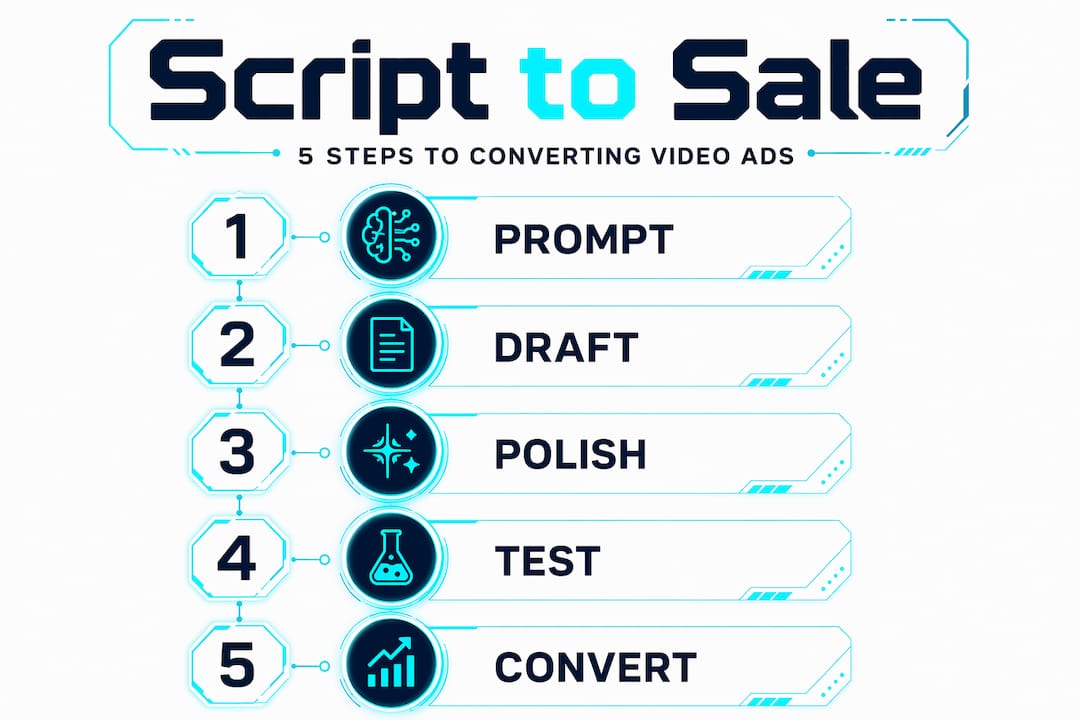
When you automate video content for your business, this five-step process is what separates a polished, conversion-ready ad from one that sounds robotic and generic. The workflow is repeatable, which means your team can produce consistent scripts at scale without reinventing the process every time.
Choosing the right AI script tools for your e-commerce videos
There are two broad categories of AI scriptwriting tools: generalist platforms and specialist platforms. Generalist tools like ChatGPT are powerful for brainstorming and drafting, but they do not retain your brand voice between sessions, and they have no built-in knowledge of direct response frameworks or e-commerce conversion structures.

Specialist tools are built specifically for video scripts. They know that an ad needs a hook in the first three seconds. They understand scene pacing, platform length requirements, and call-to-action placement. Specialized tools with domain knowledge and persistent memory deliver consistently stronger video scripts than general-purpose AI.
Here is a comparison of what to look for:
| Feature | Generalist AI | Specialist AI |
|---|---|---|
| Script structure knowledge | Basic | Built-in (hooks, CTA, pacing) |
| Brand voice memory | Session only | Persistent across projects |
| Platform format awareness | Manual input required | Automatic (TikTok, YouTube, etc.) |
| E-commerce optimization | Requires detailed prompting | Native capability |
| Video production integration | None | Often included |
When evaluating tools, prioritize these features:
- Script structure templates for ads, explainers, and social content
- Brand voice files so you are not re-training the tool on every project
- Research integration that pulls in product data or reviews automatically
- Platform-specific output that formats scripts for 15-second, 30-second, or 60-second formats
If you want to see how full-stack AI video platforms compare to tools that only handle the script layer, a review of QuickAdVideo alternatives breaks down the key differences in production capability and output quality.
The right choice depends on your volume. If you are producing two or three videos a month, a generalist tool with strong prompting may be enough. If you are running product launches, seasonal campaigns, and ongoing social ads simultaneously, a specialist platform pays for itself in hours saved.
Best practices to maximize AI video scripts for higher conversions
Producing a script is step one. Getting it to convert is a different challenge. Here are the practices that consistently move the needle for e-commerce sellers:
-
Create hook variants with different emotional angles. Write one hook that leads with pain (“Still losing sales because your ads look cheap?”), one that leads with curiosity (“Here’s why 3-second videos outperform 30-second ones”), and one that leads with social proof. Test them. The winner is rarely the one you expect.
-
Keep each scene to three sentences maximum. Tight scenes pace naturally for voiceover and prevent the viewer from zoning out. More than three sentences per scene and you are writing a blog post, not a video.
-
Build in a pattern interrupt at 25 to 35 seconds. This is where most viewers drop off. A sudden visual change, a bold claim, or a direct question resets their attention. Generating multiple hook variants and building pacing into your script from the start is what keeps viewers watching long enough for your call to action to land.
-
Maintain a brand voice file. Save a 200-word document that describes your tone, your audience, your forbidden phrases, and your key differentiators. Paste it at the start of every AI session. This keeps your scripts consistent even when different team members are generating them.
-
Always do a human editing pass. AI drafts are starting points. Edit for contractions, remove passive voice, and cut anything that sounds like marketing copy rather than conversation.
Pro Tip: Use AI to generate five versions of your call to action and test them against each other. Small word changes (“Get yours now” vs. “Claim your discount today”) produce measurable differences in click-through rates, and generating variants takes about 30 seconds.
When you invest in video ads with strong scripts, the return compounds. Better scripts mean better retention. Better retention means better algorithm performance. Better performance means lower cost per acquisition.
Measuring success and scaling your AI-driven video marketing
Producing great scripts is only worth the effort if you track whether they are working. These are the metrics that matter most for e-commerce video ads:
-
Viewer retention rate. If people are dropping off at the five-second mark, your hook is failing. If they drop off at 25 seconds, your middle section is losing them. Retention data tells you exactly where to revise.
-
Click-through rate (CTR). This measures whether your call to action is compelling enough to pull someone off the platform and onto your product page.
-
Conversion rate from video traffic. A high CTR paired with a low conversion rate means the script is over-promising. The landing page and the video need to tell the same story.
-
Cost per acquisition (CPA). The ultimate metric. Track it by ad variant so you know which scripts are delivering profitable results.
| Metric | What it reveals | Action if low |
|---|---|---|
| Retention rate | Hook and pacing quality | Rewrite hook; tighten scenes |
| Click-through rate | CTA effectiveness | Test 5 new CTA variants |
| Conversion rate | Script-to-landing page alignment | Align video promise with page |
| Cost per acquisition | Overall script profitability | Scale winners; cut losers |
Notably, 71% of creators use AI for first drafts and then manually refine them, which confirms that the human editing pass is not optional if you want professional results. AI handles volume. You handle quality control.
Scaling works when you build a script template library. Every time a script performs well, document its structure, hook format, and scene sequence. Feed that structure back to your AI tool as a model for the next campaign. Over time, you build a library of proven formats that AI can populate with new product details in minutes.
If you want to see how interactive video formats can further lift retention and conversion rates alongside strong scripts, the results are worth studying.
Why entrepreneurs must focus on strategic script orchestration, not just automation
Here is the uncomfortable truth most AI content articles skip: the entrepreneurs who will win with AI video scripts are not the ones who automate the most. They are the ones who orchestrate the best.
The role has shifted from execution to orchestration, which means knowing what to make, why to make it, and using AI to produce it efficiently. That is a creative and strategic job, not a technical one.
What we see consistently is that entrepreneurs who treat AI as a co-writer outperform those who treat it as a vending machine. The vending machine approach produces volume. The co-writer approach produces volume and brand consistency and emotional resonance.
The strategic layer that AI cannot provide includes things like: knowing your customer is tired of being sold to and wants entertainment first; understanding that your product’s biggest competitor is customer inertia, not a rival brand; and recognizing when a script is technically correct but emotionally flat. Those judgments require a human who knows the business.
When you are getting started with AI video ads, resist the temptation to measure success purely by output volume. Measure by the quality of what your AI is producing with your direction. Ten well-orchestrated scripts will outperform a hundred automated ones every time.
Get started with QuickAdVideo’s AI-powered sales video generator
If you have read this far, you already understand more about AI video scripts than most of your competitors. The next step is putting that knowledge to work with a platform built specifically for e-commerce sales results.
QuickAdVideo takes everything covered in this guide and packages it into a single workflow. You paste your product URL, and the platform generates a direct-response script using proven sales frameworks, then builds the video around it using your choice of UGC, cinematic, or viral story formats. No editing skills required. No camera. No crew. Explore the full range of AI video models to find the format that fits your campaign, or check out the complete advertising solutions to see how QuickAdVideo supports everything from product launches to ongoing social media scaling.
Frequently asked questions
What exactly is an AI video script?
An AI video script is copy produced by an artificial intelligence tool from a prompt or brief, structured specifically for marketing, explainer, or social media video formats to speed up production. These tools produce video content from text prompts and other inputs, eliminating the need for a professional copywriter on every project.
How much can AI reduce video production costs?
AI video generators cut production costs by roughly 91%, bringing the average cost per minute from about $4,500 down to around $400 per minute while compressing production time from 13 days to 27 minutes.
Are AI-generated scripts effective for e-commerce ads?
Yes. Specialized AI tools produce conversion-focused e-commerce scripts in 2 to 3 hours with platform-specific adaptations for TikTok, Instagram, YouTube, and Facebook built in from the start.
What is the best workflow for writing AI video scripts?
Generating 8 hooks first and outlining scenes with timing before expanding them gives you the strongest foundation, followed by a read-aloud editing pass to catch unnatural dialog before production begins.
Can AI replace human creativity in video scripts?
AI handles repetitive production tasks efficiently, but the strategic direction, brand voice, and emotional nuance that make a script actually connect with an audience still require human orchestration and judgment at every step.
Recommended
Related Posts

Why Use Templates for Video Ads: Scale Smarter
Discover why use templates for video ads to streamline production. Boost efficiency and scale your campaigns without losing creativity!

The Role of Data-Driven Video Ads in Boosting ROI
Discover the role of data-driven video ads in boosting ROI. Learn how analytics enhance engagement, optimize campaigns, and drive results.

Create Persuasive Video Ads Workflow That Converts
Learn how to create persuasive video ads workflow that transforms your ideas into optimized, high-converting campaigns. Get started today!