
AI video content creation: real benefits in 2026
QuickAdVideo Team
Author
Most entrepreneurs assume that plugging AI into their video workflow means instant results with zero effort. That assumption costs them time, money, and conversions. AI video generation has matured fast, but it still works best when treated as a powerful draft engine, not an autonomous creative director. The real competitive advantage is knowing exactly what AI handles brilliantly, where it breaks down, and how to fill those gaps with targeted human input. This article walks you through the core models, the real limitations, and the hybrid workflows that turn AI-generated footage into high-converting sales videos.
Table of Contents
- Understanding the core AI models and video generation techniques
- Addressing the challenges and limits of AI video content
- Hybrid human-AI workflows: maximizing efficiency and authenticity
- Practical applications and strategies for e-commerce marketers
- Why smart marketers combine AI with human creativity
- Supercharge your video marketing with QuickAdVideo
- Frequently asked questions
Key Takeaways
| Point | Details |
|---|---|
| AI boosts efficiency | AI tools speed up video content creation while reducing repetitive manual work. |
| Human input matters | Authentic, high-converting content requires human editing, brand voice, and strategic oversight. |
| Hybrid workflows win | Combining AI-generated drafts with human refinement delivers scalable, optimized results. |
| Choose models carefully | Different AI models fit different campaign goals; prompt engineering and model routing make a big difference. |
Understanding the core AI models and video generation techniques
Before you route any content through an AI system, you need to understand what’s under the hood. Modern AI video tools are built on a handful of foundational architectures that shape what they can and cannot produce.
Diffusion models are currently the dominant approach. They work by progressively removing noise from a random signal until a coherent image or video frame emerges. U-Net structures (the backbone of many image diffusion systems) handle the spatial encoding and decoding, while Transformers manage long-range dependencies across frames. The combination gives these models strong visual quality but high computational cost.
Text-to-video and image-to-video are the two most common input modes. Text-to-video lets you describe a scene in natural language and receive a generated clip. Image-to-video takes a static image and animates it, useful for product photography. AI video generation research confirms that key methodologies include diffusion models with U-Net and Transformers, coarse-to-fine generation for efficiency, and model-specific strengths like Kling 3.0 for 4K and multi-shot sequences and Sora for photorealism.
Here is how the leading models compare right now:
| Model | Best use case | Key strength | Key weakness |
|---|---|---|---|
| Kling 3.0 | Product shots, multi-scene ads | 4K output, multi-shot continuity | Higher generation time |
| Sora | Lifestyle, brand storytelling | Photorealistic motion | Limited editing control |
| Seedance | Talking head, UGC-style | Lip-sync accuracy | Shorter clip length |
You can explore how platforms route across these AI video models to match output quality with campaign goals. The smartest approach is never committing to one model for all your content. A product launch needs something different from a UGC testimonial.
Key capabilities to look for in any AI video tool:
- Coarse-to-fine generation: Renders a rough version first, refines it, saving processing time
- Video continuation: Extends an existing clip while maintaining scene context
- Multi-shot sequencing: Stitches multiple scenes into one coherent narrative
- Style conditioning: Locks visual tone across a full ad campaign
For a full breakdown of how to start applying this in paid campaigns, the AI video ads guide covers the essentials without the jargon. Understanding model architecture is not about being technical. It is about making smarter decisions when you brief a tool or interpret its output.
Addressing the challenges and limits of AI video content
AI video tools are genuinely impressive. They are also genuinely unreliable in specific, predictable ways. Understanding those failure points is what separates marketers who get consistent results from those who waste budget on unusable clips.
The most documented issues are:
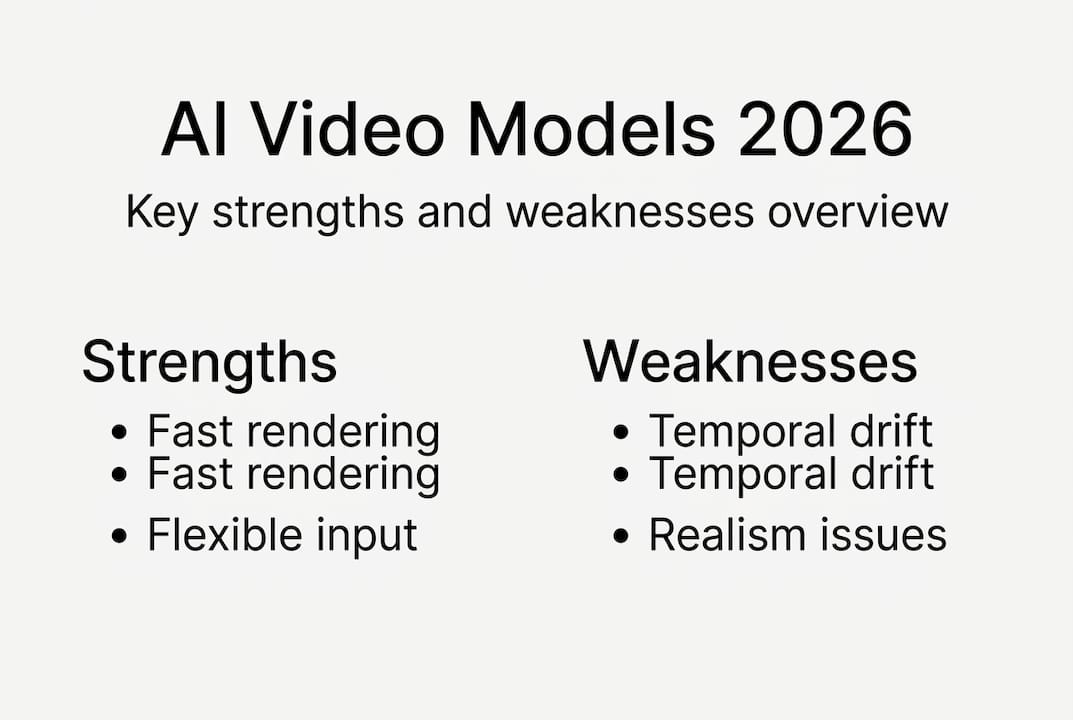
- Temporal drift: After roughly 30 seconds, many models lose coherence. Objects shift, lighting changes, and continuity breaks
- Poor physical realism: The Morpheus benchmark consistently shows models failing on basic conservation laws, meaning liquids pour wrong, objects fall incorrectly, and cloth behaves strangely
- Complex motions: Hands, fingers, and expressive facial micro-movements remain a persistent weak point across all major models
- No contextual memory: AI cannot remember brand guidelines, previous campaigns, or character consistency across separate generations without explicit re-prompting
Research on content creation limits confirms that no single model excels across all use cases, and temporal incoherence, physics failures, and complex motion remain the primary edge-case failures in 2026.
“No single model excels at everything. Route by use case, and expect human review at every stage where realism and trust are on the line.”
Here is a quick reference for where AI struggles and what to do about it:
| Problem area | Trigger condition | Mitigation strategy |
|---|---|---|
| Temporal drift | Clips over 30 seconds | Split into shorter segments |
| Physics errors | Liquid, cloth, object physics | Use real product footage inserts |
| Hand/face artifacts | Close-up shots | Crop or composite with real footage |
| Brand inconsistency | Multi-session generations | Lock style with reference images |
Despite these limitations, the market signal is strong. The AI video sector is projected to reach $9.2B by 2033, which tells you that brands are solving these problems through workflow design, not waiting for perfect AI. The brands winning right now are not using AI to eliminate production effort entirely. They are using it to eliminate the expensive, slow parts and then applying human judgment where it counts most.
Hybrid human-AI workflows: maximizing efficiency and authenticity
Pure AI output is a starting point, not a finished product. The workflows that produce high-converting video consistently follow a clear pattern: AI handles the heavy lifting on speed and volume, humans handle strategy, brand voice, and final quality control.
Here is how a high-performing hybrid workflow typically looks:
- Brief the AI with a detailed prompt specifying shot type, subject, action, and visual style
- Generate multiple variations across two or three models to compare output quality
- Select the strongest raw clips based on visual coherence and on-brand feel
- Layer in brand voice through voiceover, text overlays, or a human presenter segment
- Apply human editing for pacing, hook strength, and call-to-action placement
- Run a QA pass against your brand guidelines before publishing
The evidence supports this approach strongly. AI content platform research shows that hybrid workflows, where AI handles drafts and efficiency while humans manage editing, brand voice, and strategy, consistently outperform pure AI output on authenticity and trust signals. And industry analysis is direct: AI scales efficiency, but risks producing generic content that algorithms deprioritize when humans are removed from the process entirely.
This is especially relevant for platforms like TikTok and Instagram, where algorithmic distribution rewards content that feels real. A UGC vs traditional ads comparison shows that human-feeling content consistently earns stronger engagement signals than polished, generic production.
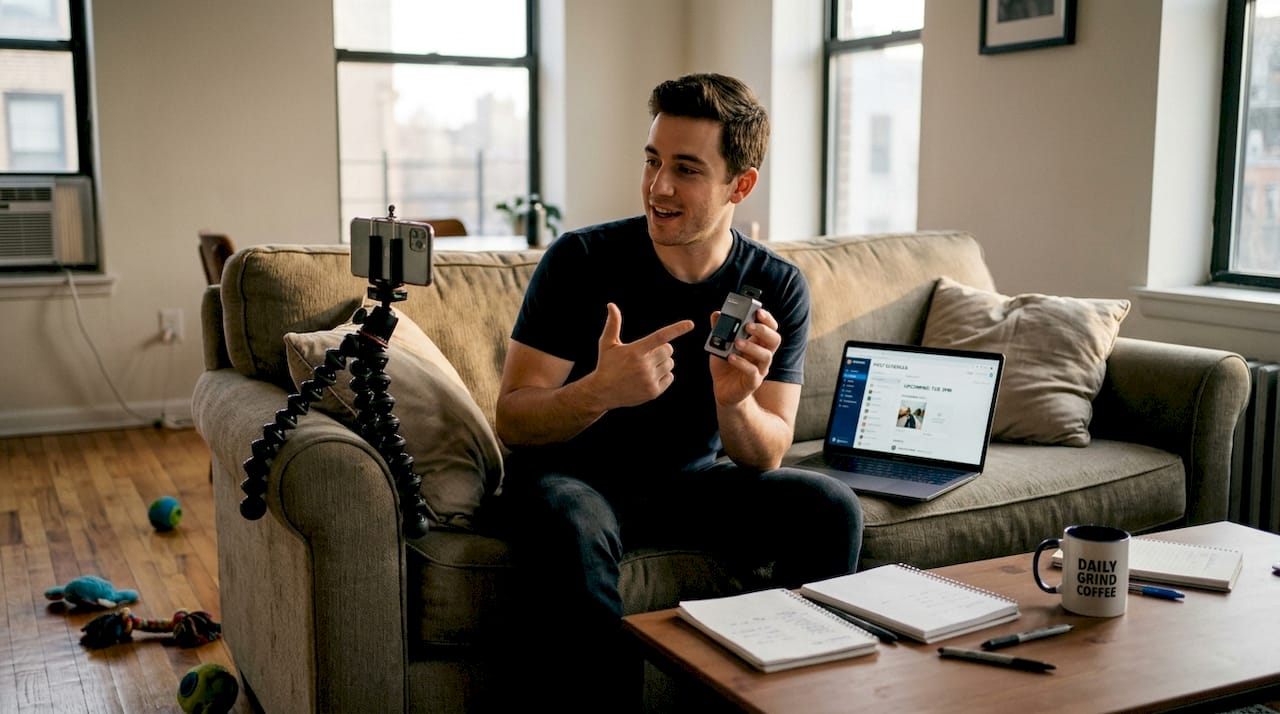
Pro Tip: Drop your brand tone-of-voice guide directly into your prompt and add a human-scripted hook as the first three seconds of every AI-generated video. Those first three seconds determine whether viewers stay. AI rarely nails that without guidance.
For e-commerce, hybrid videos in cinematic AI ad formats are outperforming static image ads by significant margins because they combine AI’s visual production speed with human-crafted persuasion structure.
Practical applications and strategies for e-commerce marketers
Knowing that hybrid workflows work is useful. Knowing exactly how to run them for your campaigns is what actually moves revenue.
Here are the highest-value use cases for AI video in e-commerce right now:
- Product launches: Generate a rapid batch of introductory clips across visual styles, test them simultaneously, and scale the winner fast
- UGC-style ads: Use Seedance for lip-sync accuracy on spokesperson scripts without hiring talent
- A/B creative testing: Generate 5 to 10 variations of the same core message with different visual treatments and hooks
- Seasonal campaigns: Spin up themed content in hours instead of days by prompting for seasonal style references
- Retargeting variants: Create slightly different versions of your core offer video to avoid ad fatigue across longer campaign windows
The AI video market is projected to reach $9.2B by 2033, with growth driven largely by e-commerce and agency adoption of exactly these use cases.
Pro Tip: Structure every prompt using four fields: SHOT (wide, close-up, POV), SUBJECT (who or what is in frame), ACTION (what is happening), and STYLE (cinematic, UGC, lifestyle). This four-part format dramatically reduces unusable output and cuts generation time. You can see this approach applied across video trends 2026 to understand what visual styles are performing on each platform.
For agencies managing multiple clients, the scaling opportunity is significant. You can explore AI tools for marketers to compare how different platforms handle batch generation and campaign routing. The step by step ad guide is also a practical resource for structuring full campaigns around AI-generated video assets.
Personalization is the next frontier. AI makes it feasible to generate dozens of product-specific variants for different audience segments without blowing your production budget. The constraint is no longer cost. It is having a clear enough brief to guide the model toward something worth publishing.
Why smart marketers combine AI with human creativity
Here is the uncomfortable truth that most AI tool vendors will not tell you: generic AI content is becoming easier to spot, and platforms are getting better at identifying and deprioritizing it. The novelty of AI video is gone. What remains is the quality bar.
We have seen this pattern consistently. Brands that pour AI-generated content into their feeds without a human creative layer see initial engagement gains followed by a sharp drop. The algorithm rewards content that holds attention and earns genuine interaction. Pure AI output rarely does that reliably because it lacks the specific, opinionated, brand-authentic voice that makes people stop scrolling.
The brands winning long-term are using AI the same way a skilled athlete uses training equipment. It builds capacity. It does not play the game for you. Building a UGC business in 2026 shows exactly this pattern: the operators scaling fastest are those who treat AI as a production accelerator, not a creative replacement.
AI earns its place in the workflow through speed, volume, and cost efficiency. Humans earn their place through judgment, strategy, and the kind of authenticity that converts browsers into buyers.
Supercharge your video marketing with QuickAdVideo
If you are ready to put these hybrid strategies into practice, QuickAdVideo is built specifically for e-commerce sellers and agencies who want AI-generated video without the generic output problem. You input your product URL, and the platform generates sales videos using proven direct response frameworks in minutes.
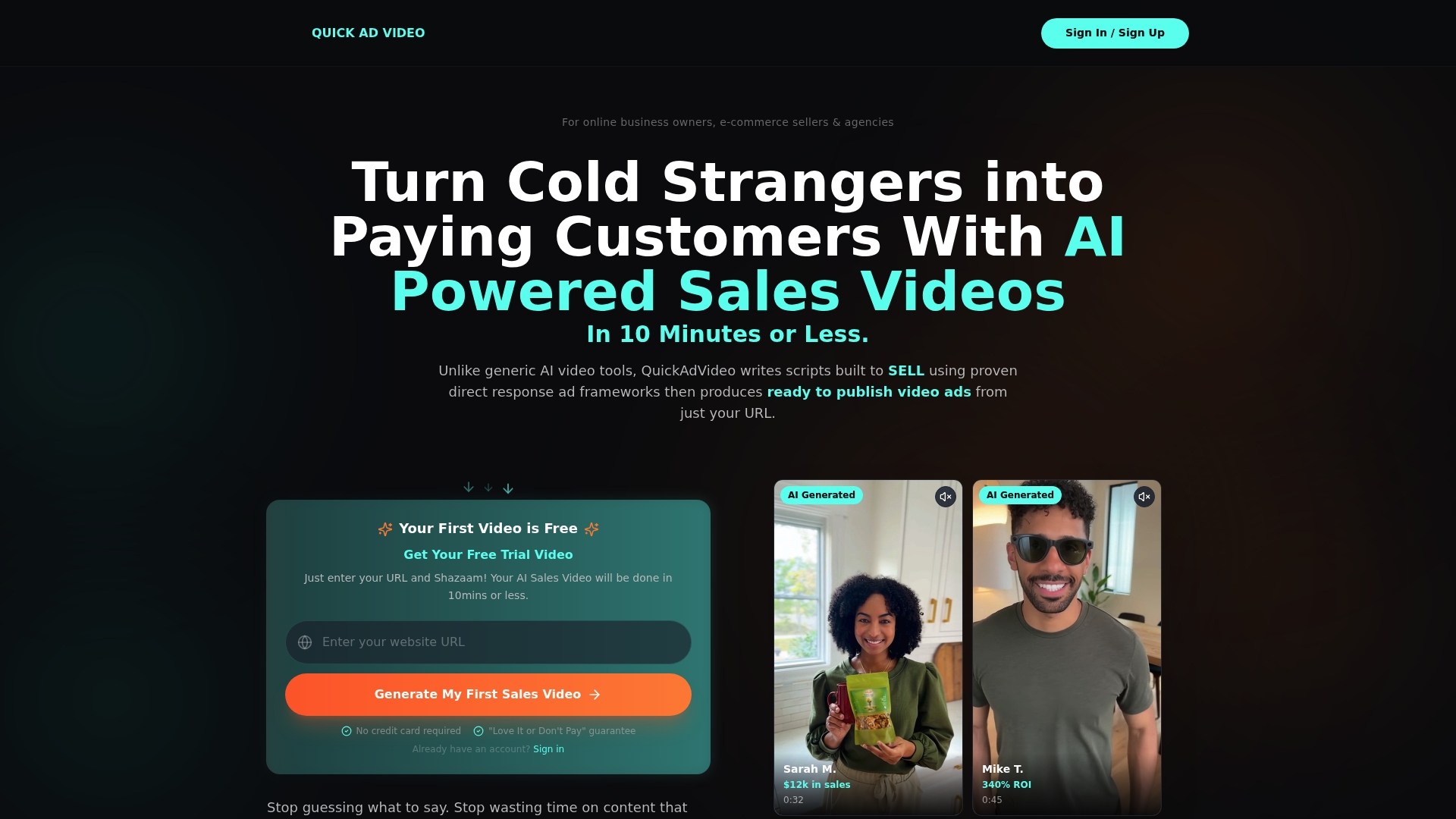
What separates it from basic AI generators is that the models are structured around conversion, not just visual quality. You can apply human creative layers using the AI video editor to refine AI drafts, add your brand voice, and publish directly to TikTok, Instagram, YouTube, and Facebook. No editing experience required. No production team needed. Just a smarter, faster path from product to paying customer.
Frequently asked questions
Can AI completely replace humans in video content creation?
AI cannot replace humans entirely. Pure AI output lacks the authenticity, brand voice, and strategic judgment that human editors and strategists provide, which are essential for building trust and driving conversions.
What are the main limitations of current AI video generation models?
Current models struggle with temporal drift after 30 seconds, physical realism failures, complex hand and face rendering, and the inability to retain context or brand memory across separate generation sessions.
How can marketers maximize AI’s value in campaigns?
Use a hybrid approach where AI generates the initial draft and humans refine it for brand voice, pacing, and hook strength. This workflow consistently outperforms purely AI-generated content on engagement and conversion metrics.
Which AI models are best for video marketing in 2026?
Model selection depends on your goal. Kling 3.0 leads for 4K multi-shot product content, Sora performs best for photorealistic lifestyle storytelling, and Seedance is the strongest option for lip-sync and UGC-style spokesperson videos.
Recommended
- Video marketing for e-commerce: ROI and strategies 2026 | QuickAdVideo Blog
- Getting Started with AI Video Ads: A Complete Guide | QuickAdVideo Blog
- QuickAdVideo - AI Sales Video Generator
- QuickAdVideo - AI Sales Video Generator
- What is video marketing: effective strategies for 2026
- Master AI-powered content checklists for 2026 success | Rule27 Design
Related Posts

Why Use Templates for Video Ads: Scale Smarter
Discover why use templates for video ads to streamline production. Boost efficiency and scale your campaigns without losing creativity!

The Role of Data-Driven Video Ads in Boosting ROI
Discover the role of data-driven video ads in boosting ROI. Learn how analytics enhance engagement, optimize campaigns, and drive results.

Create Persuasive Video Ads Workflow That Converts
Learn how to create persuasive video ads workflow that transforms your ideas into optimized, high-converting campaigns. Get started today!