
5 powerful advantages of video marketing for online sales
QuickAdVideo Team
Author
Selling online has never been more competitive. Thousands of brands are fighting for the same eyeballs, the same clicks, and the same wallets. Static images and product descriptions alone are no longer enough to break through the noise or turn a casual browser into a confident buyer. Video marketing has emerged as the clearest separator between brands that grow and brands that plateau, with shoppable and interactive videos delivering up to a 246% increase in conversion rates when embedded on product pages. This article breaks down the core advantages of video, with specific tactics you can act on today.
Table of Contents
- Why video marketing is essential for e-commerce brands
- 1. Boosts customer engagement and time on site
- 2. Dramatically increases conversion rates
- 3. Builds trust and showcases product benefits
- 4. Supports SEO, discoverability, and cross-platform reach
- 5. Delivers measurable ROI beyond vanity metrics
- What most marketers miss about video marketing’s real value
- Accelerate your video marketing results with QuickAdVideo
- Frequently asked questions
Key Takeaways
| Point | Details |
|---|---|
| Skyrocketing conversions | Interactive and shoppable videos can increase your ecommerce conversion rates by 246%. |
| Stronger customer trust | Videos help showcase authenticity, build brand trust, and reduce purchasing friction. |
| Better engagement metrics | Site visitors spend more time and interact more deeply with video-led experiences. |
| SEO and reach boost | Video content, paired with text, improves your company’s visibility on search and social. |
| Trackable ROI impact | Success depends on measuring sales growth, not just view or like counts. |
Why video marketing is essential for e-commerce brands
Human attention is a finite resource, and it is shrinking. A static image gives your visitor a fraction of a second to decide whether to keep scrolling. Video, on the other hand, tells a story, demonstrates a product, and creates an emotional pull in the first few seconds. That dynamic quality is why brands that invest in e-commerce video ROI strategies are consistently outperforming those that still rely on traditional product photography alone.
Video does something text and images cannot: it communicates your brand’s personality, values, and unique selling proposition all at once. A well-crafted 30-second clip can answer the most common buyer objections, show exactly how a product works, and create a sense of connection that a bullet list of features never will.
Key reasons video is now a non-negotiable tool for e-commerce brands include:
- Instant visual impact: Video captures attention faster than any other content format.
- Storytelling at scale: You can demonstrate value, not just describe it.
- Reduced purchase hesitation: Shoppers who watch a product video feel more confident hitting “Buy.”
- Cross-platform flexibility: One video can run as a TikTok ad, an Instagram Reel, a YouTube pre-roll, and a product page embed simultaneously.
- Higher recall: Viewers retain significantly more information from video than from text.
The rise of shoppable and interactive video formats has pushed these advantages even further. Conversion rates can jump by 246% when interactive video is embedded directly on a site, compared to pages with no video at all. That is not a marginal improvement. That is a category change.
1. Boosts customer engagement and time on site
Engagement is the first signal that your marketing is working. When a visitor lands on your page and watches a video rather than immediately bouncing, they are already more invested in your brand. Video naturally encourages visitors to explore more, stay longer, and absorb more information about what you offer.

Interactive video ads take this a step further by turning passive viewers into active participants. Instead of watching a product demo, the viewer can click embedded hotspots, choose their own path through the content, or add items directly to their cart without ever leaving the video. Interactive formats can produce engagement surges of 130% or more compared to standard video.
Here is a quick look at how different video tactics stack up on engagement:
| Video format | Average time on page | Engagement lift |
|---|---|---|
| Static image only | 1.2 minutes | Baseline |
| Standard product video | 2.8 minutes | +60% |
| Interactive or shoppable video | 4.5 minutes | +130% |
| UGC style video testimonial | 3.4 minutes | +90% |
The logic is straightforward. Greater time on page means more exposure to your offer. More exposure means stronger brand recall. Stronger brand recall means higher likelihood of a completed purchase, either on the first visit or after a retargeting touchpoint later.
Effective engagement tactics to build into your videos include:
- Clickable product links embedded within the video timeline
- Polls and quizzes that personalize the viewing experience
- Countdown timers tied to limited-time offers
- End screens with clear, single calls to action
- Chapter markers on longer explainer videos to improve navigation
The key is treating your video not as a passive broadcast, but as an interactive experience that moves the viewer toward a decision.
2. Dramatically increases conversion rates
Engagement gets viewers interested. Conversion is where that interest turns into revenue. The gap between these two outcomes is where most e-commerce brands lose money, and video is one of the most reliable tools for closing it.
Different video formats drive conversion in different ways. Shoppable videos let viewers buy without friction. Explainer videos answer objections before they arise. Testimonial videos reduce risk by showing real customers who have already made the purchase decision successfully.
| Content type | Typical conversion rate | Vs. no video |
|---|---|---|
| Static product images | 1.5% to 2.5% | Baseline |
| Standard product video | 3% to 4.5% | +80% to +100% |
| Shoppable or interactive video | Up to 6% | +200% to +246% |
| Customer testimonial video | 3.5% to 5% | +100% to +140% |
The data speaks clearly. Interactive video formats produce conversion lifts that static content simply cannot match. As one retail strategist put it, shoppable video is not just a content format, it is a sales channel embedded directly into the entertainment.
“Video that removes the distance between inspiration and purchase is the future of e-commerce. Every click you eliminate from the buying journey is a conversion you save.” — Retail e-commerce strategist
Pro Tip: Place your product video directly above or beside the “Add to Cart” button on your product page. Visitors who watch that video are already in a buying mindset. Keeping the video and the purchase action in the same visual space reduces the chance they drift away before converting. Even a 15-second autoplay demo at that location can noticeably reduce cart abandonment.
Effective video messaging also involves structuring your content around a direct response framework: open with a problem, agitate that problem briefly, then present your product as the clear solution. This is the same approach professional copywriters use, and it translates powerfully to video format.
3. Builds trust and showcases product benefits
Trust is the single biggest barrier between a visitor and a completed purchase, especially for brands that are not yet household names. People buy from brands they believe in. Video accelerates the trust-building process because it shows rather than tells.
Unboxing videos, behind-the-scenes content, and live-use product demonstrations all create transparency. When a shopper can see a real person interacting with a product in a realistic setting, the abstract risk of buying something online becomes much more manageable. Video builds trust through visual proof that no amount of written copy can fully replicate.
Tactics that specifically build trust through video include:
- Authentic customer testimonials featuring real names and faces, not stock footage
- Before and after demonstrations that make the product’s value undeniable
- Founder or team introduction videos that humanize the brand
- Transparent unboxing experiences that show packaging, product quality, and details
- Third-party review compilations that aggregate social proof in a watchable format
The nuance here is important. Video excels at communicating emotion and USPs, but you should always pair it with strong, keyword-optimized text for SEO and AI search discoverability. A product page with both an embedded video and a detailed written description will always outperform a page that relies on either alone.
Pro Tip: Script your trust-building videos around the most common objections your customer service team hears. If people constantly ask “Is this product durable?”, show a durability test on camera. Answering objections visually before the customer even has a chance to think of them removes the last psychological barrier to purchase.
4. Supports SEO, discoverability, and cross-platform reach
Creating great video content is only half the job. Getting that content in front of the right people at the right moment is where your distribution strategy matters. Video, when paired with smart text optimization, is one of the most powerful tools for improving organic search rankings and multiplying your brand’s reach across channels.
Here is a practical process for maximizing video SEO and discoverability:
- Optimize your file names and metadata. Before uploading any video, name the file with your target keyword. Write a detailed description that includes relevant search terms, your brand name, and a clear call to action.
- Add captions and transcripts. Captions serve two purposes: they improve accessibility for viewers watching without sound, and they give search engines text to index. A full transcript embedded on your product page adds keyword-rich content without duplicating your main copy.
- Use structured data markup. Adding VideoObject schema to your page tells Google exactly what your video contains, which increases the chance of appearing in rich results and video carousels.
- Distribute across all relevant platforms. Publish the same video (or platform-specific versions) on YouTube, TikTok, Instagram, Facebook, and your email newsletters simultaneously. Each platform has its own algorithm that rewards fresh video content.
- Embed video in email campaigns. Adding a video thumbnail with a play button in your email increases click-through rates significantly, sending warm traffic back to your site.
AI-powered video SEO tools now make it possible to auto-generate captions, transcripts, and even alt-text descriptions at scale, removing one of the most time-consuming steps in video distribution.
The cross-platform reach of a single well-produced video is remarkable. What starts as a product launch video can become a TikTok ad, a YouTube pre-roll, an Instagram Story, a blog post embed, and a homepage feature all from one production effort. That multiplier effect is why video delivers such strong return relative to its production cost.
The key insight from measuring real-world video performance is that discoverability and revenue impact are linked. Brands that optimize for search and reach consistently find that their video content generates compounding returns over time, not just a spike at launch.
5. Delivers measurable ROI beyond vanity metrics
Views and likes feel good. They do not pay for inventory, ad spend, or operational costs. The most successful video marketers track what actually drives business outcomes, and they build their measurement systems around those metrics from day one.
Measuring revenue impact rather than views is the single most important mindset shift for any e-commerce brand investing in video. A video with 500 views that converts 15% of its viewers into buyers is infinitely more valuable than a video with 50,000 views and a 0.1% conversion rate.
| Metric | What it tells you | Priority level |
|---|---|---|
| Views and impressions | Reach only | Low |
| Watch time and completion rate | Content quality signal | Medium |
| Click-through rate | Intent to learn more | Medium |
| Add-to-cart rate after video | Direct purchase intent | High |
| Revenue attributed to video | Actual business impact | Critical |
| Average order value with video | Upsell effectiveness | High |
Build your reporting framework around the high and critical priority metrics. Platforms like Google Analytics 4, Shopify Analytics, and third-party tools like Triple Whale can attribute revenue directly to video-assisted conversions when set up correctly.
Pro Tip: Run controlled A/B tests with and without video on identical product pages for at least two weeks. Send equal traffic to both versions and compare add-to-cart rates, checkout completion rates, and average order values. This isolates the true revenue impact of your video content with real data, not assumptions. Use those findings to justify further video investment internally or with stakeholders.
Track video ads ROI through both paid and organic channels separately so you understand where your best returns are coming from and where to scale.
What most marketers miss about video marketing’s real value
Here is the honest reality that most marketing guides skip over: the video marketing industry has a vanity metric addiction, and it is costing brands real money.
The obsession with viral moments, follower counts, and view numbers has led countless e-commerce brands to pour resources into content that looks impressive in a deck but does nothing for their bottom line. A video with a million views from an audience that will never buy your product is a sunk cost, not a marketing win.
The brands we see getting outsized returns from video are not chasing trends. They are doing something less glamorous and far more effective. They are mapping out the specific questions and objections their customers have at each stage of the buying journey, then creating video content that directly addresses those concerns. That is it. A founder demo addressing the top three purchase hesitations. A short comparison video that positions their product clearly against competitors. An authentic customer story that mirrors the situation of their ideal buyer.
Cinematic video strategies work brilliantly for premium brands building emotional connection, but they work because the creative aligns with a real customer insight, not just because it looks beautiful. Production value matters, but message-market fit matters more.
The brands that win with video measure revenue impact over views and use those results to iterate relentlessly. They treat video like a sales tool, not a content obligation. That mindset shift is what separates the brands scaling on video from the ones still wondering why their polished content is not converting.
Accelerate your video marketing results with QuickAdVideo
If these advantages have you thinking about how to scale your video output without scaling your budget or workload, that is exactly the problem QuickAdVideo was built to solve.
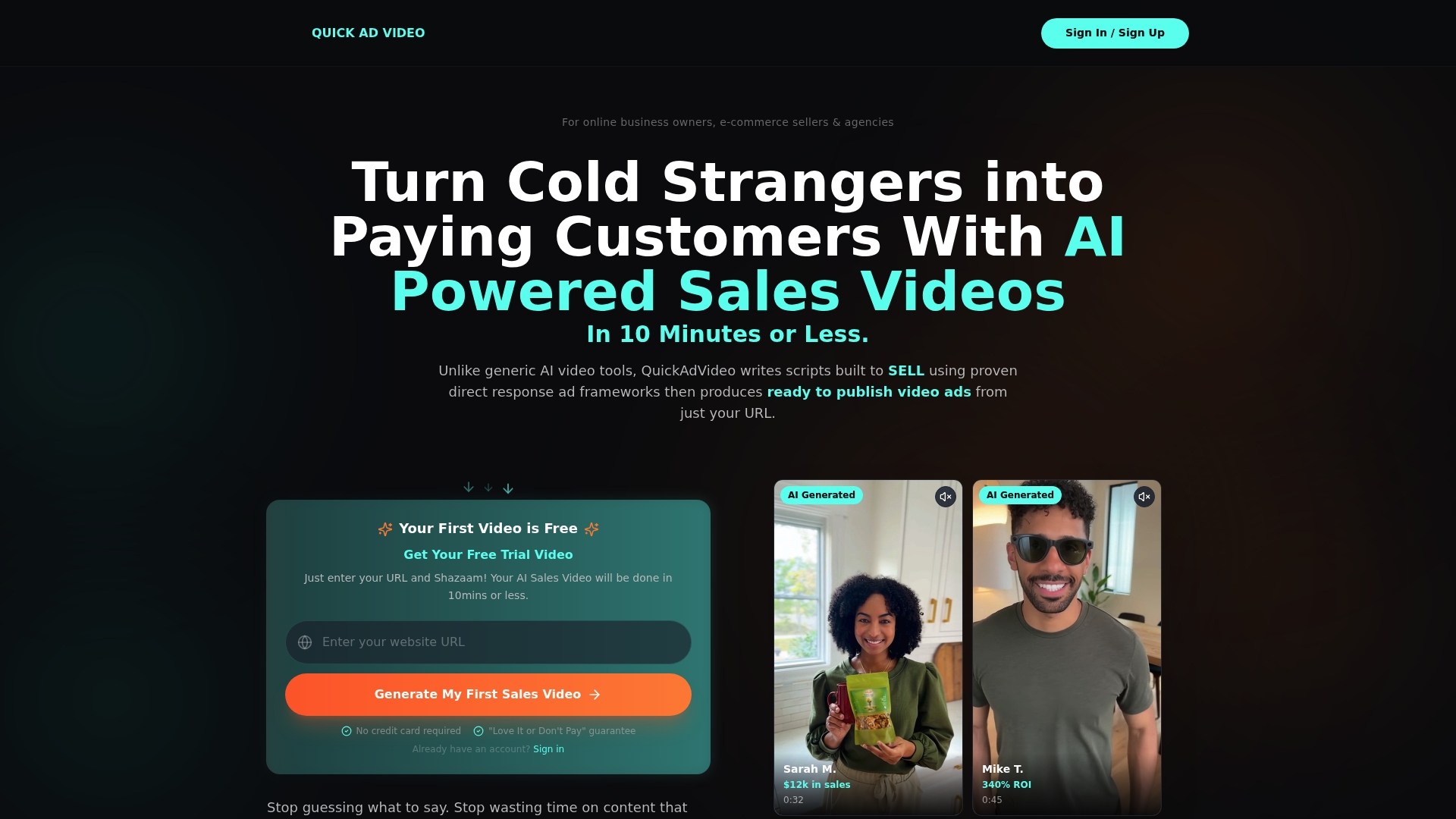
QuickAdVideo is an AI-powered platform that creates high-converting sales videos in minutes. You paste in your product URL, and the platform generates persuasive video content using proven direct response frameworks, no camera required, no editing skills needed, no creative team on standby. Choose from AI-powered video templates including UGC, cinematic, and viral story formats, all optimized for the platforms where your customers spend time. You can build, customize, and publish directly to TikTok, Instagram, YouTube, and Facebook. The video editor makes it easy to fine-tune every element, even if you have never touched editing software before. For e-commerce brands ready to put video to work for their bottom line, this is the fastest path from strategy to results.
Frequently asked questions
How much can video marketing improve my ecommerce sales?
Shoppable and interactive videos can increase conversion rates by up to 246% over standard content when embedded directly on product pages. The exact lift depends on your product category, traffic quality, and video placement.
What types of videos work best for ecommerce marketing?
Shoppable videos, interactive demos, and authentic customer testimonials consistently drive the highest engagement and conversion rates. Interactive formats that let viewers take direct action within the video perform especially well.
How should I measure the ROI of video content?
Focus on revenue lift, completed sales, and average order value rather than views or likes. Measuring revenue impact over vanity metrics gives you a clear picture of what your video investment is actually returning.
Can video marketing help with SEO and online visibility?
Yes. Adding video alongside keyword-optimized text, captions, and structured data improves search rankings and cross-platform discoverability. Pairing video with text ensures both human visitors and AI-powered search engines can find and index your content effectively.
Recommended
- Why video sells products: psychology, trust, and ROI | QuickAdVideo Blog
- Video marketing for e-commerce: ROI and strategies 2026 | QuickAdVideo Blog
- Boost E-Commerce Sales with Creative Video Content Ideas | QuickAdVideo Blog
- Why invest in video ads? Boost sales and ROI with AI | QuickAdVideo Blog
- What Is Video Marketing And How Do You Get Results From It?
Related Posts

Why Use Templates for Video Ads: Scale Smarter
Discover why use templates for video ads to streamline production. Boost efficiency and scale your campaigns without losing creativity!

The Role of Data-Driven Video Ads in Boosting ROI
Discover the role of data-driven video ads in boosting ROI. Learn how analytics enhance engagement, optimize campaigns, and drive results.

Create Persuasive Video Ads Workflow That Converts
Learn how to create persuasive video ads workflow that transforms your ideas into optimized, high-converting campaigns. Get started today!