
10 winning examples of video content for e-commerce
QuickAdVideo Team
Author
Picking the right video format for your online store feels like standing in front of a massive menu when you’re already hungry. Product demos, testimonials, unboxing clips, cinematic brand films — they all promise results, and every marketing blog tells you to use a different one. The problem is not a lack of options. It is the cost of choosing wrong: wasted budget, low engagement, and campaigns that simply don’t convert. This guide cuts through the noise by giving you ten proven video content examples, a fast-selection framework, and a practical playbook so you can stop debating formats and start publishing content that actually drives sales.
Table of Contents
- How to choose the right video content for your business
- 10 powerful examples of video content for e-commerce marketing
- Comparison: Which video content type drives the best results?
- When to use each video content type: situational playbook
- The surprising truth about choosing video content for e-commerce
- Accelerate your video content strategy with AI tools
- Frequently asked questions
Key Takeaways
| Point | Details |
|---|---|
| Selection made simple | Applying clear criteria rapidly narrows the best video options for your campaign. |
| Diverse content wins | Mixing multiple formats maximizes engagement and conversions. |
| AI unlocks speed | AI tools let you produce, test, and refine videos faster than ever before. |
| Best type is situational | Choosing the right format depends on your funnel stage and audience goal. |
How to choose the right video content for your business
Before you shoot a single frame or generate a single clip, you need a clear set of criteria. Without them, you end up making decisions based on trends rather than strategy, and trends rarely pay your ad spend back.
Start by defining your main objective. Are you trying to build brand awareness with cold audiences? Educate potential buyers about a complex product? Drive a direct purchase from someone already in your funnel? Each goal calls for a different video format, and mixing them up is one of the most common and expensive mistakes in e-commerce marketing.
Here is a quick set of criteria to run through before choosing any video format:
- Goal: Is this for sales, engagement, education, or brand trust?
- Funnel stage: Is your audience seeing you for the first time, or are they close to buying?
- Platform: Are you running this on TikTok, Instagram Reels, YouTube pre-roll, or your product page?
- Resources available: Do you have original footage, customer photos, or existing assets to work with?
- Speed needed: Is this for a campaign launching next week, or do you have time to polish a full production?
One factor that has completely shifted the speed calculation is AI. The AI video content benefits for e-commerce businesses include dramatically faster production times and the ability to scale multiple formats without hiring a production team. What used to take days now takes minutes.
Pro Tip: If you are launching your first video campaign, start with formats that require minimal original assets. Testimonial-style videos and product demos work with existing product photos, written reviews, and a basic script, making them the fastest path to your first published video.
10 powerful examples of video content for e-commerce marketing
Now that you have a framework for evaluating formats, here are the ten video content types that consistently drive results for online stores and digital marketers. Each one serves a specific purpose, and knowing that purpose is what separates brands that scale from brands that stall.
-
Product demo videos. These are the workhorses of e-commerce video marketing. A good demo shows your product in action, addresses the top two or three pain points your buyer has, and answers the question “why this product over anything else?” Demos work especially well on product pages and paid ads. Using creative video content ideas like side-by-side “before and after” demo clips can significantly boost conversions at the bottom of the funnel.
-
Customer testimonial videos. Nothing builds purchase confidence faster than a real person describing a real result. Testimonial videos do not need to be polished. In fact, raw, authentic clips filmed on a phone often outperform studio-shot content because they feel credible. Use these in retargeting ads, email campaigns, and on your homepage.
-
Explainer videos. If your product solves a problem that is not immediately obvious, an explainer video is essential. These are short (ideally 60 to 90 seconds), clear, and focused on a single core benefit. Think of them as your elevator pitch in visual form. They are powerful at the top of the funnel because they create instant clarity for cold audiences.
-
How-to and tutorial videos. These help buyers succeed with your product, which directly reduces return rates and builds long-term loyalty. A customer who knows exactly how to use what they bought is far more likely to leave a positive review and come back for more. Tutorial videos also perform well as organic content on YouTube and Pinterest.
-
Unboxing videos. Unboxing content taps into genuine excitement, and that emotional energy is contagious. It is especially effective for new product launches, subscription boxes, and any product with premium packaging. These videos drive shares and user-generated content (UGC), which is essentially free advertising.
-
Brand story videos. Consumers increasingly buy from brands, not just products. A well-crafted brand story video communicates your mission, your values, and the people behind your business. This format builds the kind of emotional connection that turns one-time buyers into loyal customers and brand advocates.
-
Interactive video ads. This is where modern video marketing gets genuinely exciting. Interactive video ads allow viewers to click, choose a path, or explore product options directly within the video player. The data consistently shows higher engagement and conversion rates because the viewer becomes an active participant rather than a passive watcher. For e-commerce brands running paid campaigns, this format is worth testing seriously.
-
Behind-the-scenes videos. Transparency sells. Showing your production process, your team, or even your packing station humanizes your brand in a way that polished ads simply cannot. Behind-the-scenes content performs extremely well on TikTok and Instagram Stories, where audiences expect authenticity over perfection.
-
Comparison videos. These are decision-stage gold. A comparison video that honestly shows how your product stacks up against alternatives builds credibility and helps buyers justify their purchase decision. The key word is honestly. Cherry-picked comparisons that ignore real weaknesses get called out in comments and damage trust fast.
-
Cinematic intro and outro videos. Not every video needs to close a sale directly. Cinematic marketing videos elevate your brand’s perceived value and create a premium feel that lingers in memory. Think of them as brand impression investments, particularly useful for YouTube ads, brand launches, and trade show or event marketing.
“The best-performing e-commerce brands don’t pick one video format and stick to it forever. They build a rotating library of content types matched to specific goals and funnel stages, then let performance data guide the next round of production.”
Pro Tip: For maximum e-commerce video marketing ROI, combine a high-trust format (like testimonials) with a high-clarity format (like demos) in the same campaign. The pairing covers both the emotional and rational sides of the buying decision.
Comparison: Which video content type drives the best results?
With so many options, a direct comparison helps you make faster decisions. Here is a head-to-head breakdown based on goal alignment, trust-building power, and production speed.
| Video type | Best use case | Funnel stage | Trust building | Engagement | Production speed |
|---|---|---|---|---|---|
| Product demo | Product pages, paid ads | Mid to bottom | Medium | High | Fast with AI |
| Customer testimonial | Retargeting, email | Bottom | Very high | Medium | Fast with AI |
| Explainer | Social ads, landing pages | Top | Medium | High | Fast with AI |
| How-to / tutorial | Email, YouTube, website | Bottom | High | Medium | Moderate |
| Unboxing | Launch campaigns, TikTok | Top to mid | High | Very high | Moderate |
| Brand story | Homepage, YouTube | Top | Very high | Medium | Moderate to slow |
| Interactive video ad | Paid social, retargeting | Mid to bottom | Medium | Very high | Moderate |
| Behind-the-scenes | Instagram, TikTok | Top | High | High | Fast |
| Comparison video | Landing pages, ads | Bottom | High | Medium | Moderate |
| Cinematic video | YouTube, brand events | Top | Very high | Medium | Slow |
One critical data point: according to research on effective video messaging, video content types have measurably different impacts depending on where they appear in the sales funnel. A cinematic brand video placed on a product page rarely converts as well as a concise demo, even if the production quality is higher. Placement matters as much as format.
The 80% conversion stat worth remembering: Adding video to a product page can increase conversions by up to 80%. That alone makes video one of the highest-ROI investments available to any e-commerce brand, especially when AI tools make production fast and affordable.
When to use each video content type: situational playbook
Knowing the strengths of each format is just the start. Here is when to use each type based on real marketing situations.
Top-of-funnel scenarios (building awareness):
- Use explainer videos when introducing your brand to a completely cold audience on social media or YouTube ads
- Use brand story videos when you are entering a new market or repositioning your brand
- Use cinematic intro videos when running high-impression campaigns where brand recall is the primary metric
- Use behind-the-scenes content for organic social growth, especially on TikTok and Instagram
Mid-funnel scenarios (building consideration):
- Use product demo videos once your audience knows you exist and is evaluating whether your product fits their need
- Use customer testimonials in retargeting campaigns targeting visitors who viewed a product page but didn’t purchase
- Use comparison videos when your audience is actively shopping alternatives and you need to be the obvious choice
Bottom-of-funnel scenarios (driving decisions):
- Use how-to tutorial videos on your product pages and in post-click landing pages to reduce purchase anxiety
- Use interactive video ads in paid campaigns targeting warm audiences who have engaged with your brand before
- Use unboxing videos during product launches to build excitement and urgency around a limited-time offer
Social media specific plays:
- Short-form explainers (under 30 seconds) work best on TikTok and Instagram Reels for cold audiences
- Testimonials and behind-the-scenes clips perform well in Instagram Stories and Facebook organic posts
- Longer tutorials and brand stories are better suited to YouTube, where viewers expect more depth
Learning to automate video content with AI means you can deploy across all these channels simultaneously without multiplying your production workload.
Pro Tip: Rotate two to three video formats per campaign rather than relying on a single type. For example, pair a demo video with a testimonial and a short-form comparison clip. This combination addresses different objections and buying triggers without requiring a massive content budget.
The surprising truth about choosing video content for e-commerce
Here is something most articles won’t tell you directly: the format debate is mostly a distraction.
We’ve worked with hundreds of e-commerce brands and digital marketers, and the pattern is remarkably consistent. The teams that drive results are not the ones who spent three weeks selecting the “perfect” format. They are the ones who picked a solid option, launched fast, read the data, and iterated. The teams stuck in endless format debates are almost always the ones with the worst-performing video libraries, because they built nothing while researching everything.
The uncomfortable truth is that proven video structures, like testimonials and demos, have been working for decades. What has changed is the cost and speed of production. AI-driven video content creation now makes it genuinely realistic to test three different formats in a single day. What used to require a production team, a studio booking, and a week of post-editing can now be done by a solo founder with a product URL and a few minutes.
That changes the math on every decision. When testing costs almost nothing, analysis-paralysis becomes an even more expensive mistake than choosing the “wrong” format. The brands winning at video marketing in 2026 are not the ones with the biggest budgets or the most sophisticated strategies. They are the ones moving fastest, learning from real data, and using AI sales video tools that remove most barriers to consistent content production.
Start with a template. Launch it. See what your audience responds to. Then double down on what works. That cycle, repeated consistently, beats any amount of theoretical format optimization every time.
Accelerate your video content strategy with AI tools
You now have ten proven video content examples, a comparison table, and a situational playbook. The next step is execution, and that is exactly where most e-commerce marketers slow down.
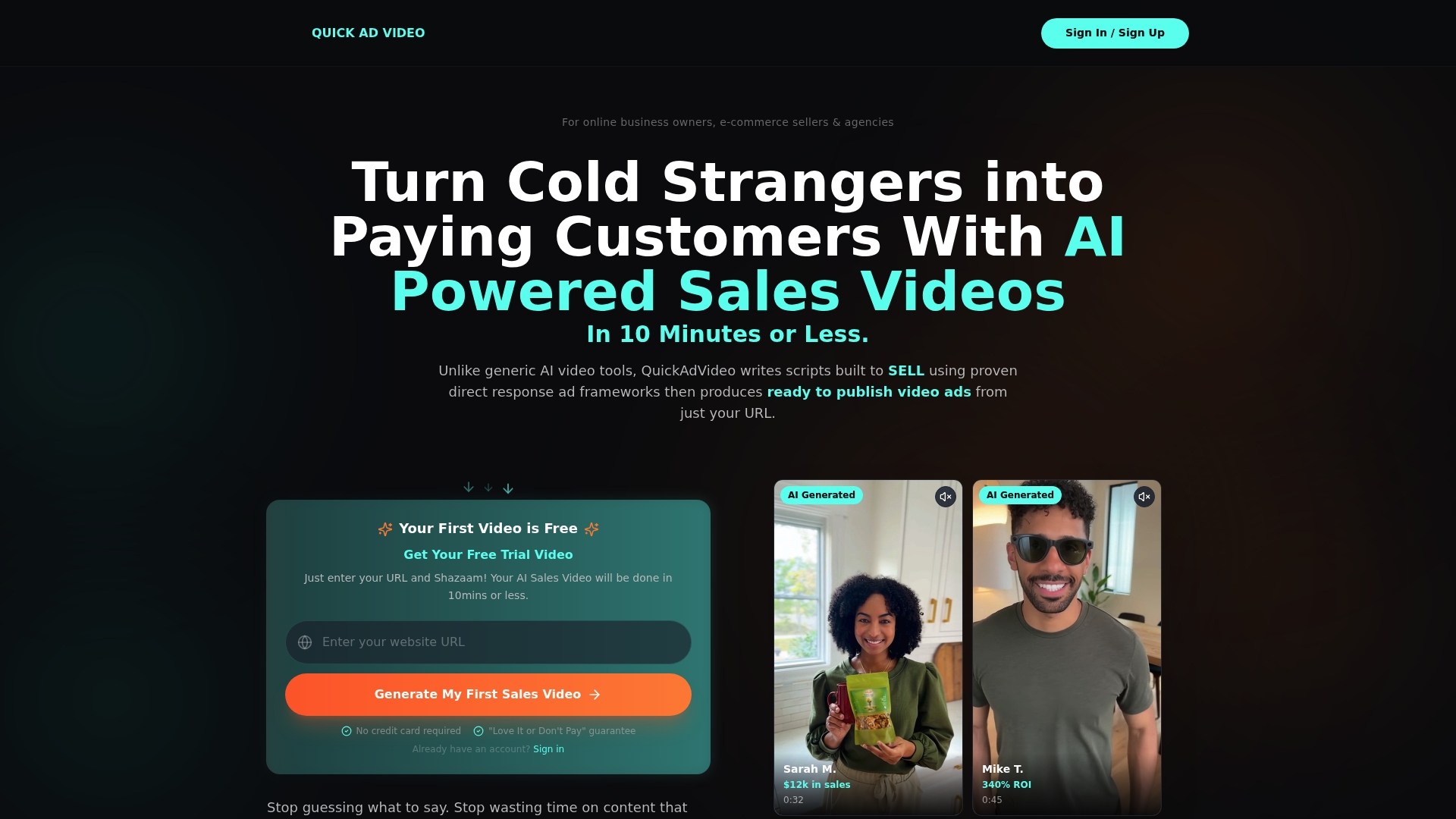
QuickAdVideo is built specifically for entrepreneurs and digital marketers who need to move fast without sacrificing quality. Paste in your product URL, choose from a library of proven AI video generator models including UGC, cinematic, and viral story formats, and get a high-converting sales video in minutes. No camera, no editor, no production delays. You can publish directly to TikTok, Instagram, YouTube, and Facebook from a single dashboard. Whether you are testing three formats this week or scaling an agency’s client roster, the platform removes every bottleneck between your idea and a live video campaign.
Frequently asked questions
What is the fastest type of video content to create with AI?
Product demos and testimonial videos can be generated in minutes with AI tools using existing assets and scripts, making them the fastest entry point for new campaigns thanks to faster production and scalability.
How do I know which video content type fits my campaign goal?
Match the video type to your goal: explainer for awareness, demos for education, testimonials for trust, and interactive ads for conversions, since video types impact differently depending on funnel placement.
Are interactive video ads worth the extra effort?
Yes. Interactive video ads consistently boost engagement and conversion rates by making viewers an active part of the experience rather than passive observers.
Can I automate my entire video content creation process?
You can automate most video production steps, from script to distribution, because AI-powered deployment allows rapid publishing across multiple channels from a single platform.
What is the ROI of adding video content to e-commerce sites?
Video on product pages can lift conversion rates by up to 80%, and creative video ideas paired with AI production tools deliver measurable results even on small budgets.
Recommended
Related Posts

Why Use Templates for Video Ads: Scale Smarter
Discover why use templates for video ads to streamline production. Boost efficiency and scale your campaigns without losing creativity!

The Role of Data-Driven Video Ads in Boosting ROI
Discover the role of data-driven video ads in boosting ROI. Learn how analytics enhance engagement, optimize campaigns, and drive results.

Create Persuasive Video Ads Workflow That Converts
Learn how to create persuasive video ads workflow that transforms your ideas into optimized, high-converting campaigns. Get started today!